What Is Cassava? The Benefits and Effects of Cassava and Whether It Is Yam
Organic Cultivation of Cassava
Cassava, an erect shrub, 1.5-3 m tall; tuberous roots cylindrical. Leaves papery, outline nearly circular, palmately parted almost to the base, lobes 3-7, oblanceolate to narrowly elliptic, apex acuminate; petiole 8-22 cm long, slightly peltate, with inconspicuous fine ridges; stipules triangular-lanceolate, entire or with 1-2 bristle-like fine lobes. Panicles terminal or axillary, bracts linear-lanceolate; calyx purplish red with a white powdery bloom; male flowers: calyx about 7 mm long, lobes oblong-ovate, subequal, hairy inside; stamens 6-7 mm long, anthers tipped with short white hairs; female flowers: calyx about 10 mm long, lobes oblong-lanceolate, stigma recurved, fan-folded. Capsule elliptic, surface rough, with 6 narrow wavy longitudinal wings; seeds about 1 cm long, more or less trigonous, seed coat crustaceous, mottled, smooth. Flowering period September-November.
Cassava has the ability to survive under low-input and water-deficient conditions, along with resistance to pests and diseases; it is easy to grow and manage, and has few pests and diseases, making it suitable as a crop for organic ecological farms. At organic ecological farms, the Kaohsiung District Agricultural Research and Extension Station, Council of Agriculture, through trials in years 90 and 91, selected yellow-fleshed and white-fleshed varieties with excellent tuberous root quality and recommended them for adoption by organic cultivation farmers.
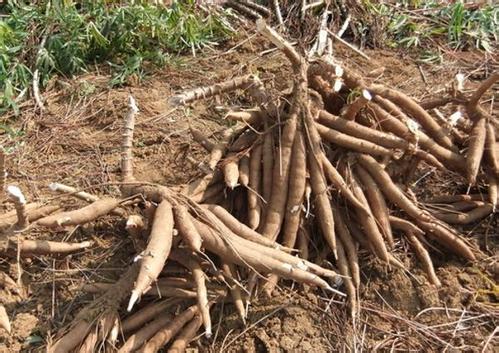
The Kaohsiung District Agricultural Research and Extension Station points out that dense planting of cassava reduces the harvest index and the yield of qualified tuberous roots; the suitable row spacing is 200 × 100 cm, and the compost application rate is 10000-20000 kg/hectare. At maturity, plant height is 365 cm for the yellow-fleshed variety and 432 cm for the white-fleshed variety. Planting can be done throughout the year; at planting time, cut mature branches of about 20 cm as cuttings, with buds pointing upward, and irrigate the whole plot to promote sprouting. Moderate irrigation during the growing period can promote growth, but do not overwater. About 8 months after planting, harvesting can begin successively; stop watering one month before harvest to improve tuberous root quality. In terms of yield, the yellow-fleshed variety can reach 45 metric tons per hectare, while the white-fleshed variety can reach 35 metric tons.
The Kaohsiung District Agricultural Research and Extension Station states that previously cultivated cassava varieties were mainly used for processing, chiefly for starch extraction, with poorer eating quality and relatively high cyanide content. The two varieties recommended by the Kaohsiung District Agricultural Research and Extension Station are suitable for cooking and eating; the tuberous roots can be peeled, cut into pieces and steamed, and suit either sweet or savory preparations, and can also be made into rice cakes; their eating quality is excellent, their cyanide content is low, and they are non-toxic varieties. Among them, the yellow-fleshed variety turns golden yellow after cooking, with a fragrant, springy texture and excellent mouthfeel; the white-fleshed variety has a fine texture and is not cloying. Because fresh tubers do not keep long, and quality deteriorates very easily 2-3 days after harvest, they can be peeled, cut into pieces and frozen for storage, for a period of up to 6 months.
The Benefits and Effects of Cassava: