-
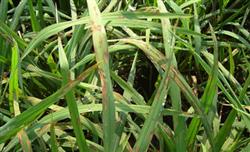
Rice Cultivation: How to Control Pests and Diseases in the Mid-to-Late Stages of Rice?
How to control pests and diseases in the mid-to-late stages of rice? Please explain the methods in detail. The main pests and diseases that need to be controlled in the mid-to-late stages of rice are rice blast, bacterial leaf blight, stem borers, and planthoppers. You can refer to the following methods for control: (1) Control of rice blast. During the jointing and tillering stage of rice, when central diseased plants appear in the field (early July), apply per mu...
-
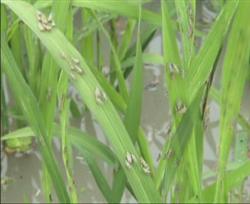
What should be noted for pest and disease control in the late stage of rice?
What should be noted for pest and disease control in the late stage of rice? Please advise. The following points should be noted for pest and disease control in the late stage of rice: The control target must be clear. According to the different types of pests and diseases in the field, corresponding pesticide control should be adopted. When pesticides are mixed, their content must be clearly understood, especially for the control of panicle neck blast. Tricyclazole has...
-
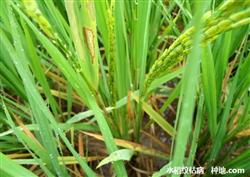
What pests and diseases affect rice in the late stage? A single article explains the control methods clearly
What pests and diseases affect rice in the late stage? How to control them? Please explain in detail. The main pests and diseases in the late stage of rice are: 1. Sheath blight: the disease has recently risen faster, with an average diseased-hill rate of 13.7% and a diseased-plant rate of 3.3%. The rise in disease severity is noticeably faster than in the previous period, especially for the Wuyunjing series varieties, where sheath blight is generally quite severe...
-
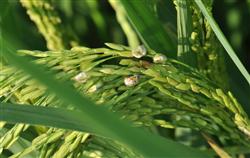
Rice pests and diseases: What pests and diseases affect rice in August?
What pests and diseases affect rice in August? Please explain and guide how to prevent and control them. The key targets for prevention and control of rice pests and diseases in August are rice false smut, neck blast, and bacterial leaf streak, while also controlling rice planthoppers and rice leaf folders. You can refer to the following methods for prevention and control: 1. One week before rice booting (when the boot swells),...
-
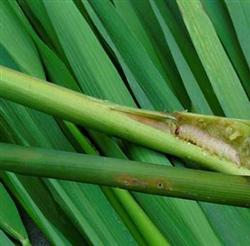
What are the prevention methods for the rice stem borer (Chilo suppressalis)?
How to prevent the rice stem borer (Chilo suppressalis)? Please provide an introduction to the methods. The following methods can be used for preventing the rice stem borer (Chilo suppressalis): 1. Agronomic measures. When damaged plants with dead leaf sheaths, dead hearts, or dead panicles are found, they should be pulled out promptly, which not only reduces the number of insects but also prevents larvae from moving to other plants to cause damage. 2. Chemical control. When the control threshold is re...
-
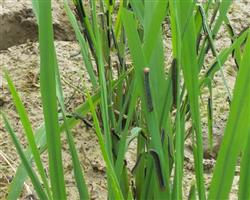
Main Pests and Control Methods for Rice in the Mid-to-Late Growth Stage
Which pests should be controlled in the mid-to-late growth stage of rice? Please provide an introduction and control methods. The pests to be controlled in the mid-to-late growth stage of rice are: 1. Control of rice planthopper: Rice planthoppers mainly inhabit the base of rice clumps, suck plant sap, causing rice plants to turn yellow and affecting yield. The control agents selected are: ① 25% Youlede wettable powder at 30 grams per mu: ② 25% sumicidin wettable powder at 100 grams per mu, mixed with 45 kg of water for spray control; ③ 20% yamailing emulsifiable concentrate at 100 mL per mu mixed with 45 kg of water for spray control; ④ saiqinone or 10% imidacloprid at 30 grams/mu mixed with 45 kg of water for spraying.
-
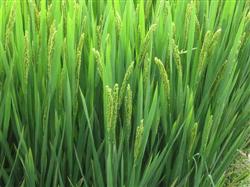
How to scientifically manage water and fertilizer in the middle and late stages of rice?
How should water and fertilizer be managed in the middle and late stages of rice? Please provide an introduction to the management methods. Water and fertilizer management in the middle and late stages of rice can refer to the following: (1) Apply panicle fertilizer cautiously as appropriate to promote large panicles, full grains, and high yield. Based on the earlier rice seedling growth and field diagnosis results, for fields with high soil fertility, strong water and fertilizer retention capacity, many tillers, and darker leaves, delay, reduce, and lower the application rate of panicle fertilizer, generally applying 4-5 kg of urea per mu at the 5th-7th stage of panicle differentiation or at the penultimate leaf stage; for fields with poor fertilizer retention capacity, insufficient tillering, and lighter leaf color, appropriately increase the panicle fertilizer rate earlier, generally applying 6-8 kg of urea per mu at the 4th leaf from the top stage when entering the panicle initiation stage, and spray trace element fertilizers such as potassium dihydrogen phosphate on the leaves at the initial heading stage to increase grain filling and raise yield.
-
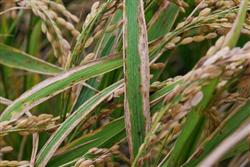
What are the control methods for the three major rice diseases?
How do you control the three major rice diseases? Please explain the control methods. The three major rice diseases can be controlled by referring to the following methods: 1. Rice blast (1) Leaf blast: dark green, nearly round or oval lesions, which later become slightly pointed at both ends; generally, when acute-type lesions appear or an infection center develops, especially in rice fields with high nitrogen fertilizer rates and tender, lush green growth, when the total number of leaf blast lesions occurring on 20 hills of rice during the entire growth period before heading reaches more than 400, spraying must be carried out, with an interval of 3 to 5 days, and continuous spraying 2 times.
-
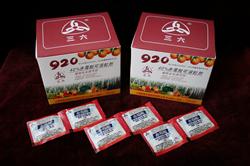
Can gibberellic acid (920) be sprayed on rice to promote heading?
Can gibberellic acid (920) be sprayed on rice to promote heading? Please give an introduction. Gibberellic acid, also known as gibberellin, 920, is a broad-spectrum plant growth regulator. It mainly enters the plant body through leaves, young shoots, flowers, seeds or fruits, and then is transported to actively growing parts to take effect. This agent can promote cell elongation,...
-
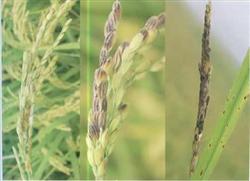
Why does rice produce empty and blighted grains, and how should it be prevented and controlled?
Why does rice produce empty and blighted grains, and how should it be prevented and controlled? Please give a detailed introduction. Under normal conditions, the rate of empty and blighted rice grains is generally 10%-20%, and in severe cases can reach 40%, which greatly affects rice yield. 1. Causes of formation. The rate of empty and blighted rice grains is mainly affected by 3 factors. 1. Climatic...
条件筛选