-

Morphological Characteristics and Damage of the Jujube Carpenter Moth
The jujube leopard carpenter moth belongs to the order Lepidoptera, family Zeuzeridae. It is also called the trunk-cutting worm. The adult has a body length of 18-22 mm, a white head, a grayish-white thorax and abdomen, filiform antennae, and 6 blue spots on the back of the thorax arranged in 2 longitudinal rows. The forewings are scattered with irregular blue spots of varying sizes, while the area before the submedian fold of the hindwings is covered with narrow blackish-blue transverse bands, and the marginal spots of the wings are darker in color. The back of each abdominal segment has 3 black longitudinal spots and one round spot on each side. The eggs are spherical, pale yellow when newly laid, and densely covered with reticulate sculpturing. The larva has a body length of 30-40 mm, a yellowish-brown head, a purplish-red trunk, and a black pronotum
-
A Detailed Explanation of the Damage Characteristics and Control Methods of the Jujube Geometer Moth
I. What Are the Damage Characteristics and Living Habits of the Jujube Geometer Moth? The jujube geometer moth, also known as the bow-waisted worm, the top-door eater, or the jujube looper. When the larvae crawl, they stretch and contract, hence the name "jujube looper." It is one of the most important insect pests of jujube trees. It is distributed throughout all major jujube-growing regions in China, with the most severe damage occurring in the jujube regions of Hebei, Shandong, Henan and Shanxi provinces. Its larvae are highly voracious, damaging all green tissues of jujube trees, including tender buds, leaves, flower buds, bearing shoots and new branch tips. In severe outbreaks, they can eat all the jujube leaves or buds bare, causing
-
What are the control methods for the peach tree peach moth?
This insect is also known as the apricot star caterpillar and the plum moth, commonly called the red-bellied worm. Its larvae damage the buds, flowers and young leaves of peach trees. Affected peach trees not only suffer yield losses, but also decline in vigor, and in severe cases the entire tree can die. This insect mainly damages peach, plum, apricot and plum, and also harms pear and persimmon trees. It is mainly distributed in North China and Northwest China, and in recent years it has gradually spread in the Yangtze River basin, with worsening damage.
-
Identification and Control Methods for the Carambola Fruit Borer Moth
The carambola fruit borer moth is commonly known as the red-line worm. Its larvae occur in large numbers during the flowering period and invade the small flowers to feed on the stamens. The peak occurrence period is usually from late June to early August, and the damage is most severe in extremely hot weather. All the damaged small flowers drop off, often causing crop failure. During the summer full-bloom period, trichlorfon 1000x solution can be sprayed continuously every 5 to 7 days to kill the pests.
-
What are the pollution-free control methods for the jujube looper moth?
The control principle is to make use of its characteristics of overwintering under the tree and the wingless female moth, strengthen control efforts under the tree, and eliminate or stop the female moths from climbing the tree to lay eggs. Large-scale control can reduce the insect population by 80%-90%. On this basis, to eliminate the larvae that slip through the net on the tree, pollution-free pesticides can be used for control. 1. Artificial pupa digging. Before the adults emerge in spring, turn the soil within 1 m around the tree and 15 cm deep to dig out pupae, collect the pupa clumps and dispose of them in a centralized manner. You can also deep-plow the tree in autumn to destroy its overwintering sites so that it cannot
-
How to control the jujube leopard moth? These methods you need to master
(1) Manual pruning of infested branches: during early spring pruning, cut off the damaged branches to eliminate the overwintering stages of the pest, and destroy them in a centralized manner. (2) Use black light traps to kill the adults during their emergence period from June to July. (3) Protect and make good use of natural enemy resources, such as braconid wasps, ants and birds. (4) Chemical control: inject 80% dichlorvos 200-fold solution into the entry holes, and seal the openings with mud.
-
Control methods and key technical points for the peach fruit moth
(1) Manual and physical control. Scraping bark to destroy pupae: during the dormant season of winter jujube, manually scrape off the coarse bark and scaly bark on the trunk and branch forks; beforehand, spread plastic sheeting under the tree to collect the bark and cocoons, then pour boiling water over them in a centralized manner. Blacklight trapping of adults: during the adult emergence period, set up blacklight lamps (insect-killing lamps) to trap and kill adults. From May to June, remove the moth cocoons missed by chemical control. From early September, tie grass bundles at the trunk and branch forks to attract the insects for pupation, then take them down and burn them. (2) Chemical control. The key is
-
Identification and Control Methods for the Peach Fruit Moth
Latin scientific name: Carposina niponensis Walsingham Distribution: Morphological characteristics: Adult body length 7-8 mm, wingspan 16-18 mm, grayish brown. The middle of the front wing's leading edge has a large blue-gray nearly triangular patch. The wing surface has 7 clusters of blue-brown obliquely erect scale hair tufts. The female's labial palps are longer, the male's shorter. Eggs are oval, red, with 2 or 3 rings of "corpse-shaped bristles" at the top. Larvae are 13-16 mm long, peach-red, with a brown pronotal plate. Young larvae are yellowish-white. No anal
-

-
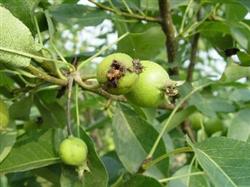
Chemical control methods for the pear fruit moth
Sex pheromone lures can be hung in the orchard, and the number of trapped moths checked daily; generally, 1 lure per 15 mu of orchard is sufficient. When the number of trapped adults increases sharply, check for egg-infested fruit once every 3 days. When the rate of egg-infested fruit reaches 0.5%-1%, chemical control can be carried out. The main chemicals are: 1. 20% diflubenzuron suspension concentrate or 25% diflubenzuron wettable...
条件筛选