-
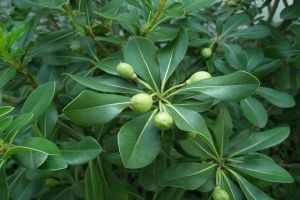
How to Grow Pittosporum tobira? Detailed Guide to Cultivation Methods and Precautions
Pittosporum tobira is a shrub-type plant with a very wide distribution, and with the advancement of landscaping techniques, more and more people have started growing this plant at home. Many people are particularly fond of it, but sometimes, due to their own carelessness or a lack of landscaping knowledge, they don't understand how to grow it or what to pay attention to. So today let's talk about these points.
-

Detailed Explanation of Pest and Disease Control Methods and Techniques for Sambucus javanica
Sambucus javanica is a common plant with relatively abundant fruit that is small and compact, red in color, and highly valuable medicinally. Quite a few people cultivate it. However, because it is susceptible to pests, if no one takes measures to save it, or if there are no natural enemies of the insects to eliminate them, it is very difficult to cure. So today we will discuss exactly how to do a good job of pest and disease control.
-
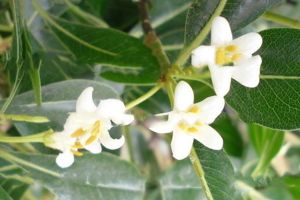
What are the methods for preventing and treating pests and diseases of Pittosporum tobira?
The flowers of Pittosporum tobira are small and white, very lovely, and a great helper in landscaping. With Pittosporum tobira helping to green the landscape, it can fill gardens with vitality and add a touch of brightness to the city. But if Pittosporum tobira gets sick or infested with insects, that vitality is gone, and so is the brightness. Therefore, we must take good care of it and prevent pests and diseases. To ensure they grow normally and play their role in beautifying our homes, we must first understand what pests and diseases there are, and then treat them according to the symptoms.
-

Introduction to the Characteristics of the Lingmei Chunlan Variety and Its Cultivation and Care Methods
Lingmei, petal type: plum petal. History: discovered in 1990 by Zhao Yinquan of Tangdi, Shaoxing, who dug it up in Shangyu. Characteristics: the three outer petals have long stems and round tips with tightly rolled edges, silkworm-moth-style holding petals, a Liu Hai tongue, and three red dots on the tongue arranged in a regular pattern. The flower scape is tall, the flower is well-formed, and the leaves are slanted and upright.
-
Characteristics and Cultivation Methods of the Cymbidium goeringii 'Yuxinmei' Variety
Yuxinmei, petal type: plum petal. History: selected in 1997 by Yu Jifa of Diezhou at a flower market. Characteristics: the three outer petals are broad and large with pointed tips, Guanyin (Bodhisattva) lip, Liuhai (bangs) tongue, with large red round spots on the tongue. The flower color is green with level shoulders, and the scape is tall. The bracts are pale purplish red. The leaves grow obliquely, a vigorous plant.
-
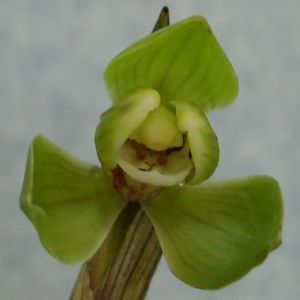
Variety Characteristics and Care Methods of Foyin Mei Chunlan
New Zhoushan Foyin Mei Chunlan Variety
-
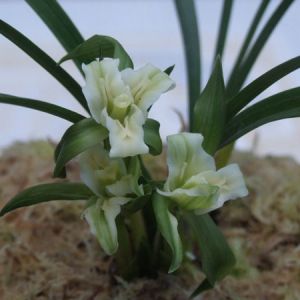
Variety Characteristics and Care Methods of the Chunlan 'Tianshan Snow Lotus'
Number: Orchid No. 0321 Name: Tianshan Snow Lotus (Chunlan) Latin name: Cymbidium goeringii 'TianShanXueLian' Namer: Zhang Youli Registrant: Yunnan Lincang Qiangli Group Registration date: May 27, 2009 Expert comments: This variety was selected from native Chunlan in Lincang City, a three-star butterfly, with petal lips...
-

Introduction to the Characteristics and Care Methods of the Shenjiguang Cymbidium sinense Variety
Beautiful Cymbidium sinense Artistry: Shenjiguang.
-
Characteristics of the Jin Fu Cui Cymbidium sinense variety and its care methods
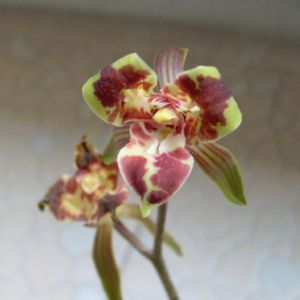
Won the Special Gold Award at the 2007 Wuhan Orchid Exhibition! The most standard three-heart butterfly type among Cymbidium sinense~! The leaves are delicate and the flowers just rise above the foliage. Every flower is uniform and very neat. The leaves are narrow, with a height of 35~45cm, semi-upright, the petals are thoroughly lip-converted, the three tongues are well-formed, the flowering form is very stable, the fragrance is rich, it blooms easily, and the flowering quantity is large.
-
What Is Huizhou Molan? Characteristics and Care Methods
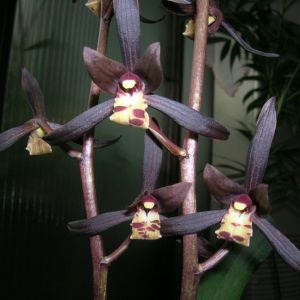
Huizhou Molan (Huizhou Ink Orchid), during the Ming and Qing dynasties, was carried back from its place of origin in Zhangnan, Fujian, by Huizhou merchants to Huizhou to be raised and propagated, and then spread with the Huizhou merchants to places such as Guangzhou, which is how it got its name. Huizhou Molan appears very elegant and noble.
条件筛选