-

Soilless Cultivation Methods and Techniques for Miniature Ficus Bonsai
Ficus is native to China, India and other places, and is commonly cultivated in Guangdong, Fujian and other areas of China. Ficus is very easy to propagate by cuttings. During the growing season, in combination with shaping, cut off a portion of a branch, disinfect it with plant ash, and after the sap has drained, insert the cutting into sand; after one and a half months it will survive and take root. Once the root system grows normally, it can be potted for cultivation and care. After potting, with careful management, after one year of growth the tree shape will be full with luxuriant branches and leaves. In the spring of the second year, soilless cultivation can be carried out to cultivate a miniature bonsai. First, the soil
-
What are the advantages of soilless cultivation for bonsai
Bonsai, especially trunk bonsai, are living sculptural works of art. Only through years of care and management can they achieve deep green leaves, branches full of flowers and fruit, elegant posture and charm, and full vitality, and only then can their ideal ornamental and decorative effect be realized and maintained. If care and management cannot keep up, or are done poorly, even the best trunk bonsai will wither and die due to mistakes in care and management, and their artistic life will come to an end. Therefore, care and management are a long-term and complicated task in the process of creating and maintaining trunk bonsai. Traditional bonsai plants usually
-
Soilless Cultivation Management Methods and Technical Key Points for Phalaenopsis
1. Temperature. During the vegetative growth period, the temperature is generally controlled at 20-35°C. The temperature required for vernalization of large seedlings is 15-18°C. The temperature requirements from spike emergence to flowering are 18-20°C at night and 25-30°C during the day. The best ornamental temperature during the flowering period is preferably controlled at 15-20°C. The day-night temperature difference is generally greater than 10°C, and a negative day-night temperature difference should especially be avoided. 2. Light. For small seedlings (from removal from the flask to 6 months of age), the light intensity is controlled at 5000-8000 lux; for medium seedlings (6 months to
-
How to grow azaleas with soilless culture? Master these key technical points
1. Preparation of the substrate. Azalea roots are very fine and require a loose substrate to facilitate aeration and drainage. Mix 1 part vermiculite, 1 part perlite sand, 1 part river sand, and 1 part coal cinder in proportion. After mixing the substrate, sterilize it with a 0.1% carbendazim solution, stir it evenly into the substrate, and cover with plastic film for 1 day. Then rinse it multiple times with clean water, and after air-drying, mix it evenly with a 0.4% agricultural compound fertilizer solution, then cover with plastic film for one month, after which it can be used for potting. 2. Preparation of the nutrient solution. Azaleas have relatively strict fertilizer requirements. During the growing period, apply light fertilizer frequently.
-
A Detailed Guide to the Traditional Method of Making Dezhou Boneless Braised Chicken
The five-spice boneless braised chicken of Dezhou, Shandong, known as "Dezhou Braised Chicken," is a traditional flavorful dish. It uses superior ingredients, is made with fine craftsmanship, and keeps its shape intact; when tasting it, one gives the chicken a shake, and in an instant the meat separates from the bones, hence the name. "Dezhou Braised Chicken" has a long history and is renowned at home and abroad. In the early 20th century, roast chicken vendors in Dezhou sprang up like bamboo shoots after rain, with many famous shops competing with one another, all striving to improve quality. It began with Hou Baoqing, owner of "Baolanzhai," who studied carefully and, building on roast chicken, pot-braised chicken and soy-braised chicken, and based on the cooking methods for braised pork knuckle and braised beef,
-
The plane tree fluff problem is expected to be solved: Huazhong Agricultural University has cultivated hairless plane trees
It was learned from Huazhong Agricultural University that the university has cultivated hairless plane trees, which is expected to solve the problem of plane tree fluff pollution. The scientific name of the French plane tree is "Platanus", and it has advantages such as fast growth and a large, dense canopy, and is known as one of the "world's five major street trees." But from April to June each year, the seed balls of Platanus scatter and the pappus flies about, not only polluting the environment but also affecting people's health. For this flying fluff pollution, chemical pruning is mostly used in China, that is, spraying chemical agents to promote early shedding of the seed balls. But this method is labor-intensive and time-consuming, and is not easy to promote on a large scale.
-
Lessons to Remember After Losing Out by Not Applying Organic Fertilizer to Jujube Trees
This year, the selling prices of jujubes varied greatly. The price differences were mainly due to differences in sweetness and crispness, and apart from varietal characteristics, the main reason for the differences in sweetness and crispness was the different types of fertilizer applied. Currently, it is the second root development period for jujube trees. The first root growth peak occurs from late May to early June after new shoots stop growing, and the second root growth peak occurs from after fruit harvest to early November. From surveys of jujube growers, many farmers are only accustomed to fertilizing fruit trees in spring,
-
Introduction and Cultivation Techniques of Thornless Large-Grain Sichuan Pepper in Linqu
Sichuan pepper is a high-quality seasoning and also has health benefits. However, for many years the local thorny Sichuan pepper planted here has had small fruits, low yield, and required much labor for harvesting. It also frequently pricked people's fingers, which affected its development. For this reason, in the spring of 2004 we introduced it from Japan. 1. Introduction process: On April 17, 2004, Japanese experts came to our county to give lectures and brought some thornless Sichuan pepper scions and seeds. The county foreign affairs office arranged for a trial in Guoquan Village, Sitou Town. The town government arranged for Comrade He Changfu of that village to carry out the specific work. The first time, 2 plants were top-grafted onto local three-year-old Sichuan pepper trees, with a total of 58 buds top-grafted, and 36 survived. The second time, grafting was done onto local one-year-old seedling Sichuan pepper plants, with a total of 2,200 plants grafted and 2,015 surviving. The top-grafted trees flowered and bore a small amount of fruit in the same year. The trees grafted onto one-year-old seedling plants flowered in 2005 and bore fruit in 2006. In 2006, the top-grafted trees had already borne fruit in large quantities, and the seedling plants raised from the introduced seeds and the trees grafted onto one-year-old seedling plants had all borne fruit. 2. Grafting time and methods: The grafting method taught by the Japanese experts was cleft grafting, with tape binding after grafting, and the survival rate was very low, less than 10%. Through experiments by Comrade He Changfu using methods such as patch budding, plug grafting, cleft grafting, and wood-attached budding, wood-attached budding had the highest survival rate, reaching more than 85%. The best grafting time was the bud-break stage. The survival rate of summer grafting was also very high, but the plants easily froze to death in winter. For autumn grafting of semi-finished plants, after surviving through one winter, the freeze-death rate of semi-finished seedlings reached more than 70%, so it was also not suitable. 3. Comparison of phenological periods: According to observations over three years, compared with local thorny Sichuan pepper, thornless Sichuan pepper sprouts and flowers about one week earlier. In our area, thornless Sichuan pepper buds in the latter half of late March, and the flowering period is from the end of mid-April to the beginning of late April. Thorny Sichuan pepper buds in early April, around Qingming; its flowering period is late April, before May 1. As for fruit ripening time, thornless Sichuan pepper ripens in mid-September, while thorny Sichuan pepper ripens in mid-to-late August. The ripening period of thornless Sichuan pepper is about 25 days earlier than that of thorny Sichuan pepper. 4. Comparison of fruit traits and yield: Thornless Sichuan pepper fruits are large, so the Japanese call it "thornless large-grain Sichuan pepper." According to measurement, the 1,000-grain weight of thornless Sichuan pepper is 100 g, while the 1,000-grain weight of thorny Sichuan pepper is 50 g, exactly a 1-fold difference. The fruit grains of thornless Sichuan pepper taste better than those of thorny Sichuan pepper. The degree of numbing and spiciness of the two is basically similar, but thornless Sichuan pepper has a stronger aroma. Under the same management conditions, compared with thorny Sichuan pepper in the same plot, the 2004 top-grafted trees had a 1-fold increase in per-plant yield in 2006. The yield of Sichuan pepper peel increased by 1.2-fold. This is because thornless Sichuan pepper fruits are large and the peel is thick. 5. Comparison of branches and leaves: Through observation, compared with thorny Sichuan pepper, thornless Sichuan pepper has slightly lighter leaf color, thicker veins, and slightly narrower and longer leaves, with shorter internodes. The branches are thick and short, with short-branch-type traits of fruit trees. Seedlings have thorns, but the thorns are thinner and shorter than those of thorny Sichuan pepper. 6. Comparison of picking efficiency: Through experiments, each person could pick about 10 kg of Sichuan pepper fruits per day from local thorny Sichuan pepper, and fingers were often pricked, while each person could pick 30 kg of Sichuan pepper fruits per day from thornless Sichuan pepper, increasing work efficiency by 2-fold, and fingers were not pricked. 7. Summary: Thornless Sichuan pepper has large fruits, thick peel, high yield, easy harvesting, and high harvesting efficiency. Its adaptability to soil, climate, and other conditions is no different from that of local thorny Sichuan pepper, and it is worth vigorous promotion.
-
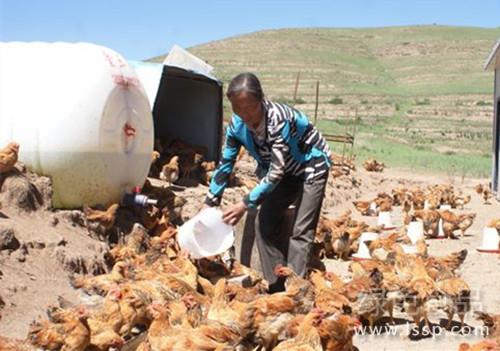
Laying hens have high water requirements during peak laying periods; they drink more in summer and no less in winter
They drink more in summer and no less in winter: water requirements of laying hens during peak laying
-
What kind of edible mushroom is the golden blessing mushroom?
The golden blessing mushroom, scientific name Tricholoma Lobayense Heim, belongs to the order Agaricales, family Tricholomataceae, genus Tricholoma, and is a rare edible mushroom still under development. In China, its commercial names include Lobay tricholoma, Loba tricholoma, large tricholoma, and so on. The fruiting bodies of the golden blessing mushroom grow in clusters or groups, are large in size, with white or creamy-white flesh, a flat, smooth, hemispherical cap, and a stipe that is narrow at the top and wide at the bottom, shaped like a long club. The golden blessing mushroom was first discovered in Africa by the French mycologist Heim, and was named in 1970. In
条件筛选