-
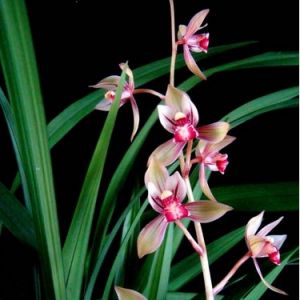
Introduction to the Cymbidium ensifolium cultivar Yurujiao and Its Main Characteristics
Yurujiao is a premium variety among the common-flowered Cymbidium ensifolium cultivars. Its petals have a true lotus form, with dazzling, vivid colors and a rich fragrance. The leaves are broad, arching in the middle, and thick in texture. When it blooms, the lotus-shaped petals are large and brilliantly colored, with a delightful fragrance.
-
-
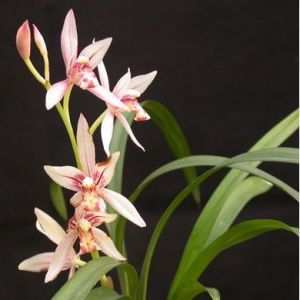
Introduction to the Baodao Yanzhi Cymbidium ensifolium Variety and Key Care Points
Cymbidium ensifolium, a famous variety. History: Baodao Yanzhi originated in Taiwan, China, and entered the domestic public eye in the early 1990s alongside famous Cymbidium ensifolium varieties from Taiwan, China such as "Baodao Jinlong" and "Baodao Xiannv". Characteristics: leaves of the mid-drooping type, leaf margins without serrations, the swept-tail variegation is the most distinctive feature, new shoots peach-red, pseudobulbs oval, flowers bloom peach-red, the column...
-
-
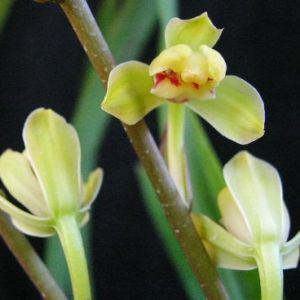
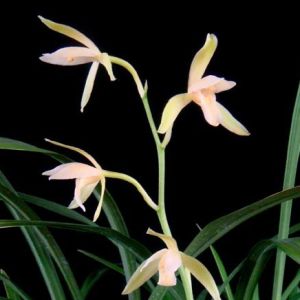
Introduction to the characteristics of the Cymbidium ensifolium variety Xinghuang Mei
A four-season summer orchid with plum-petal form, originating from Emei, Sichuan, discovered in 1994. Leaves are about 2 cm wide, arching outward and soft-drooping, with fingerprint-like markings. Strong growths reach about 35 cm long. Red stalks bear yellow flowers, flower size about 2-3.2 cm, with 4-7 flowers per spike. The flower stalk is short and held above the leaves. It produces shoots and flowers freely, with a strong fragrance. The flower form is a yellow-green plum-petal type, with short, wide, round outer petals....
-
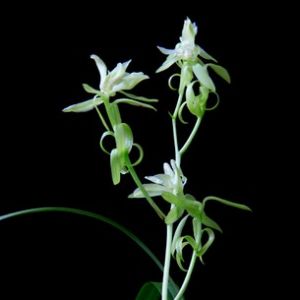
Introduction to the Cuiyu Mudan (Jade Peony) Jianlan Orchid Variety and Its Care Methods
Typically, the leaves are about 30 cm long and about 1.5 cm wide, with a flat leaf shape, tapering pointed leaf tips, medium hardness of the midrib, relatively shallow leaf grooves, average leaf texture, and fine dense serrations along the leaf margins. In strong plants, the leaf posture is mid-drooping; in weak plants, the leaf posture is dew-receiving, cupped upward and slanting upright. The leaf buds are purplish red, with evenly and softly distributed blush coloring on the bud sheaths. The flower buds are initially light red...
-
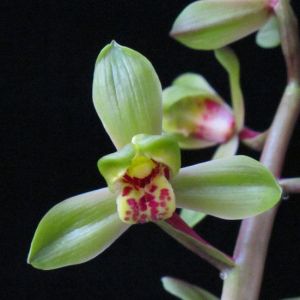
Introduction to the Characteristics and Care Methods of the Guanding Cymbidium Variety
Guanding, the "Second Master" among the red cymbidiums of the eight old cymbidium varieties. (The eight old cymbidium varieties are: Dayipin, Shanghai Mei, Pan Lu, Dangzi, Cheng Mei, Guanding, Yuanzi, Ranzi.) Why is it called the "Second Master"? Because it is old and ranks second. Guanding dates from the early period of the Qianlong era of the Qing Dynasty and originated from the Wanhe Hotel in Suzhou, so it is also known as "Wanhe Mei". By...
-
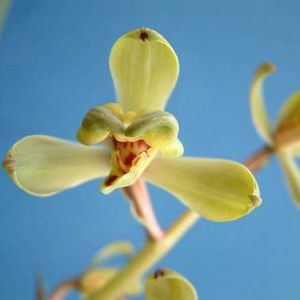
Introduction to the Ranzhi Cymbidium faberi Variety and Its Main Characteristics
One of the eight old red-to-green Cymbidium faberi varieties, also known as "Ruanzi", it has large leaves; the flower form consists of three short, round petals, with thick petals, a deep and narrow shape, flat shoulders, large Guanyin Dui-style inner petals (fist-like central column petals), a round lip, and a slender flower stalk.
-
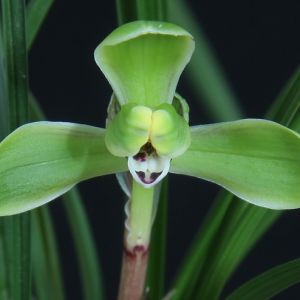
Introduction to the Characteristics and Care Methods of the Red Song Mei Cymbidium Variety
Red Song Mei, originally named "Red Yue Mei," was discovered in 1984 by Xu Hongyue of Tangdi, Shaoxing, at Yapu in Zhenhai. Red Song Mei has an obliquely upright leaf type, with rather firm and sturdy leaf texture, tight leaf stems, and the middle section of the basal leaves broadening into a wide belly. The leaf tips of Red Song Mei form a hood and curve upward in a dew-catching type, with pronounced narrowing and broadening, giving a sense of thickness and solidity. The central leaf is narrower than the other leaves, with a deep "V"-shaped groove. The midrib...
-
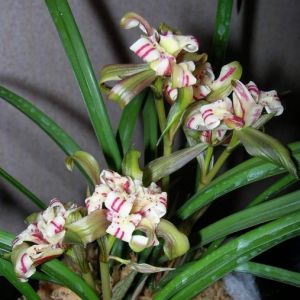
Introduction to the Variety Characteristics of Tianpeng Mudan and Chunlan
Discovered in early 2000 at Xie Mingfa's Orchid Garden in Pengzhou, Sichuan, and named by Lan Zhiyin. At that time, a single pot held five plants and two flowers, and the blooms were quite gorgeous; at the very center of the flower bud, countless U-shaped lip petals spread outward in a ring, extremely spectacular. Four people were present at the time, discussing the flower's name. Someone suggested that since this flower bloomed so well in Pengzhou, it should simply be named "Pengzhou Mudan" (Pengzhou Peony); everyone thought it over and felt it was acceptable, and were about to formally name it so, when Old Lan suddenly said: "That is not appropriate. Pengzhou has been famous since ancient times for abundantly producing peonies, and there has long been a saying: 'In the Central Plains, Luoyang peony ranks first; in Shu, Tianpeng peony ranks first.' Since Pengzhou abounds in peonies, and Tianpeng Town has been the center of Pengzhou since ancient times, why not name it Tianpeng Mudan? That way it carries more of a historical and cultural flavor." Afterward, those present all felt this name was quite good; it not only carried historical and cultural flavor but also highlighted an elegant and noble charm, so everyone unanimously agreed to name it "Tianpeng Mudan." From that day on, Tianpeng Mudan gained its name in this way. It made a great showing at the orchid exhibitions held in Mabian and Yibin.
条件筛选