Introduction to the Characteristics and Care Methods of the Guanding Cymbidium Variety
Guanding, the "Second Master" among the red cymbidiums of the eight old cymbidium varieties. (The eight old cymbidium varieties are: Dayipin, Shanghai Mei, Pan Lu, Dangzi, Cheng Mei, Guanding, Yuanzi, Ranzi.) Why is it called the "Second Master"? Because it is old and ranks second. Guanding dates from the early period of the Qianlong era of the Qing Dynasty and originated from the Wanhe Hotel in Suzhou, so it is also known as "Wanhe Mei". By...
Guanding, plum petal type, a traditional famous variety. The "Second Master" among the red cymbidiums of the eight old cymbidium varieties. (The eight old cymbidium varieties are: Dayipin, Shanghai Mei, Pan Lu, Dangzi, Cheng Mei, Guanding, Yuanzi, Ranzi.) Why is it called the "Second Master"? Because it is old and ranks second. Guanding dates from the early period of the Qianlong era of the Qing Dynasty and originated from the Wanhe Hotel in Suzhou, so it is also known as "Wanhe Mei". By this reckoning, Guanding is two and a half centuries old. In the age record of cymbidiums, Guanding is one generation apart from Laofengqiao of the Kangxi era, so it ranks second.
The leaves of Guanding Mei are semi-pendant, broad and long, as broad as those of Cheng Mei, and like Cheng Mei it is a large-leaf type. The leaf veins are thicker than those of Cheng Mei, while the leaf color is somewhat lighter than that of Cheng Mei. The leaf texture is hard and thick, more semi-pendant and arching than Cheng Mei. The new shoots have a green base with red streaks. The flower scape is purple-red, the flower buds have red sheaths with purple-red veining, and the flower stalks rise above the leaves, reaching 50 cm in height, with 8-9 flowers per stalk. Red stalk and red flower, commonly called "Lord Guan," referring to its purplish-red flowers. The three outer petals are short, round, broad and tightly edged, and their roundness resembles that of Cheng Mei. The inner petals are pod-shaped and tend to overlap. The lip is large and round, with purplish-red spots and patches on a green mossy lip. The flower color is rather dark purple, though not as bright green as Cheng Mei. In terms of round, short outer petals, Guanding and Cheng Mei are the finest among cymbidiums. In China's orchid circles, because Guanding's flower color is dull red and its pod-like inner petals overlap, it is not considered noble. Yet Japanese orchid circles regard it as top-ranking - "exceptional, flourishing, rare and precious" - showing a difference in orchid appreciation. Japanese orchid circles view it as a colored flower. As for its flower quality, with round outer petals, thick inner petals, separated inner petal segments and a large round lip, it has always been regarded as a fine plum-type cymbidium.
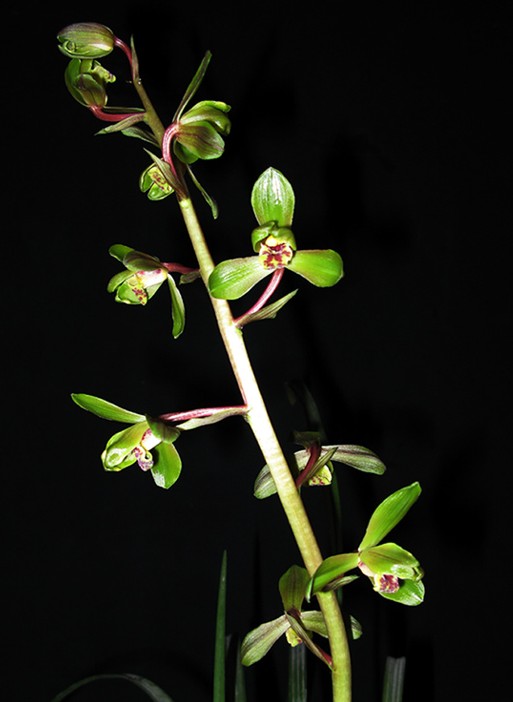
The owner of the Wanhe Hotel had the surname "Guan," the "Guan" of "guanmen" (closed door). Probably the surname was unlucky, so the Wanhe Hotel went bankrupt early. Due to work, I have been to Suzhou several times and consulted the local gazetteers several times; this Wanhe Hotel can be called obscure. However, because the Wanhe Hotel produced a Guanding, some people today still know that Suzhou had a Wanhe Hotel and that the hotel owner's surname was Guan. Otherwise, this Boss Guan would certainly have remained an unknown figure! Compared with his counterparts - "Sun Erniang" of Shilipo and "Jin Xiangyu" of Longmen Inn - he is far behind. (In the service industry, women are always better than men!)
It seems that in this life, if you do not accomplish something, it really just passes by. Whether running a human-flesh bun shop or selecting a famous flower, in the end, if you want to leave a name in history, you have to produce something in this lifetime. Although not many people know of Boss Guan - it only circulates among orchid growers - after all, several hundred years later people still know of him.
Whether one becomes famous in life can wait; Boss Guan absolutely loved his flowers. You can tell from the name - "Guanding," the finest flower to come from the old Guan family! And Boss Guan was also fully confident. But Boss Guan's confidence was justified; at the time, Guanding truly was the finest flower among plum-type cymbidiums. The flowers were large and rose above the leaves, and the plant form was magnificent. As for its flower quality, with round outer petals, thick inner petals, separated inner petal segments, and bright red markings on a large round green mossy lip, it truly was a superior fine variety among plum-type cymbidiums.
Unfortunately, Guanding was truly an unlucky one. It had not held the top position among red cymbidiums for long when a doctor surnamed Cheng in Changshu, Jiangsu, selected Cheng Mei, and Guanding was immediately dragged down from the top seat. It really had to yield the top position. Cheng Mei's plant form was as magnificent as yours, tall and rising above the leaves. Moreover, with red scapes and green flowers, it was more brilliant than yours. Its three petals were round and neat, and the petals were more delicate and thicker than yours. With split-head, closed-back hard silkworm-moth inner petals and a dragon-swallowing lip, it was superior to you in every detail, and each bloom was more beautiful than yours on quiet inspection. Poor Guanding indeed firmly took the "second" seat.
But being second also had its flavor.
Guanding is a red cymbidium, that is, a cymbidium with red flowers. Lord Guan in Romance of the Three Kingdoms also had a red face. It happens that both share the surname "Guan" and both rank second, so orchid growers simply also called Guanding "Lord Guan the Second." Well then! If an orchid can bask in the reflected glory of the Martial Saint, this second position is willingly taken.
In Far Eastern culture, China has always been first, and Japan has had to rank second. Japan also copied Chinese orchid culture wholesale, then edited and revised it a few times itself, becoming second in orchid culture. As the saying goes, "When second meets second, tears stream from both eyes." When seconds meet, they feel mutual sympathy. As soon as Japanese orchid circles introduced Guanding, they immediately raised it to the throne of the top red cymbidium, calling Guanding "exceptional, flourishing, rare and precious." I have never been able to explain this phrase in detail, but the general meaning is obvious at a glance - especially beautiful, especially precious.
Guanding did not lose out by being second.
Cheng Mei occupied the throne of the top red cymbidium. Over more than two hundred years, good flowers were grown by everyone, and since everyone wanted to grow the top one, Cheng Mei far surpassed Guanding in the number surviving in the world. In recent years, cymbidium market prices soared; what originally cost several thousand yuan per seedling jumped to tens of thousands. Rarity makes value, and Guanding's price went from equal to Cheng Mei to eventually surpassing Cheng Mei.
And so, "Lord Guan the Second" actually surpassed the top red cymbidium in price.