Introduction to the Characteristics and Care Methods of the Red Song Mei Cymbidium Variety
Red Song Mei, originally named "Red Yue Mei," was discovered in 1984 by Xu Hongyue of Tangdi, Shaoxing, at Yapu in Zhenhai. Red Song Mei has an obliquely upright leaf type, with rather firm and sturdy leaf texture, tight leaf stems, and the middle section of the basal leaves broadening into a wide belly. The leaf tips of Red Song Mei form a hood and curve upward in a dew-catching type, with pronounced narrowing and broadening, giving a sense of thickness and solidity. The central leaf is narrower than the other leaves, with a deep "V"-shaped groove. The midrib...
Red Song Mei, originally named "Red Yue Mei," was discovered in 1984 by Xu Hongyue of Tangdi, Shaoxing, at Yapu in Zhenhai.
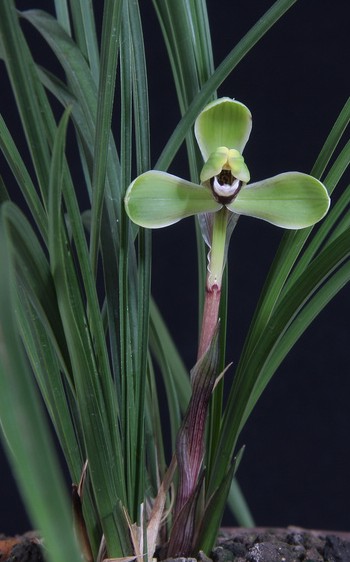
Red Song Mei has an obliquely upright leaf type, with rather firm and sturdy leaf texture, tight leaf stems, and the middle section of the basal leaves broadening into a wide belly. The leaf tips of Red Song Mei form a hood and curve upward in a dew-catching type, with pronounced narrowing and broadening, giving a sense of thickness and solidity. The central leaf is narrower than the other leaves, with a deep "V"-shaped groove. The midrib is rather bright. The overall plant form shows strength within softness, with tension. The new shoots are purple-red, with the shoot tips showing conspicuous concentrated color.
The main petal of Red Song Mei is rounded in shape, with a thick, hooded petal tip; the two lateral petals spread flat and are slightly longer, with rounded bases and heads, excellent tight edging, and a strong jade-like quality along the petal margins, suffused with faint red vein lines. Flat shoulders and flying shoulders are commonly seen. The semi-hard silkworm-moth pollinia are held tightly together, with a posture of raised head. The small ruyi tongue has a striking reddish-purple patch at the base of the tongue. The flower's appearance is dignified yet not lacking in liveliness. The flower's posture shows stillness within movement and movement within stillness. The overall flower shape is majestic in bearing, with an ethereal charm, well-proportioned embracing, and great elegance. Under the name "Red Song Mei," it has been passed down through the world, and it is indeed worthy of the name! In my humble opinion, there is absolutely no concern of borrowing fame from the great name "Song Mei"!
The classic blooming display of the Cymbidium Red Song Mei