-
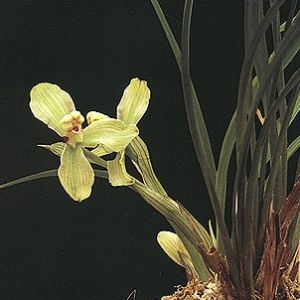
Introduction to the Chunlan 'Changle Mei' Variety and Key Appreciation Points
Leaves 25-40cm long, 0.5-0.8cm wide, broad and drooping; the three outer petals broad and round with fine, dense veins; a hard, fully closed pouch; a small ruyi tongue with bright red spots and a rich fragrance. It is an excellent lamp-wick plum-petal variety of Chunlan (Cymbidium goeringii).
-
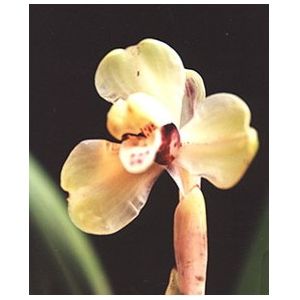
Introduction to the variety characteristics of Yuchunmei Chunlan
Purchased from a fellow orchid enthusiast in early 2000. In the spring of 2001, it bloomed again as shown in the photo. The fragrance is deep and far-reaching, and the flowering period lasts nearly two months. The main and secondary petals are round and large, uniform in size, with a tender yellow and light green color, accompanied by bright red patches. The lip petals are fleshy, and the five petals are separated into distinct segments. The Ruyi tongue has two rows of red spots arranged regularly on its surface, 6-8 in total, dazzlingly bright red. The petals are crystal-clear like jade, hence the name Yu...
-
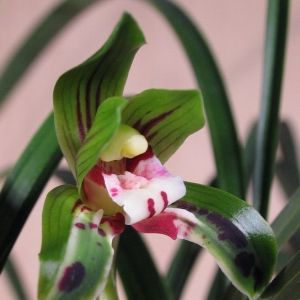
Introduction to the characteristics of the Lu's Feidie Cymbidium goeringii variety
In 1991, it was selected and named by Lu Shuiliang of Yuyao. The plant comes from the Siming Mountains. The leaf shape is elegant, the color is deep green, and it is glossy. The buds on the back are purplish red, the bud sheaths have heavy green variegation, the three outer petals are lotus-shaped, the color is emerald green, the side petals are butterfly-transformed at the 1/2 point, part of the top petal, the rolled tongue, the red dots are neat, and the fragrance is delicate and subtle. Professor Wu Yingxiang considered this flower to be a treasure among the butterfly-type flowers of Cymbidium goeringii....
-
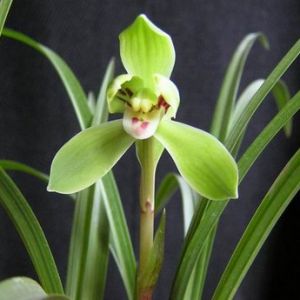
Introduction to the Sheng'an Meichunlan (Cymbidium) Variety and Its Care Essentials
In the Gengshen year of the Republic of China (1920), it was selected by Zhu Sheng'an of Shanghai (some write it as "Zhu Shenghui," which is clearly inappropriate). New shoots are purplish-red, leaves are 20-28cm long, 0.6-0.8cm wide, dark green and lusterless, with an obliquely drooping leaf posture. The flower scape is tall, exceeding the leaf surface; the pedicel is pale pink, and the bud sheath is purple-green. The three outer petals have large round heads, tapering...
-
Introduction to the characteristics of the Cymbidium goeringii cultivar Erqi Mei
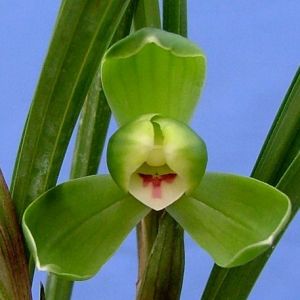
In 1980, it was selected by Zhu Erqi of Tangdi, Shaoxing, Zhejiang, and named "Erqi Mei," also called "Ye Mei" by some. The new shoots are bright red, and the newly emerged young leaves have heavy white tips. The leaves are 30cm long and 0.8-1cm wide, with blunt leaf tips, thick and substantial leaf texture, and a "V"-shaped leaf groove on the surface. The leaf posture is semi-pendant, with some twisted leaves among them. The flower scape is upright, reaching a height of...
-
A brief introduction to the variety characteristics of the Cymbidium tortisepalum 'Jianyang Butterfly'
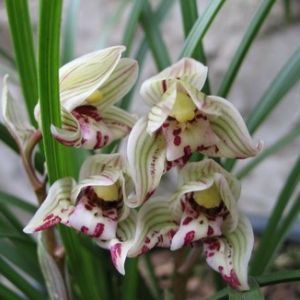
Jianyang Butterfly is a variety of Cymbidium tortisepalum (Lianban orchid), named because it was cultivated at the Jianyang Orchid Garden and its petals have become butterfly-like (petaloid). It was originally called Diangong Hua Lianban. It originates from the mountain slopes on the Jianchuan side of Laojun Mountain, at an altitude of 4247 m where Jianchuan, Lijiang, Lanping and Weixi meet, and was discovered in 1988. It was a cluster of several seedlings, originally dug up by an orchid lover from Shaxi, Jianchuan. Seeing that the petals were unusual, the owner specially made a steel-bar cage to grow and protect it. Later it was bought out in one lump sum at a high price by the skilled orchid grower Li Jian for cultivation and development, and was identified as a rare butterfly-petal wonder among orchids, named Jianyang Butterfly, winning an extremely high reputation in the orchid world. Many people have cultivated it. It is a rare and precious variety among orchids. By 2001 it had grown to several thousand seedlings.
-
Introduction to the Variety Characteristics of Tianpeng Mudan and Chunlan
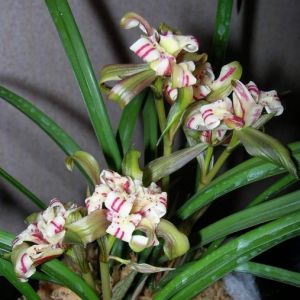
Discovered in early 2000 at Xie Mingfa's Orchid Garden in Pengzhou, Sichuan, and named by Lan Zhiyin. At that time, a single pot held five plants and two flowers, and the blooms were quite gorgeous; at the very center of the flower bud, countless U-shaped lip petals spread outward in a ring, extremely spectacular. Four people were present at the time, discussing the flower's name. Someone suggested that since this flower bloomed so well in Pengzhou, it should simply be named "Pengzhou Mudan" (Pengzhou Peony); everyone thought it over and felt it was acceptable, and were about to formally name it so, when Old Lan suddenly said: "That is not appropriate. Pengzhou has been famous since ancient times for abundantly producing peonies, and there has long been a saying: 'In the Central Plains, Luoyang peony ranks first; in Shu, Tianpeng peony ranks first.' Since Pengzhou abounds in peonies, and Tianpeng Town has been the center of Pengzhou since ancient times, why not name it Tianpeng Mudan? That way it carries more of a historical and cultural flavor." Afterward, those present all felt this name was quite good; it not only carried historical and cultural flavor but also highlighted an elegant and noble charm, so everyone unanimously agreed to name it "Tianpeng Mudan." From that day on, Tianpeng Mudan gained its name in this way. It made a great showing at the orchid exhibitions held in Mabian and Yibin.
-
Introduction to the Characteristics and Care Methods of the Red Song Mei Cymbidium Variety
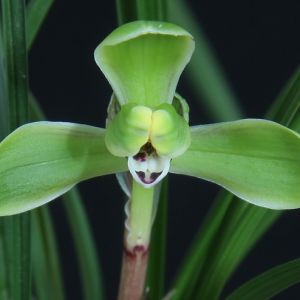
Red Song Mei, originally named "Red Yue Mei," was discovered in 1984 by Xu Hongyue of Tangdi, Shaoxing, at Yapu in Zhenhai. Red Song Mei has an obliquely upright leaf type, with rather firm and sturdy leaf texture, tight leaf stems, and the middle section of the basal leaves broadening into a wide belly. The leaf tips of Red Song Mei form a hood and curve upward in a dew-catching type, with pronounced narrowing and broadening, giving a sense of thickness and solidity. The central leaf is narrower than the other leaves, with a deep "V"-shaped groove. The midrib...
-
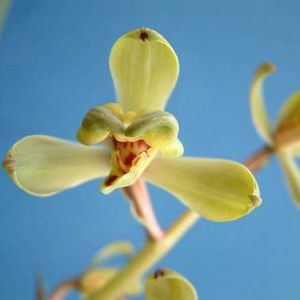
Introduction to the Ranzhi Cymbidium faberi Variety and Its Main Characteristics
One of the eight old red-to-green Cymbidium faberi varieties, also known as "Ruanzi", it has large leaves; the flower form consists of three short, round petals, with thick petals, a deep and narrow shape, flat shoulders, large Guanyin Dui-style inner petals (fist-like central column petals), a round lip, and a slender flower stalk.
-
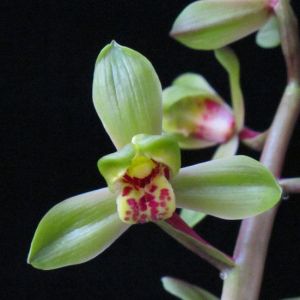
Introduction to the Characteristics and Care Methods of the Guanding Cymbidium Variety
Guanding, the "Second Master" among the red cymbidiums of the eight old cymbidium varieties. (The eight old cymbidium varieties are: Dayipin, Shanghai Mei, Pan Lu, Dangzi, Cheng Mei, Guanding, Yuanzi, Ranzi.) Why is it called the "Second Master"? Because it is old and ranks second. Guanding dates from the early period of the Qianlong era of the Qing Dynasty and originated from the Wanhe Hotel in Suzhou, so it is also known as "Wanhe Mei". By...
条件筛选