-
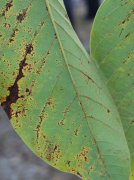
Symptoms and Control Methods of Rust Disease in Atemoya Orchards
Because orchards in mountainous areas and river valleys have high humidity, they are prone to triggering the spread and expansion of "annona rust." The Taitung District Agricultural Research and Extension Station of the Council of Agriculture (hereinafter referred to as the Taitung Station) recently monitored Beinan, Luye, and Donghe, among other areas, and found that some atemoya orchards
-

How to Apply Organic Fertilizer in Orchards in Spring? Detailed Methods and Techniques
Precautions: Choosing commercial organic fertilizer. First, clarify the source of the raw materials. Second, conduct a small-area trial demonstration with the chosen commercial organic fertilizer first. Be careful to apply it after it is fully decomposed. Most organic fertilizers, such as newly purchased chicken manure and cow manure, often carry harmful substances such as pathogens, and using them directly is harmful to crops.
-
What are the methods for planting pepper seedlings in orchards?
To grow pepper well, the quality of the pepper seedling planting is very important, so how should pepper be planted in an orchard? First, land preparation. 1) Land preparation method. When establishing an orchard on flat land, the whole orchard can be prepared. Deep plow 30-50 cm, and together with deep plowing apply 4000-
-
Key Technical Points for Fertilization and Soil Management in Pineapple Orchards
Pineapple (scientific name: Ananas comosus), commonly known as fengli, is one of the famous tropical fruits. In Fujian and the Taiwan region of China it is called wangli or wanglai (ng-li), in Singapore and Malaysia it is called huangli, and in the mainland and Hong Kong, China it is called boluo. There are more than 70 varieties, and it is one of the four famous fruits of Lingnan.
-
How to prune pear trees with an unreasonable structure
Currently, many pear orchards use high-density planting techniques for production. The single-layer high open-center form of pear trees is a tree form suitable for high-density pear orchards. Its suitable density is 44 trees planted per mu. The tree structure is a trunk height of 60-80 cm and a tree height of 3-3.5 m. The top of the central leader
-
Key Technical Points for Soil, Fertilizer and Water Management in Jujube Orchards
After jujube trees enter the full fruit-bearing stage, doing a good job of soil, fertilizer and water management and maintaining a good tree vigor are the prerequisites for high yield and quality. The soil, fertilizer and water management of jujube trees in the full fruit-bearing stage can be summarized as two tillages, four fertilizations and three waterings. The two tillages refer to deep plowing and intertillage. Deep plowing can loosen the soil in the jujube orchard,
-
Detailed Explanation of Key Technical Points for Soil Management in Apple Orchards
I. Ridge raising and mulching. 1. Dig fertilization pits (this can be done together with the application of base fertilizer). On the inner side, 30-40 cm vertically below the extended branches on the outer periphery of the tree canopy, dig 2-4 fertilization pits each 40 cm long and 40 cm wide and 50 cm deep (the depth for topdressing is 20 cm). 2. Dig trenches and raise ridges. Outside the fertilization holes, along the row direction
-
What are the key technical points for spring management of apple orchards?
I. Orchard sanitation: In combination with winter pruning, saw off rotten and diseased dead branches, cut off branches with woolly apple aphid galls, and thoroughly clean the orchard. Clear away fallen leaves, dropped fruit, residual branches and rotting bark, then bury them in pits or burn them to reduce the source of pests and diseases. In late March, when the buds show green, spray to sanitize the orchard.
-
How can fertilizer use efficiency in apple orchards be improved?
1. Increase soil organic matter content. Soil organic matter content is an important indicator for measuring the soil fertility of an orchard, and it is also a basic condition for producing pollution-free fruit. Soil organic matter can promote the formation of soil aggregate structure, increase soil aeration, and improve the soil's
-
Detailed Explanation of Key Technical Points for Soil, Fertilizer and Water Management in Apple Orchards
1. Soil management For the soil management of mature fruit tree orchards, the clear-root method or tree-disk mulching method should be adopted. From spring to before the rainy season each year, after combining fertilization and irrigation, carry out intertillage and loosening of the soil. Weed 1-2 times to keep the soil loose and free of weed growth. In the rainy season, cut grass and cover the tree disk 1-2 times. In autumn, after the fruit trees shed their leaves, carry out autumn plowing. Use an iron shovel to deep-turn the tree disk to 15-20 cm, then apply additional organic fertilizer. Apply topdressing three times, respectively before and after sprouting, after flower drop, and during the fruit enlargement stage, using nitrogen, phosphorus and potassium elements in combination. The ratio is 1:0.6:1.5.
条件筛选