-

How to prune pear trees with an unreasonable structure
Currently, many pear orchards use high-density planting techniques for production. The single-layer high open-center form of pear trees is a tree form suitable for high-density pear orchards. Its suitable density is 44 trees planted per mu. The tree structure is a trunk height of 60-80 cm and a tree height of 3-3.5 m. The top of the central leader
-
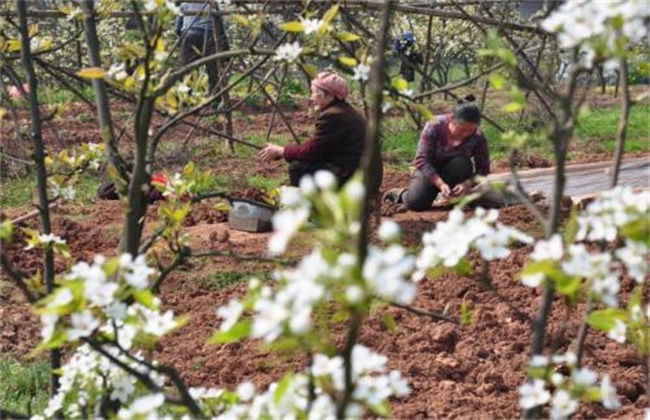
Precautions and Key Technical Points for Intercropping in Pear Orchards
Precautions for Intercropping in Pear Orchards
-
Key Technical Points for Autumn and Winter Management of Pear Orchards
Autumn and winter is an important period when pear trees shed their leaves and enter dormancy. Strengthening the management of pear orchards in autumn and winter is beneficial to the growth, flowering and fruiting of pear trees the following year. 1. Rational fertilization: By the end of November, apply a deep autumn fertilizer to the pear orchard once, and the amount applied should account for more than 30% of the total annual fertilizer application, mainly organic fertilizers such as decomposed oil cake fertilizer, residue fertilizer, composted manure and human and livestock manure. The method is: at the drip line of the canopy of adult pear trees, dig 1-2 ring-shaped fertilization pits about 60 cm long and 25 cm deep and 25 cm wide, and apply 30-40 kg of decomposed human, livestock and poultry manure water fertilizer per tree.
-
Occurrence and Control Methods of the Comstock Mealybug in Pear Orchards
(1) Occurrence patterns The Comstock mealybug belongs to the order Homoptera, family Pseudococcidae. Also known as the pear mealybug, plum mealybug, and mulberry mealybug. It generally produces three generations per year, overwintering as eggs and nymphs in hidden places such as cracks in the rough bark of tree trunks, bagged diseased and pest-infested fruits scattered in the orchard, weeds around the root zone, soil clods, and fallen leaves. Adults and nymphs suck the sap of tender buds, tender shoots, and fruits. Before bagging, it mainly damages tender buds and tender shoots, causing leaves to twist, swell, and shrivel, leading to branch dieback. After bagging, it burrows into the bags to damage the fruit, gathering in the calyx depression and stem depression, secreting white wax powder, contaminating the fruit, and sucking
-
Detailed Explanation of Management Techniques for Adult Pollution-Free Pear Orchards
February to March - Bud Break and Blooming Period 1. Apply bud-break fertilizer: In mid-to-late February, before the pear trees bud, apply 1000 kg of decomposed farmyard organic fertilizer per mu, supplemented with a quick-acting multi-element compound fertilizer based mainly on nitrogen, phosphorus, and potassium to improve quality. The application amounts of nitrogen, phosphorus, and potassium account for 35%, 30%, and 15% of the annual usage respectively. In addition, add 1.5% borax to the total amount to improve flower quality. 2. Irrigation: Irrigate once each before and after blooming in a timely manner to promote budding and uniform blooming. 3. Flower and fruit preservation: (
-
Detailed Explanation of Key Technical Points for Pest and Disease Control in Pear Orchards
Currently, pear orchards are in full bloom. At the late flowering stage of pear trees, fruit growers should promptly control the following pests and diseases: Pear midge and pear psylla: according to the flowering status of pear trees, spray for control promptly when flowering is basically over. For the pesticide, 10% Shenjian 1500x solution plus 10% Shijia Bilin 2000x solution can be used. Pear rust and pear scab: at the end of pear tree flowering, apply pesticide promptly by spraying for control. For the pesticide, 15% Fenxiuning 1500x solution or 45% Dasheng 800-1000x solution can be used, plus 105 Shigao 60
-
Winter control of psyllids in pear orchards leads to good pears in autumn
The pear psyllid is the most important pest on pear trees. It can damage pear leaves, causing blighted spots, weakening tree vigor, and reducing fruit quality and yield. It produces 4-5 generations per year. Adults are divided into winter and summer forms. Winter-form adults overwinter in the cracks of pear tree branches and trunks, with a few in weeds, fallen leaves, and soil. Integrated control should target their overwintering sites. 1. Orchard sanitation. Clear away fallen branches, fallen leaves, and weeds in and around the orchard, bury them deeply or burn them, to reduce the overwintering pear psyllid population. 2. Bark scraping. Spread plastic film on the tree tray
-
Key Cultivation Techniques for Interplanting Oyster Mushrooms in Pear Orchards
After the pears are harvested, the pear orchard has a relatively long fallow period. Using the empty rows between pear trees to grow one season of oyster mushrooms can yield good returns. 1. Choosing the bed site: It is best to choose a pear orchard relatively close to the village, with good soil quality, convenient irrigation and drainage, and smooth transportation. 2. Carefully preparing the beds: The mushroom beds are 8-10 m long and 1.2 m wide. The bed soil should be plowed 15-20 cm deep and carefully prepared so that the soil is loose and free of weeds, loose on top and firm below, forming a ball when squeezed by hand and breaking apart when dropped on the ground. Build a ridge 4-5 cm high around the bed surface to conserve moisture. After the mushroom beds are prepared, dig drainage
-
Benefits and Cultivation Techniques of Interplanting Oyster Mushrooms in Pear Orchards
After the pear trees are harvested, the pear orchard has a fairly long idle period. Using the empty rows between the pear trees to grow a season of oyster mushrooms can yield good economic, ecological and social benefits. A seedbed of about 10 sq m can produce more than 100 kg of oyster mushrooms, with an income of more than 200 yuan, requiring little input and giving quick returns; it can also increase fertilizer sources, improve the soil, build up soil fertility and raise the phosphorus and potassium content; at the same time it can kill off winter weeds; and it is beneficial for the pear trees' second autumn root growth. To successfully interplant oyster mushrooms in a pear orchard, the following points of cultivation technique should be mastered. 1. Choosing the bed site
-
What are the key management techniques for pear orchards in autumn and winter?
Autumn and winter are an important period when pear trees shed their leaves and go dormant. Strengthening field management of pear orchards in autumn and winter benefits pear tree growth and flowering and fruiting the following year. 1. Reasonable fertilization: before the end of November, apply one deep autumn fertilization to the pear orchard. The amount applied should account for more than 30% of the total annual fertilization, mainly organic fertilizers such as decomposed oil cake (rapeseed cake) fertilizer, residue fertilizer, compost, and human, livestock and poultry manure. The method is: at the drip line of the canopy of mature pear trees, dig 1-2 ring-shaped fertilization trenches about 60 cm long and 25 cm deep and 25 cm wide. Per tree
条件筛选