-

This flower can live from just a single cutting, and its blossoms can be brewed into tea to beautify the skin and brighten the eyes.
Some flowers can not only survive from just a cutting, but their blossoms can also be picked to brew into fragrant tea that clears heat and detoxifies, such as honeysuckle and jasmine. If you haven't grown them yet, hurry up - I'll teach you how to propagate them from cuttings and how to brew the tea!
-

Kalanchoe is a succulent plant in the Crassulaceae family.
Kalanchoe is the most common succulent plant. From a distance, it looks like a group of dancing little butterflies, quite whimsical. Families often keep it as a potted plant, placing it on windowsills and desks for decoration, small and compact yet elegant.
-

5 kinds of flowers that will root right now from cuttings, so you never have to spend money buying them again
Many gardening friends say they don't know how to take cuttings, and every time they try, the cuttings don't survive. Huahua wants to say that growing flowers is a skill, and no one can guarantee success on the first try. In the right season, using the correct method, you'll gradually learn how to do it!
-
How can you tell real orchids from fake ones? These few methods help you identify them easily
In recent years, some unscrupulous flower vendors have stopped at nothing, making and selling fakes to pocket ill-gotten gains, with ever-changing tricks that leave people unable to guard against them. The author now summarizes here personal experiences and the lessons learned by surrounding orchid friends who fell victim in transactions, hoping orchid friends can take warning. Tiger-stripe seedlings 'tiger-stripe variegation' is what many orchid friends pursue...
-
How to distinguish Jianlan (Sijilan, Cymbidium ensifolium) from Chunlan (Cymbidium goeringii) when they are not in bloom
(1) Sijilan has only a few small serrations at the leaf tip, while Chunlan has very obvious serrations along the leaf margins. (2) Sijilan's leaves are wider than Chunlan's, while Chunlan's leaves are harder and rougher than Sijilan's. (3) Sijilan's pseudobulbs are larger than Chunlan's; Chunlan's are smaller. (4) Sijilan...
-
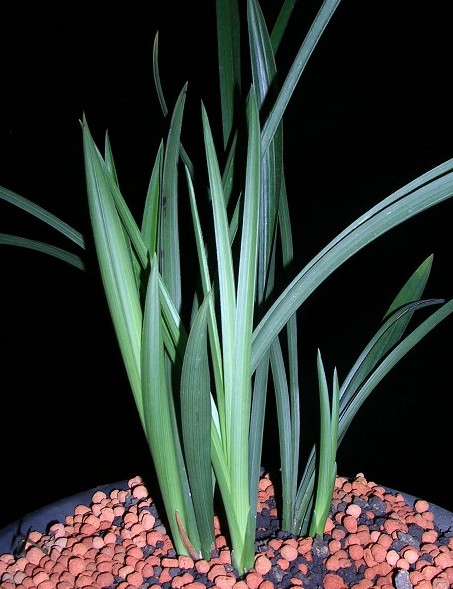
Myth and Legend: A Fine Tale from the World of Agriculture
Xinchang in Shaoxing, Zhejiang, is a picturesque small town in the Jiangnan region. The world-famous Xinchang Dafo Temple is a must-visit for everyone who comes to Xinchang. In orchid circles, Xinchang is a very important orchid town, long a blessed land for orchid production and a place where legends are made. The renowned Cymbidium goeringii 'Hurui Die' (Tiger-stamen Butterfly) comes from...
-
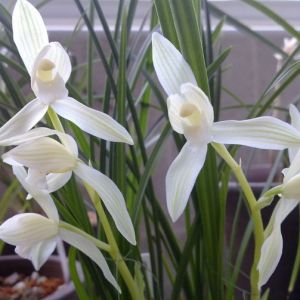
Lianban Orchid Taibai Su originates from Weixi, Yunnan
Taibai Su is a variety of Lianban Orchid (Cymbidium tortisepalum var. lianpan), named for its discovery in the valley of Taizi Snow Mountain and its pure white flowers without any speckles. It was originally called Lianban Su. Weixi is located on the borderland of Yunnan and Tibet, in the Three Parallel Rivers region of the Jinsha River, Lancang River and Nujiang River, where mountains are high and valleys are deep and unfathomable, with snow peaks reaching nearly 5000m and river valleys less than 1000m deep, an elevation difference of 4000 meters. High mountains bring much mist and cloud, deep valleys bring many streams, and the clear cold brings many orchids. In 1989, Chen Zhongqin, owner of the Snow Mountain Botanical Garden, found Taibai Su. The following spring, when Taibai Su bloomed, he wore Tibetan clothing and delivered it to the Second China Orchid Expo in Xiamen for exhibition, causing a sensation in the orchid world, and it was bought away by a foreign orchid merchant at a high price. Because of the discovery of Taibai Su, Weixi was listed as a famous orchid-producing area.
-
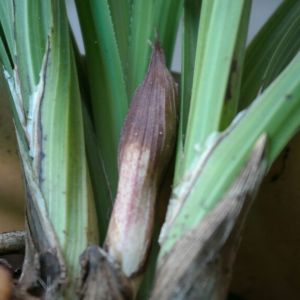
What are the fragrance characteristics of Cymbidium goeringii? A detailed explanation of the fragrances of Cymbidium goeringii from different regions
Bud abortion means the flower buds wither before they bloom. This phenomenon may be caused by deficiencies in bud-stage management techniques or inadequate care for the flower buds; the buds wither or rot before reaching bloom time. The main causes of bud abortion are dry air and excessively high temperatures. Both Cymbidium goeringii and Cymbidium faberi require 1 to 2 months at around 5°C of low...
-
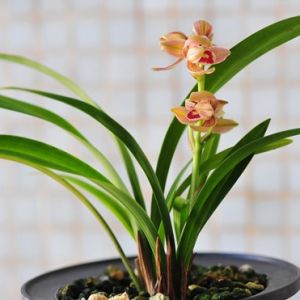
How to distinguish Cymbidium kanran from Cymbidium goeringii when they are not in bloom
This plant was collected in 2009 from the Fuzuo forest area of Langshui Township, Rong County. When collected, it was only a single seedling with a dragon root, and its plant form showed relatively strong lotus-petal characteristics. Looking at the whole flower: its constricted base and flared corners, cupping, and the vividness of its red color are all better than those of Honghe Guan, and a good constricted base is a standout feature that lotus-petal types from Rong County find hard to surpass. This follows the Honghe Guan, Lianzi He, and extra-large lotus types collected from Rong County...
-
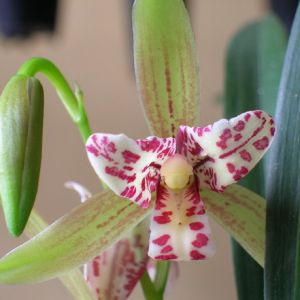
Introduction to the Four-Season-Blooming Butterfly Cymbidium Variety from Jianlan
Introduction: A four-season orchid butterfly-flower variety from Cunya Village, Nankeng Town, Nanjing County, Fujian Province. This variety has a semi-upright leaf type, fine serrations along the leaf margins, and thin leaf texture. The flower is 4.5 cm large, with the petals (pengban) curled outward in a true three-star shape, bright and evenly distributed spots, and a small, centered column (nose). Based on observation of the current flowers and two photographs from the original flower owner, the bloom form is confirmed to be quite stable, with strong fragrance...
条件筛选