-

Taitung County Government Leads the Development of the Red Quinoa Specialty Industry
Taitung red quinoa has become a hit, and Taitung's specialty sightseeing tourism has become a hit along with it! Led by the Taitung County Government, 20 local hotel and accommodation operators, together with the Taitung Branch of the Soil and Water Conservation Bureau of the Council of Agriculture, Executive Yuan, the Taitung County Farmers' Association, and the Taimali Township Farmers' Association...
-
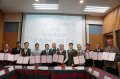
Hsinchu County Signs the Friendly Farming and Honest Agriculture Strategic Alliance
On January 16, the Hsinchu County Xinpu Township Office invited representatives from industry, government, academia and research in the agricultural field to sign the "Friendly Farming and Honest Agriculture" strategic alliance memorandum of cooperation at the Xinpu Township Visitor Center, announcing that farmers in Xinpu Township will, under the joint professional guidance of all invited parties...
-

Occurrence and Control Methods of the Black Velvet Chafer in Fengxiang County, Shaanxi
The black velvet chafer (commonly known as "louhu") has a body length of 7-8 mm, a blackish-brown or purplish-brown body color, and blackish-brown fine hairs on its body surface. It has one generation per year and overwinters as an adult. In April of the following year, it emerges and becomes active, then feeds on the leaves of weeds, poplar, willow, and elm trees. After crop seedlings emerge, it migrates to sunflowers, beans, and other crops to feed and cause damage. During the day, it hides in weeds and soil cracks. It mostly flies out in groups in the evening to cause damage, biting the tender leaves of willow, elm, and fruit trees, as well as the seedlings of crops such as alfalfa, sunflower, sweet potato, potato, and kidney bean. Adults have a death-feigning habit and phototaxis. From May to
-
Key High-Yield Transplanting Techniques for Rice Variety Xinyou 205 in Jinggu County
Xinyou 205 is one of the main rice varieties promoted under the 2010 Science and Technology Demonstration County Project in Jinggu County. The following technical points should be noted during transplanting: 1. Field preparation: the field must be plowed three times and harrowed finely, with the field level and the soil turned to mud. 2. Fertilization: apply 1000-2000 kg of decomposed farmyard manure deeply per mu, 40 kg of compound fertilizer in the middle layer, and 10-15 kg of potassium sulfate or potassium nitrate. 3. Transplanting time and density: the transplanting period is mid-April, and transplanting should be done on the second day after field preparation, with seedling age of 40-45 days.
-
It is the right time for honeysuckle pest and disease control, and Xiushan County, Chongqing Municipality is strictly implementing it
Honeysuckle, formerly known as Japanese honeysuckle, also called silver flower, honeysuckle flower, or double flower, is a twining vine of the Caprifoliaceae family. The county has developed a honeysuckle base of 60,000 mu. Because the base farmers manage extensively and supporting technologies have not kept up, especially pest and disease control management, the yield of honeysuckle is low and the quality is poor. According to a survey by the county plant protection station, honeysuckle pests and diseases occur relatively commonly in our county, among which honeysuckle powdery mildew, brown spot disease, aphids and red spiders are relatively serious in occurrence and damage. At present, it is the best period for controlling honeysuckle powdery mildew, brown spot disease, aphids and red spiders and other pests and diseases
-
Colored potatoes successfully introduced and cultivated in Ningshan County, Shaanxi
From the Zhengzhou Grain Wholesale Market: In a trial field in Jieyan Village, Jifaping Town, Ningshan County, Shaanxi Province, freshly dug potatoes displayed a striking array of colors including bright red, light red, deep purple and pale yellow. These are new specialty-type potato varieties introduced and developed through cooperation between the Ningshan County Agricultural Technology Center, the Ningshan County Seed Company and Northwest A&F University, with 12 new varieties introduced from the United States and Canada for the first time. After successful spring trial planting in 2004 at Xunyangba Town at an altitude of 1300 m
-
Impact of High-Temperature Heat Damage on Rice Production in Fanchang County and Defensive and Remedial Measures
In the process of rice production, the climate factors with the greatest impact and the hardest to control are temperature and water. Reasonable irrigation can supplement and regulate water, but temperature is difficult to control, and it exerts a major influence on the entire life of rice. Rice is the main crop in grain production in Fanchang County, ranking first among grain crops in both planting area and total output. At present, the rice planting area in Fanchang County is about 16,360 hectares (including the multiple cropping index), of which about 13,191 hectares are middle-season indica rice (mainly hybrid rice), about 1,514 hectares are early rice, and about 1,655 hectares are double-cropping late rice.
-
How to manage garlic in the mid-to-late stages? 2011 production management recommendations for Midu County
At present, the garlic planted in Midu County has entered a period of rapid growth, and early-maturing varieties have entered the bolting stage. In view of the characteristics of garlic cultivation in Midu County and in light of this year's climatic conditions, we should focus on strengthening mid- and late-stage field management. Taking into account the characteristics of excessive rainfall at sowing time in September-October last year, soil compaction, and poor quality of spot sowing, and based on the county's conditions, we should apply fertilizer reasonably, carry out shallow tillage and weed control, and carry out timely pest and disease control focused mainly on leaf blight, so as to ensure a stable yield and bumper harvest of garlic this year. 1. Timely shallow tillage and weed control. As temperatures gradually rise, conditions are relatively favorable for weeds in garlic fields
-
How to grow garlic for high yield? Key points of high-yield cultivation techniques in Midu County
I. Variety selection The garlic bolt-type varieties suitable for cultivation in Midu County are mainly Han garlic, Hongqixing, Wen'erzao, Erjizao, and Chi garlic, with a seeding rate of 120-150 kg per mu. II. Field selection Select fields for garlic that are on high ground, have high fertility, deep soil layers, and are convenient for irrigation and drainage. III. Field preparation First deep-plow the soil, sun-dry the field, make furrows and level the land, requiring level fields, fine soil, and deep furrows. IV. Timely sowing Sow garlic at the right time to promote early emergence and rapid growth, early bolt formation, and high economic returns. But garlic sown too early out of season
-
Production Technology for Grade A Green Food Garlic in Dongping County
Green food refers to safe, high-quality, nutritious foods that follow the principles of sustainable development, are produced according to specific production methods, are certified by a specialized agency, and are permitted to use the green food label, being free from pollution. Grade A green food refers to products whose production site environmental quality meets the requirements of NY/T391-2000, which are produced in strict accordance with the green food production material use guidelines and production operating procedures, with limited use of restricted chemically synthesized production materials, whose product quality meets green food standards, and which are certified by a specialized agency and permitted to use the Grade A green food label.
条件筛选