-

Talking Farming in the Year of the Horse: A Bumper Grain Harvest
In the Year of the Ox or Horse, farming goes well. Grain growers toil for a year, and Heaven rewards diligence with a bountiful harvest. This year marks the opening year of the new national food security strategy and a crucial year for defending high grain output levels after ten consecutive years of increase. Throughout the year, grain production withstood severe natural
-
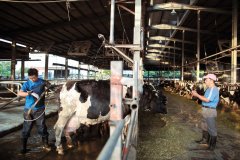
Dairy Cattle Farming Has a Promising Future: Reasons for Increased Milk Yield and Handling Milk from Sick Cows
Dairy cattle are great partners for dairy farmers to make money, and whether they live comfortably on the farm is tied to their health. Wu Jinlong, Secretary-General of the Dairy Farmers Association, said that sick cows affect dairy farmers' income, and once milk from a sick cow is mixed with other milk, the entire batch of raw milk is ruined
-
A Complete Analysis of Key Points for Cattle Farm Planning and Layout
Summary Foundation and walls: the foundation depth is about 80 cm, and the brick wall thickness is about 24 cm. Doors and windows: they can be set as roll-up doors, and enclosed windows need to be larger. Site area: the area of cattle sheds and other buildings is 15-20% of the total site area. Roof: gable
-
Detailed beef cattle farming technical plan to help you raise cattle scientifically
Summary Farming environment: The site should be built in a dry place with higher terrain, abundant forage resources and good transportation. Breed selection: Select breeding cattle with good reproductive capacity, robust growth and no diseases. Feeding management: In summer, forage can be fed 3 times a day; in winter and spring
-
What are the taboos in cattle farming? These points need attention
Summary Introducing breeding stock from non-local sources: if breeding cattle are available on the local market, they should be bought nearby; introducing breeding stock from non-local sources increases transport costs and makes it easy to be cheated. Not vaccinating: skipping vaccines to save costs is the biggest taboo. Incomplete disinfection of pens: incomplete disinfection easily triggers
-
Analysis of Cattle Farming Costs and Profits with a Detailed Explanation of the Farming Cycle
Cattle are an ordinary cattle breed native to China. Cattle have very short horns, and their coats are yellowish-brown or black, though some are also mixed-colored; cattle hair is very short. Cattle can be used for plowing fields or pulling carts, their meat can be enjoyed by people, and their hide can be made into leather.
-
Yellow Cattle Farming, Breeding and Reproduction Techniques and Precautions
When people think of cattle, most think of dairy cows or the cattle they raise themselves. Yellow cattle (Bos taurus) are also an ordinary cattle breed native to China. In China, their numbers rank first among all large livestock and among cattle, and they are raised in almost every region of the country. Some people ask how yellow cattle should be raised
-
What is the outlook for beef cattle farming? Cost and profit analysis of raising one beef cow
Now, as people's living standards improve, people are increasingly particular about clothing, food, housing and transportation. In terms of food, people are also increasingly focusing on choosing green foods. Therefore, people's demand for beef cattle meat is also growing. Raising beef cattle
-
Cattle farm construction pictures for a 50-head operation
When cattle farmers establish a cattle farm, there are many points that need attention, otherwise they will cause all kinds of problems for the cattle farm later, such as environment, disease and so on. Therefore a good cattle farm construction plan is very important. Below, combined with cattle farm construction pictures, we
-
What are the considerations for combining pasture grasses for cattle farming?
Cattle prefer grasses (Poaceae) and tall-stemmed plants, followed by legumes. Pasture grass varieties suitable for feeding cattle include Sudan grass, alfalfa, and rye. Beef cattle generally need 30-50 kg of green fodder per head per day; for a mixed herd including young cattle and calves, the average daily green fodder requirement is 30 kg per head.
条件筛选