Dairy Cattle Farming Has a Promising Future: Reasons for Increased Milk Yield and Handling Milk from Sick Cows
Dairy cattle are great partners for dairy farmers to make money, and whether they live comfortably on the farm is tied to their health. Wu Jinlong, Secretary-General of the Dairy Farmers Association, said that sick cows affect dairy farmers' income, and once milk from a sick cow is mixed with other milk, the entire batch of raw milk is ruined
Dairy cattle are great partners for dairy farmers to make money, and whether they live comfortably on the farm is tied to their health. Wu Jinlong, Secretary-General of the Dairy Farmers Association, said that sick cows affect dairy farmers' income, and once milk from a sick cow is mixed with other milk, the entire batch of raw milk is ruined, so dairy farmers pay very close attention to the health of their dairy cattle to avoid affecting the farm's operations.
To avoid affecting raw milk quality, milk from sick cows must be discarded
Wu Jinlong said that the likelihood of dairy cattle developing diseases such as mastitis depends on the farm's management approach, so keeping the farm clean is very important. Once a dairy cow is found to be sick, the raw milk it produces must be discarded. To be safe, dairy farmers often discard the raw milk produced by sick cows within 7 to 10 days after medication. There was once a case in which a dairy farmer, during a period when a cow was sick and on medication, mistakenly mixed 12 kg of raw milk milked from the sick cow into the raw milk produced by other healthy cows, causing all 12 tonnes of raw milk in the milk collection truck to fail drug testing; the entire truckload of raw milk had to be discarded. Later, by analyzing the raw milk samples retained by each farm and tracing upward, it was discovered that the mistake had been caused by an operational error by a new employee.
Wu Jinlong believes that all animals get sick, and dairy cattle are the property of dairy farmers, so they are cared for even more attentively. Dairy farmers isolate and treat sick cows to ensure the health of the herd. In addition, dairy farmers now have basic treatment knowledge, and in recent years some farms have brought in professional veterinarians to be stationed on site, providing immediate medical care. Given the current situation at most farms, veterinarians are not in seriously short supply.
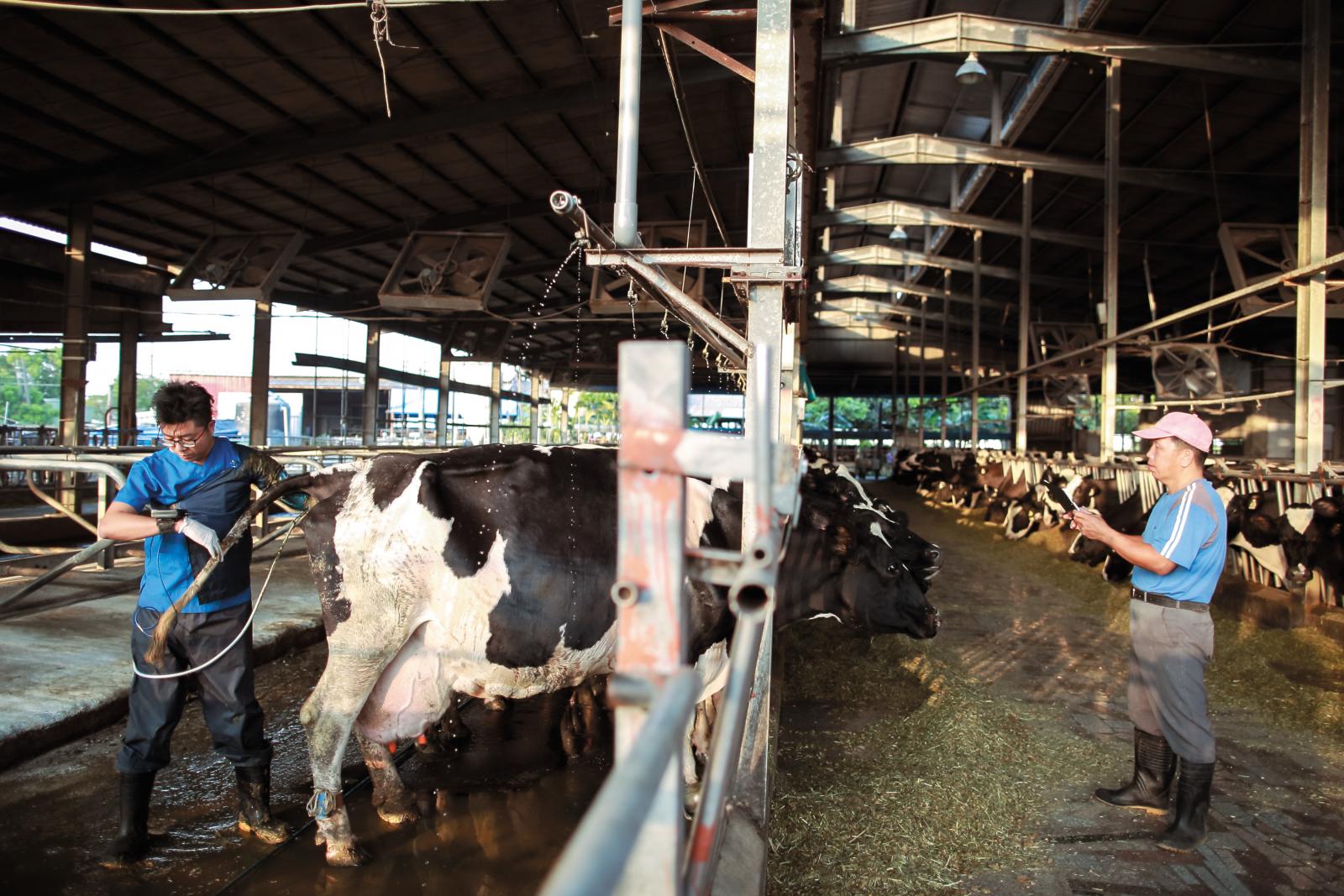
Because early farms mostly had concrete floors, dairy cattle suffered hoof discomfort. Wu Jinlong explained that as technology has improved, farms have largely been upgraded. Dairy farmers now mostly use soft mats instead of hard concrete floors, and use methods such as sprinkling water and electric fans to reduce the discomfort high temperatures cause dairy cattle and improve their health. Environmental hygiene is tied to the physical health of dairy cattle, and sick cows affect dairy farmers' income.
Increased milk yield in dairy cattle? Scholar: the result of long-term selective breeding
Hsu Chi-tai, a professor in the Department of Animal Science and Technology at National Taiwan University, said that the milk yield of dairy cattle varies depending on the number of inseminations. For Holstein cattle, which currently account for 90% of farm stock, before early breeding and selection was carried out, a cow produced about 10 kg of raw milk a day. After many years of selective breeding in countries around the world, Holstein cattle can now produce about 9000 kg of raw milk a year.
As for whether the practice by some dairy farmers of inserting a hand into a cow's rectum to check on it harms the cow, Hsu Chi-tai explained that to check whether artificial insemination has succeeded, dairy farmers put on a long glove that reaches to the shoulder, apply petroleum jelly or medical gel to it, and then reach in below the cow's rectum, gently touching the changes in the reproductive organs with the hand to judge the state of fertilization. Some dairy farmers instead use ultrasound machines, inserting an ultrasound probe into the rectum to scan in place of a hand. As long as lubrication is properly done and the movements are not too rough, this examination has little effect on the dairy cow.
Regarding directions for improving farms in the future, Hsu Chi-tai suggested that dairy farmers must pay attention to whether the farm environment is comfortable for the dairy cattle, check whether the bedding laid on the ground has been contaminated by the cattle's excrement, and replace it in a timely manner to ensure the farm's environmental hygiene. In addition, Taiwan's weather is hot and humid, so it is necessary to pay attention to how the dairy cattle respond to high temperatures and take cooling measures. When choosing cow beds for dairy cattle to lie down and rest on, it is best to select a cow bed size according to the cow's body size, so that the cow can sit or lie down on it, but the space should not be so large that the cow can turn around substantially, causing its hindquarters, which should face outward, to face inward and letting excrement contaminate the cow bed.