-

What are the key technical points for raising geese on pasture?
1. Pay attention to selecting good grass species. According to the digestive characteristics of geese, choose grass varieties suitable for raising geese. Pastures are divided into grasses (Poaceae) and legumes (Fabaceae), as well as amaranth family plants such as grain amaranth. For raising geese, it is suitable to plant grasses and amaranth family pasture, such as ryegrass, Rumex, and grain amaranth.
-
What are the considerations for combining pasture grasses for cattle farming?
Cattle prefer grasses (Poaceae) and tall-stemmed plants, followed by legumes. Pasture grass varieties suitable for feeding cattle include Sudan grass, alfalfa, and rye. Beef cattle generally need 30-50 kg of green fodder per head per day; for a mixed herd including young cattle and calves, the average daily green fodder requirement is 30 kg per head.
-
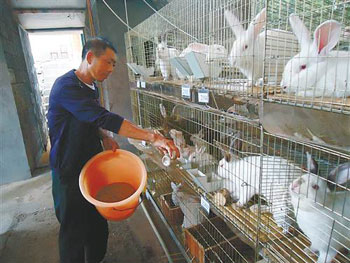
Raising rabbits on pasture grass is highly profitable, with an annual net income of 200,000 yuan
Raising rabbits on pasture grass is so profitable, with an annual net income of 200,000 yuan
-
Methods for Measuring Pasture Grass Yield and Calculating Sheep Carrying Capacity
(1) Grass yield measurement. The grass yield of pasture land is affected by factors such as season, climate, variety, and grazing utilization patterns. Measuring pasture grass yield is of great significance for determining a reasonable sheep carrying capacity. The quadrat sampling method can be used. The method takes the grass cut from 1 sq m of pasture land as one quadrat; at least 10 quadrats are sampled in each grazing subplot, 10-20 quadrats are sampled in each major area, and 50-100 quadrats are needed for desert-type pasture land. Divide the total grass yield of the quadrats (kg) by the actual number of quadrats sampled, then multiply by 10000 to calculate the grass yield per hectare of pasture land (kg). The calculation formula is:
-
条件筛选