-

Is Acacia the national flower of Australia? A detailed guide to growing it in pots
Acacia, also known as the soap-pod tree, thorn-ball flower, message tree and so on, is an ornamental flower with a rather unusual flower shape; its flowers are yellow and have a certain fragrance. Acacia has many branches and many thorns, so it can be planted as a hedge, and its wood is very hard and can be made into rather precious
-
How to Grow Senegalia pennata? Detailed Guide to Planting Methods and Key Technical Points
The scientific name of Senegalia pennata is Acacia pennata, and it is the most distinctive wild vegetable in Xishuangbanna and other places. So how do you grow Senegalia pennata? 1. Growth habits of Senegalia pennata. Senegalia pennata is a perennial plant of the Fabaceae family, mainly produced in Xishuangbanna. Its scientific name is Acacia pennata. It is covered in thorns and is neither a tree nor a vine nor a grass. The tender leaves of the plant are edible. It is very nutritious, with a protein content (as high as 8.59%) even higher than that of soybeans, and it is deeply loved by many ethnic groups in neighboring Laos, Myanmar and Thailand.
-
When Does Black Locust (Robinia pseudoacacia) Bloom and Bear Fruit, How Many Years Until It Flowers After Planting, and How Does It Differ from Chinese Scholar Tree?
Black locust, also known as false acacia. Black locust flowers are edible. The honey produced from black locust flowers is very sweet, and honey yields are also high. Cultivated varieties include Hongsen locust, red-flowered black locust, golden-leaf black locust, and others. So when does black locust bloom and bear fruit? How many years after planting will it flower? And how does it differ from Chinese scholar tree
-
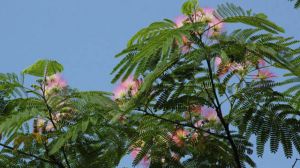
The difference between acacia trees and silk trees: easily distinguished by leaves and flowers
Trunk distinction: The trunk of the acacia tree has many thorns distributed on it; the trunk of the silk tree has no thorns. Leaf distinction: The former blooms first and then grows leaves; the latter grows leaves first and then blooms. Flower distinction: The former's flowers are yellow; the latter's flowers are white or pink.
-

Grafting and Cutting Propagation Techniques and Overwintering Management Tips for Golden False Acacia
The golden false acacia (Robinia pseudoacacia 'Frisia') has an umbrella-shaped crown. Its leaves are golden yellow in spring, turning yellow-green in summer and yellow-orange in autumn. In early summer it bears fragrant white flowers in pendulous racemes. It is a tree species with very high ornamental value.
-
What are the key technical points for land preparation and fertilization in black locust (Robinia pseudoacacia) seedling cultivation?
The method for land preparation and fertilization in black locust seedling cultivation is: the seedling bed should undergo deep plowing and thorough harrowing, preferably deep plowing in autumn or winter, and in the following early spring, harrowing fine and level while the soil is still frozen, to a depth of 20 to 30 cm, removing stones and grass roots during harrowing. Apply 4000 to 5000 kg of decomposed barnyard manure per mu, and apply 10 to 15 kg of ferrous sulfate to control underground pests.
-
Detailed Explanation of Management Techniques for Black Locust (Robinia pseudoacacia) at the Seedling Stage
The management method for black locust at the seedling stage is: when the seedlings are 3 to 4 cm tall, carry out the first thinning; afterwards, based on the growth of the seedlings, carry out 1 or 2 more thinnings, with the final thinning carried out when the seedlings are 10 to 15 cm tall; after final thinning, leave about 10,000 plants per mu. Black locust is susceptible to waterlogging, so drainage should be carried out promptly after heavy rain. After the young seedlings grow 3 or 4 true leaves, apply a chemical fertilizer as a top dressing, and apply another top dressing in July; after August, generally no more irrigation or fertilization is done.
-
Detailed Explanation of Key Techniques for Root-Buried Propagation of Black Locust (Robinia pseudoacacia)
1. Site Selection and Land Preparation: The nursery site should be flat terrain, convenient for irrigation and drainage, with deep soil layers, fertile soil, and a groundwater level below 1.5-2m, preferably sandy loam or loam soil. Low-lying areas with excessively high groundwater levels, saline-alkali land, and heavy clay soil are not suitable for nurseries. 2. Selecting Seed Roots: 1-2 year old seedling roots should be selected, including residual root systems after lifting from the nursery or roots trimmed from seedlings. The length of seed roots is preferably 10-20 cm, with the thick end having a diameter of 1.5-4 cm. The collection time for seed roots can be from after leaf fall to before bud break, generally
-
Detailed Explanation of the Key Cultivation and Management Techniques for the Black Locust (Robinia pseudoacacia 'Idaho')
I. Propagation Methods The black locust is easy to propagate by root burying, cuttings, or grafting, and can also be propagated by digging up roots. For root burying propagation, select 1-2 year old main and lateral roots of the black locust, with a diameter of 0.3-1.5 cm being suitable. Each mu requires 10-12 kg of seed roots, and each kg of seed roots can be cut into 300-400 segments. Two methods can be used: greenhouse seedling raising and transplanting, and field root burying. The seedling raising time indoors varies depending on the region, and transplanting to the field is done in mid-May. Field root burying is carried out when the outdoor minimum temperature is above 10°C. Cut the
-
Robinia pseudoacacia 'Idaho'
Call it a tree if you like, yet it blooms every year; call it a flower if you like, yet by any measure it still looks like a tree. This is the Robinia pseudoacacia 'Idaho', also known as the "wealth tree", a precious tall arbor species successfully introduced from abroad. Every May, as spring deepens, the Robinia pseudoacacia 'Idaho' bursts into beautiful bloom. Unlike other trees, it can flower twice a year, with each flowering lasting as long as a month, making it an excellent tree for landscaping. Don't believe it? First take a look at the tree's form: an open canopy and a straight trunk, full of the elegance of a woody plant; then look at its leaves: neither too long nor too short, smooth and handsome; as for the flowers,
条件筛选