-

When Does Black Locust (Robinia pseudoacacia) Bloom and Bear Fruit, How Many Years Until It Flowers After Planting, and How Does It Differ from Chinese Scholar Tree?
Black locust, also known as false acacia. Black locust flowers are edible. The honey produced from black locust flowers is very sweet, and honey yields are also high. Cultivated varieties include Hongsen locust, red-flowered black locust, golden-leaf black locust, and others. So when does black locust bloom and bear fruit? How many years after planting will it flower? And how does it differ from Chinese scholar tree
-
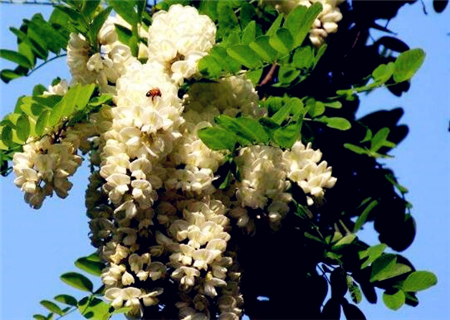
When does the black locust (Robinia pseudoacacia) bloom and bear fruit, how many years of planting before it flowers, and how does it differ from the Chinese scholar tree?
Black locust, also known as Robinia pseudoacacia. Black locust flowers are edible. The honey produced from black locust flowers is very sweet, and honey yields are also high. Cultivated varieties include Hongsen locust, red-flowered black locust, golden-leaf black locust, and others. So when does the black locust bloom and bear fruit? How many years of planting before it flowers? And how does it differ from the Chinese scholar tree?
-
What kind of tree species is the twice-blooming black locust (Robinia pseudoacacia 'Decaisneana')?
The twice-blooming black locust is a rare landscaping tree species, a tree. It was introduced to Henan from the Netherlands in 1996. It grows and develops normally in Henan. Its rarity lies in that it blooms twice a year: the first bloom occurs around May 1, and the second bloom occurs around July 10. The flowers are large and pink, with a flower length of 3.7 cm, and each blooming period lasts about 15 days. The young leaves are yellow with a hint of red, and at the end of growth the seedling stem turns reddish-brown. A one-year-old seedling grows about 3 m tall, making it an excellent street tree and garden landscaping tree species.
-
Detailed Explanation of Seedling Raising Methods and Techniques for the Golden Tree Species Robinia pseudoacacia 'Idaho'
Robinia pseudoacacia 'Idaho' (RobiniapseudoacaciaCV.ldaho) is a variety of black locust, a deciduous tree of the legume family Papilionoideae, with a tree height of 5-8 m, a straight trunk, and two full blooming seasons per year. The first is in May, with a flowering period of about 20 d, and the second is in July-August, with a flowering period of 40 d. The flowering period is long, the number of flowers is large, the flowers are large, and the flower shape is beautiful. It is a landscaping tree species introduced to China in recent years. It has vigorous growth, a well-developed root system, and strong stress resistance. It grows noticeably better than black locust on dry mountain land, and
-
How to propagate Robinia pseudoacacia 'Idaho'? A detailed explanation of propagation methods for landscaping nursery stock
Robinia pseudoacacia 'Idaho' is an ideal rare tree species introduced from abroad in recent years for beautifying and greening urban landscapes. Whether for ornamental landscaping, afforestation and sand fixation, or improving the ecological environment, it demonstrates enormous advantages and potential through its unique characteristics. It will also play a huge role in promoting the adjustment of rural industrial structure and increasing farmers' income. Because Robinia pseudoacacia 'Idaho' was introduced to China relatively recently, the vast number of farmers are not very familiar with its propagation methods. Based on several years of cultivation experience, the author has drawn the following conclusions for everyone's reference. 1. Site selection and land preparation: Choose
-
Why is the fragrant rosewood (Robinia pseudoacacia 'Idaho') called a precious tree species?
The fragrant rosewood, also known as the "tree of wealth," is a deciduous tree in the Fabaceae (Papilionaceae) family, native to Spain and introduced from South Korea in 1998. It can be planted in both northern and southern China. In the north it blooms twice a year, and in the south three times a year, with a flowering period of 60-90 days. Its corolla is butterfly-shaped, pink or purplish-red, with abundant and beautiful flowers, and it has high ornamental, environmental, landscaping and economic value. It grows rapidly with a well-developed root system; a 3-year-old tree reaches 4.5-5.0 m in height, 5-7 cm in diameter and 2.0-2.5 m in crown width, and is cold-resistant, drought-resistant and salt-alkali-resistant. Propagation of the fragrant rosewood
-
Detailed Explanation of Key Techniques for Planting Black Locust (Robinia pseudoacacia) in Autumn and Winter
Black locust (Robinia pseudoacacia) is widely used in landscaping for its strong adaptability, but surveys have found that some black locusts do not grow vigorously after planting, and the reason for this is largely related to improper planting techniques. Key techniques for stem-truncated planting of black locust in autumn and winter: 1. Planting time: plant as soon as possible after all leaves have fallen in November each year. 2. Seedling specifications: for general barren hill afforestation, select seedlings with a ground diameter above 1 cm; for roadside greening, select large seedlings with a ground diameter above 2.5 cm; when planting, keep the root system intact
-
Robinia pseudoacacia 'Idaho'
Call it a tree if you like, yet it blooms every year; call it a flower if you like, yet by any measure it still looks like a tree. This is the Robinia pseudoacacia 'Idaho', also known as the "wealth tree", a precious tall arbor species successfully introduced from abroad. Every May, as spring deepens, the Robinia pseudoacacia 'Idaho' bursts into beautiful bloom. Unlike other trees, it can flower twice a year, with each flowering lasting as long as a month, making it an excellent tree for landscaping. Don't believe it? First take a look at the tree's form: an open canopy and a straight trunk, full of the elegance of a woody plant; then look at its leaves: neither too long nor too short, smooth and handsome; as for the flowers,
-
Detailed Explanation of the Key Cultivation and Management Techniques for the Black Locust (Robinia pseudoacacia 'Idaho')
I. Propagation Methods The black locust is easy to propagate by root burying, cuttings, or grafting, and can also be propagated by digging up roots. For root burying propagation, select 1-2 year old main and lateral roots of the black locust, with a diameter of 0.3-1.5 cm being suitable. Each mu requires 10-12 kg of seed roots, and each kg of seed roots can be cut into 300-400 segments. Two methods can be used: greenhouse seedling raising and transplanting, and field root burying. The seedling raising time indoors varies depending on the region, and transplanting to the field is done in mid-May. Field root burying is carried out when the outdoor minimum temperature is above 10°C. Cut the
-
Detailed Explanation of Key Techniques for Root-Buried Propagation of Black Locust (Robinia pseudoacacia)
1. Site Selection and Land Preparation: The nursery site should be flat terrain, convenient for irrigation and drainage, with deep soil layers, fertile soil, and a groundwater level below 1.5-2m, preferably sandy loam or loam soil. Low-lying areas with excessively high groundwater levels, saline-alkali land, and heavy clay soil are not suitable for nurseries. 2. Selecting Seed Roots: 1-2 year old seedling roots should be selected, including residual root systems after lifting from the nursery or roots trimmed from seedlings. The length of seed roots is preferably 10-20 cm, with the thick end having a diameter of 1.5-4 cm. The collection time for seed roots can be from after leaf fall to before bud break, generally
条件筛选