-
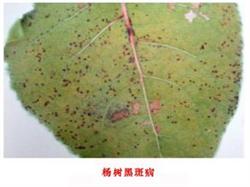
Detailed Explanation of Prevention and Control Methods and Occurrence Patterns of Poplar Black Spot Disease
Poplar black spot disease, also known as poplar brown spot disease, generally occurs on young leaves, tender shoots and fruit clusters, spreading from top to bottom, mainly damaging leaves. In the early stage of the disease, needle-like sunken shiny small spots first appear on the underside of leaves, then the lesions expand to about 1 mm, black, slightly raised, and brown spots also appear on the upper side of the leaves, 5-6 days...
-
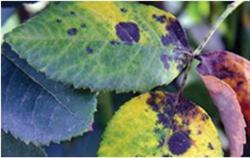
Occurrence patterns and control methods of black spot disease in Chinese roses
Black spot disease of Chinese roses (Rosa chinensis) and roses is a worldwide disease, occurring commonly across China. It mainly damages the leaves, followed by petioles, leaf tips, young tender shoots and flower stalks. It occurs severely in both southern and northern regions and other areas. The disease causes leaves to turn yellow and drop early. When the disease is severe in summer during April and May and in late summer during August and September, the leaves can drop completely, causing Chinese roses...
-
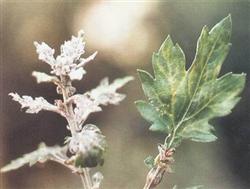
Detailed Explanation of the Occurrence Patterns and Control Methods of Chrysanthemum Powdery Mildew
Chrysanthemum powdery mildew is one of the common diseases in flowers, and it is distributed in both southern and northern China. Chrysanthemum powdery mildew causes poor plant growth, leaf death, and even failure to bloom, seriously affecting greening and beautification results and flower production; it also harms cineraria, pot marigold, coneflower, African daisy, cosmos, aster, dahlia...
-

Occurrence Patterns and Control Methods of the Euonymus Leafroller Moth
The Euonymus leafroller moth belongs to the order Lepidoptera, family Zygaenidae. Its larvae damage the tender leaves and shoots of host plants, feeding on the foliage; in severe cases they strip the branches bare, or even cause entire stands to wither and die. In the Jining region, the Euonymus leafroller moth has one generation per year and overwinters as eggs on the host's branches and shoot tips. The overwintering eggs mostly hatch in mid-to-late March; in sheltered, sunny spots they can hatch 5-7 days earlier, and the hatching peak generally occurs around March 20. A single egg mass can finish hatching in 2-3 days, which coincides with the emergence of new leaves on the Euonymus. From late April to early May, the mature lar
-
A Detailed Explanation of the Onset Patterns of Fusarium Wilt in Japanese Euonymus
Onset patterns of Fusarium wilt in Japanese euonymus: the pathogen is Fusarium existing in the soil. The fungus mostly invades through wounds on the roots, but can also directly invade the plant. It generally begins to develop in mid-May, with July and August being the peak period of onset; some plants go from onset to death in no more than a week.
-
What are the occurrence patterns of the black locust aphid?
Occurrence patterns of the black locust aphid: it produces more than 20 generations a year, overwintering as wingless solitary aphids, nymphs, or a small number of eggs on the roots, stems, and leaves of legumes such as wild alfalfa; in March and April of the following year it reproduces on the overwintering host, and in late April winged parthenogenetic females are produced and migrate to legumes such as black locust (Robinia pseudoacacia) and Chinese scholartree (Sophora japonica) where they cause damage. Damage occurs throughout the year, with the heaviest damage at the early flowering stage of black locust; by October winged aphids again migrate to the host to reproduce, cause damage, and overwinter. The most suitable temperature for aphid reproduction is 19 to 22 degrees Celsius, with relative humidity of 65% to 70%; when the temperature is below
-
What are the occurrence patterns of the black-spotted inchworm on black locust
Occurrence patterns of the black-spotted inchworm on black locust: it has 4 generations a year and overwinters as pupae in the surface soil. In early April of the following year, eclosion begins, followed by mating and egg laying; the egg stage lasts 15 days, and the larval stage about 25 days. In early May, the larvae begin to enter the soil to pupate; the pupal stage lasts about 10 days, after which the first-generation adults emerge, with an adult lifespan of about 5 days. Second-generation adults appear in early to mid-July. Third-generation adults appear in mid-to-late August, and the larvae of the last generation cause damage until mid-September, after which they mature, enter the soil, and pupate to overwinter. Eggs are laid in the cracks of rough bark below 2 m on the tree trunk base, piled into masses and covered with gray down. Newly hatched
-
What are the occurrence patterns of the privet hawk moth (Clanis bilineata)?
Occurrence patterns of the privet hawk moth (Clanis bilineata): In Hebei, Shandong, Jiangsu, Anhui and other places, 1 generation occurs per year, and the mature larvae burrow into the soil at a depth of 10 to 15 cm to overwinter. In early to mid-June of the following year, pupation begins. The pupal stage lasts 10 to 15 days. In early to mid-July, adults emerge, with mid-month being the peak emergence period. During the day, adults rest quietly among branches and leaves, and begin activity in the evening; adults are phototactic. Generally, egg laying begins 3 hours after mating, with eggs mostly laid on the underside of leaves and a few on the upper side. Each female lays an average of about 350 eggs. Adults live 7 to 10
-
Occurrence patterns and control methods of black locust canker disease
Black locust canker disease is a major trunk and branch disease of black locust (Robinia pseudoacacia), affecting both young and mature trees. The disease mostly occurs in the bark of the main trunk. After trees are affected, lesions of varying sizes mostly appear on the lower part of the main trunk and at branch forks, and the lesions are spindle-shaped, oval or irregular. On young trees, the diseased part of the main trunk is cankerous and slightly sunken; on large trees, the bark of the main trunk is thick, and the diseased part is water-soaked with no obvious sunken areas. The disease spreads faster lengthwise than crosswise. When the diseased area encircles the trunk completely, the tree withers and dies. In the later stage, at the lenticels and bark cracks of the diseased part
-
What are the occurrence patterns of the black locust moth?
Occurrence patterns of the black locust moth: In Shandong it has 2 generations a year, overwintering as second-generation larvae of various instars inside thin silken cocoons in tunnels in the trunk. In late March of the following year they become active and feed and cause damage, and mid-May is the peak period of adult emergence. Eggs are mostly laid in wounds on branches and trunks or in bark crevices, and first-generation larvae begin hatching in mid-June. Newly hatched larvae are active and agile, burrowing under the bark and feeding on the phloem and cork cambium layers, forming vertical, irregular tunnels. The damaged areas proliferate and swell, and the bark splits and curls. In mid-July mature larvae begin to pupate, adults can be seen in late July, mid-August is the peak period of adult emergence, and
条件筛选