Occurrence patterns and control methods of black spot disease in Chinese roses
Black spot disease of Chinese roses (Rosa chinensis) and roses is a worldwide disease, occurring commonly across China. It mainly damages the leaves, followed by petioles, leaf tips, young tender shoots and flower stalks. It occurs severely in both southern and northern regions and other areas. The disease causes leaves to turn yellow and drop early. When the disease is severe in summer during April and May and in late summer during August and September, the leaves can drop completely, causing Chinese roses...
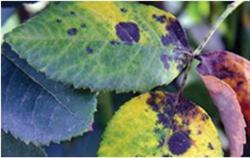
Black spot disease of Chinese roses (Rosa chinensis) and roses is a worldwide disease, occurring commonly across China. It mainly damages the leaves, followed by petioles, leaf tips, young tender shoots and flower stalks. It occurs severely in both southern and northern regions and other areas. The disease causes leaves to turn yellow and drop early. When the disease is severe in summer during April and May and in late summer during August and September, the leaves can drop completely, dealing a devastating blow to the autumn blooming of Chinese roses and roses and severely weakening the vigor of the plants. Besides infecting Chinese roses and roses, this disease also damages Rosa multiflora, Rosa laevigata, Rosa roxburghii, Rosa xanthina and others.
I. Symptoms: After leaves are infected, purple-brown round spots of varying sizes or irregular-shaped lesions appear, with a diameter of about 4 mm to 12 mm. The edges are fringed with fine hairs, and they gradually develop into dark brown coalesced lesions. The lesion edges have a yellow halo and are radially arranged, initially not very obvious; in the later stage, the lesion margins are purple-brown or brown, and the radial pattern is clearly visible. In severe cases, the lower leaves drop completely, the tender shoots dry up and die, and many small black dots, namely the fungal acervuli of the pathogen, form on the lesions.
II. Pathogen and occurrence patterns: The pathogen is Marssonina rosae of the Deuteromycotina (Fungi Imperfecti), which is the anamorph of Diplocarpon rosae of the Ascomycotina. The apothecia have a covering, and the ascospores are two-celled. It overwinters as mycelium or acervuli on diseased plant debris. In the following spring, conidia are produced and spread by wind, rain, dew, watering or insects to cause damage. In the Guangzhou area, the disease completes its annual infection cycle asexually, with no obvious overwintering period. In areas south of Guangzhou and around the Pearl River Delta, the disease enters its onset period in mid-to-late April. High temperature and high humidity in summer are unfavorable for the growth of Chinese roses and roses, and the plants enter a "summer dormancy" period, during which the disease also becomes relatively mild. Humidity has a greater impact on the disease than temperature. In years with early and abundant rainfall, the disease occurs earlier and more severely; high air humidity, frequent rain, heavy dew (fog), and poor ventilation in protected cultivation make the plants prone to the disease. The pathogen can cause repeated infections, and the disease can occur throughout the entire growing season. It is especially severe during the plum rain season and in years with frequent typhoons and torrential rain, and the disease worsens in summer, accelerating its spread. Rainy, foggy and dew-heavy conditions worsen the disease. In the Guangzhou area, the disease occurs from April to May, with peak periods in mid-May and mid-August, and the disease declines somewhat in September. The optimal temperature for the disease is around 20 to 25°C, and it is more severe when humidity is above 90%. Temperatures above 30°C are unfavorable for the disease. The onset and final stages of the disease vary from place to place depending on local climate. For example, in humid and rainy weather, leaf spores can germinate and invade within 6 hours, with an incubation period of 7 to 10 days. The disease is especially severe in waterlogged fields with poor maintenance and management and weakened plants, and disease resistance varies greatly among varieties. However, poor soil permeability and improper fertilizer and water management make the disease more severe in fields and gardens.
III. Control measures: In summer, during the period of rapid growth of Chinese roses and roses, the infection rate is highest, and it is also the peak period for black spot and powdery mildew. Disease prevention measures should follow the principle of "prevention" over "treatment."
1. Select resistant varieties.
2. Remove the pathogen. Persist in clearing dead plants and fallen leaves and diseased leaves every year to reduce the source of infection.
3. Enhance resistance. Strengthen field management, fertilize rationally, apply more phosphorus and potassium fertilizer, clear ditches and drain water, avoid watering by sprinkling, prune moderately, loosen and mound the soil, improve root vitality and growth vigor, and enhance the disease resistance of the plants.
4. Chemical control. In the following spring before Chinese roses and roses sprout, spray 100-fold diluted crystal lime sulfur mixture. Begin spraying when the new leaves have just unfurled in summer and continue until winter. In the early stage of the disease, alternately spray 3000-fold diluted Heisha, 75% chlorothalonil wettable powder at 1000-fold dilution, or 45% thiabendazole (Tecto) suspension concentrate at 500 to 600-fold dilution, 40% flusilazole or 25% myclobutanil emulsifiable concentrate at 800-fold dilution, or 40% lime sulfur suspension concentrate or 50% thiophanate-methyl wettable powder or 50% compound thiophanate wettable powder at 800-fold dilution, 70% thiophanate-methyl at 700 to 1000-fold dilution, 50% thiram wettable powder at 800 to 1000-fold dilution, 80% zineb at 800-fold dilution, 12.5% Deqing (Banjietuo) emulsifiable concentrate at 1000-fold dilution. Spray once every 7 days during the rainy season, and once every 7 to 10 days during the normal growing period and the plum rain season, for 4 to 5 consecutive sprays, which can control the spread of the disease. When the disease is severe, spray 3000-fold diluted Heisha, 70% copper hydroxide, 30% copper oxychloride suspension concentrate at 800-fold dilution, 75% chlorothalonil at 500-fold dilution, 12.5% Deqing emulsifiable concentrate at 1000-fold dilution, for 3 to 5 consecutive sprays, once every 7 to 10 days. Among these, 3000-fold diluted Heisha has the best control effect.