Detailed Explanation of Prevention and Control Methods and Occurrence Patterns of Poplar Black Spot Disease
Poplar black spot disease, also known as poplar brown spot disease, generally occurs on young leaves, tender shoots and fruit clusters, spreading from top to bottom, mainly damaging leaves. In the early stage of the disease, needle-like sunken shiny small spots first appear on the underside of leaves, then the lesions expand to about 1 mm, black, slightly raised, and brown spots also appear on the upper side of the leaves, 5-6 days...
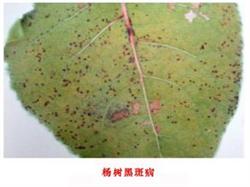
Poplar black spot disease, also known as poplar brown spot disease, generally occurs on young leaves, tender shoots and fruit clusters, spreading from top to bottom, mainly damaging leaves. In the early stage of the disease, needle-like sunken shiny small spots first appear on the underside of leaves, then the lesions expand to about 1 mm, black, slightly raised, and brown spots also appear on the upper side of the leaves. After 5-6 days, milky white raised small spots appear in the center of the lesions, which are the conidia clusters of the pathogen. Afterwards the lesions expand and merge into large patches, mostly round. When the disease is severe, the entire leaf turns black, and diseased leaves may fall off 2 months early. When seedlings are young and tender, if all leaves wither and die, the plant is likely to die; if the disease occurs when small seedlings emerge, the small leaves and seedling collar will all turn black, and the diseased seedlings become twisted and not straight.
I. Occurrence patterns:
The pathogen overwinters as mycelium in the lesions of fallen leaves or branch tips. The disease begins to occur in early May, is most prevalent in summer and autumn, and continues until leaf fall. It can damage poplar leaves, petioles, fruit clusters, tender shoots, etc., forming angular, nearly round or irregular dark brown lesions on them, about 1 mm in diameter, some reaching 5 mm. When there are many lesions, they can merge into irregular large patches, causing early leaf fall. In May and June of the following year, the newly produced conidia of the pathogen are spread by wind, land on seedling leaves, invade the leaves through stomata, symptoms appear in 3-4 days, and conidia clusters form in 5-6 days, causing re-infection.
II. Prevention and control methods:
1. Strengthen nursery management. Disease-resistant varieties should be selected for raising seedlings, attention should be paid to timely thinning, improving ventilation and light conditions, and doing well in drainage and other field management to reduce conditions for disease occurrence. Nursery land should avoid continuous cropping or being located near susceptible plants. Crop rotation for seedling cultivation can be carried out in a planned way. Seeds carrying the pathogen need chemical treatment to prevent disease in seedlings grown from seed. Dry seeds can be treated by spraying powder with 85% chlorothalonil wettable powder at 1000-1500 times dilution, or with thiophanate-methyl and dodine.
2. Plant at a reasonable density, thin in time, and maintain ventilation and light penetration in the stand. Clean up fallen leaves in the stand in time to reduce sources of the pathogen.
3. During the disease period, spray nurseries and mature stands with 200 times Bordeaux mixture or 85% mancozeb at 250 times dilution. When spraying during the rainy season, 0.3% gelatin (or bean flour juice, soybean milk) should be added to the spray solution to prevent it from being washed off by water, and diseased leaves and fallen leaves should be cleaned up and treated at any time to eliminate the pathogen. In early June, 40% carbendazim at 800 times dilution, or 25% chlorothalonil at 600 to 800 times dilution, or a mixture of 0.3% urea and monopotassium phosphate can also be sprayed for control.