-

Occurrence Patterns and Control Methods of the Azalea Lace Bug
The azalea lace bug (Stephanitis scotti) belongs to the order Hemiptera, family Tingidae. It is extremely widely distributed and is a major pest of azalea flowers. Its host plants are azaleas (Rhododendron spp.) and pieris (Pieris spp.), and it seriously affects the growth, reproduction and ornamental value of flowers in both genera. 1. Damage symptoms The azalea lace bug mainly damages the leaves of host plants as nymphs and adults, sucking sap and excreting feces, causing the undersides of the leaves to appear rust-yellow and the upper surfaces to show needle-point-like white spots; in severe cases the entire leaf loses its green color and turns pale, affecting plant
-
Cotton-lily intercropping: a commonly used cotton field intercropping and relay cropping pattern
Cotton-lily intercropping is a cotton field intercropping pattern widely used in dryland sandy loam areas along the coast and along rivers. The two crops have little mutual influence and are mutually beneficial in fertilizer use, but note that lilies cannot be continuously cropped and must be rotated to a different crop. This intercropping pattern generally has a bed width of about 3 m, with cotton planted in wide and narrow rows, wide row spacing 140 cm, narrow row spacing 50 cm, and 4 rows of cotton per bed. In the wide cotton rows, 6 rows of lilies are planted, with row spacing 20 cm and plant spacing 20-25 cm, 5000-6000 plants per mu. Cotton is raised as seedlings and transplanted, planted separately on both sides of the bed, per mu
-
Occurrence patterns and control methods of black locust canker disease
Black locust canker disease is a major trunk and branch disease of black locust (Robinia pseudoacacia), affecting both young and mature trees. The disease mostly occurs in the bark of the main trunk. After trees are affected, lesions of varying sizes mostly appear on the lower part of the main trunk and at branch forks, and the lesions are spindle-shaped, oval or irregular. On young trees, the diseased part of the main trunk is cankerous and slightly sunken; on large trees, the bark of the main trunk is thick, and the diseased part is water-soaked with no obvious sunken areas. The disease spreads faster lengthwise than crosswise. When the diseased area encircles the trunk completely, the tree withers and dies. In the later stage, at the lenticels and bark cracks of the diseased part
-
Occurrence Patterns and Control Methods of the Euonymus Leafroller Moth
The Euonymus leafroller moth belongs to the order Lepidoptera, family Zygaenidae. Its larvae damage the tender leaves and shoots of host plants, feeding on the foliage; in severe cases they strip the branches bare, or even cause entire stands to wither and die. In the Jining region, the Euonymus leafroller moth has one generation per year and overwinters as eggs on the host's branches and shoot tips. The overwintering eggs mostly hatch in mid-to-late March; in sheltered, sunny spots they can hatch 5-7 days earlier, and the hatching peak generally occurs around March 20. A single egg mass can finish hatching in 2-3 days, which coincides with the emergence of new leaves on the Euonymus. From late April to early May, the mature lar
-
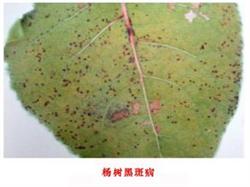
Detailed Explanation of Prevention and Control Methods and Occurrence Patterns of Poplar Black Spot Disease
Poplar black spot disease, also known as poplar brown spot disease, generally occurs on young leaves, tender shoots and fruit clusters, spreading from top to bottom, mainly damaging leaves. In the early stage of the disease, needle-like sunken shiny small spots first appear on the underside of leaves, then the lesions expand to about 1 mm, black, slightly raised, and brown spots also appear on the upper side of the leaves, 5-6 days...
-
Occurrence Patterns and Control Methods of Cherry Brown Spot Shot Hole Disease
Symptoms: Small brown, grayish-brown, or purplish-brown spots initially appear on the leaves, gradually forming circular lesions that are non-water-soaked and opaque, with no yellow-green halo around the lesions, 2-4 in diameter, with clear boundaries and a purplish-brown outer margin. In the later stage, the center turns white or brown, slightly zonate, and the lesions die and fall off, forming irregular shot holes. 2. Occurrence patterns: The pathogen overwinters on fallen leaves and spreads by wind and rain in the following spring. The disease begins in June, with the peak period from August to September. Heavy rainfall promotes disease occurrence and epidemic, and weakened tree vigor leads to severe disease. 3. Control methods:
-
Cotton and lily intercropping planting pattern
Cotton and lily intercropping is a cotton-field intercropping pattern widely used in coastal and riverside dryland sandy loam areas. The two crops affect each other little and are mutually beneficial in fertilizer use, but note that lily cannot be continuously cropped and must be rotated to a different crop. This intercropping pattern generally has a bed width of about 3 m, with cotton planted in wide and narrow rows, the wide row spacing being 140 cm and the narrow row spacing 50 cm, with 4 rows of cotton per bed. In the wide cotton rows, 6 rows of lily are planted, with a row spacing of 20 cm and a plant spacing of 20-25 cm, at 5000-6000 plants per mu. Cotton is raised as seedlings and transplanted, planted separately on both sides of the bed,
-
Detailed Explanation of the Fertilizer Requirement Patterns of Lilies Throughout the Growing Period
Understanding the fertilizer requirement patterns of lilies at each growth stage is very beneficial for rational fertilization and promoting high yields. The patterns of lily demand for the three major nutrients: 1. Nitrogen fertilizer: The nitrogen absorption rate of lilies varies at different growth stages. At emergence, the nitrogen absorption rate is 3.5537 probit units, and the cumulative nitrogen absorption percentage is 7.4%, equivalent to 0.201 kg of nitrogen absorbed per mu. This indicates that during the seedling stage, in addition to receiving nutrients from the mother bulb, the plant also needs to absorb a certain amount of nitrogen from the soil. 2. Phosphate fertilizer: At emergence, the phosphorus
-
Occurrence Patterns and Control Methods of Black Spot Disease in Impatiens
Black spot disease of Impatiens is an important disease in the production and cultivation of Impatiens. It occurs commonly in our country and causes serious damage, so it should be taken seriously. Symptoms: The disease damages leaves, especially the older leaves in the middle and lower parts, which are susceptible to infection. Affected leaves develop circular or oval spots that are dark brown, 2-10 mm in diameter, with inconspicuous concentric rings and darker edges. When the disease is severe, the spots can expand and merge into patches, and on the spots appear pale green or olive-black mold-like growth, which is the pathogen's conidiophores and conidia. This causes the diseased leaves to shrivel and die.
-
Carbon sink patterns of old-growth Korean pine forests in Changbai Mountain revealed
On December 23, the project "Study on Carbon Sink Function of Old-Growth Broad-Leaved Korean Pine Forests in Changbai Mountain," completed under the auspices of the Jilin Changbai Mountain Forest Ecosystem National Field Scientific Observation and Research Station, passed expert review organized by the Changchun Branch of the Chinese Academy of Sciences in Changchun. Experts held that the integration of multiple methods in this project, along with research on flux changes of components and process mechanisms, has reached the international advanced level. As the main body of terrestrial ecosystems, forests' carbon cycle processes and mechanisms play an important role in understanding forest carbon sink functions and their impact on and response to global climate change, while old
条件筛选