-

How to water bark-grown Phalaenopsis orchids in summer and do they need more water?
As soon as summer arrives, the pots of those Phalaenopsis orchids planted in bark dry out completely - time to water? But I've heard that Phalaenopsis roots are delicate and too much water easily causes root rot... This punishing summer, what on earth should be done with them? Bark-grown Phalaenopsis orchids can't just be watered carelessly in summer. Bark has excellent air permeability, and when watered too much
-

Do water-soaked patches on Phalaenopsis leaves mean too much sun, and how should they be treated?
When water-soaked patches suddenly appear on the leaves of a home-grown Phalaenopsis. Some people, at first sight, think "Is it because it got too much sun?" Actually, this matter is not that simple. Today I will talk with you about the ins and outs of these water-soaked patches, and how to deal with them. Could too much sun cause this
-

During peak chikungunya season, mosquito prevention brooks no delay! These 4 "natural mosquito-repelling guardians" - just place the right green plants at home and mosquitoes will retreat! Retreat! Retreat!
As soon as summer arrives, mosquitoes seem to shift into double speed, buzzing around people, not only leaving itchy bites all over but, more frustratingly, they may also carry various viruses, such as chikungunya fever, which has been frequently mentioned lately. The disease sounds tongue-twisting, but when it strikes it is truly brutal - persistent high fever, joint pain as if your body is being taken apart, just thinking
-

Does the Phalaenopsis orchid fear the sun, and what should be done if its leaves dry out after sun exposure?
In the morning, when you open the curtains and look at the Phalaenopsis orchid on the balcony, should you let it get some sun? Some people say, "Flowers need sun to bloom vibrantly," but you also worry that too much sun will make the leaves dry up like greens that have been drained of water, which is really puzzling. Phalaenopsis orchids aren't unable to get sun; they fear that kind of "harsh sun." Their native environment is under the shade of trees in tropical rainforests, and they simply can't grow in places that are exposed to strong sun all day. So if you're growing them at home, you need to find a "semi-shaded" spot for them - the slanted morning sun before 9 a.m. is fine for a while, but the strong light at noon and in the afternoon must absolutely be blocked. Healthy Phalaenopsis orchid leaves are glossy, thick, and neatly edged. If they get too much sun, the leaf tips first turn scorched yellow, and in severe cases, the entire leaf will wrinkle and turn gray, feeling dry and rough, as if it has been roasted.
-
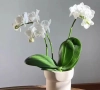
Why Are the New Leaves of Your Phalaenopsis Orchid Splitting, and How Should You Handle It?
Phalaenopsis orchids (moth orchids) are elegant and beautiful, but when the new leaves suddenly split, it really ruins their looks! In fact, it is mostly due to a few care details being done poorly. Today I will help you pinpoint the causes, with simple solutions attached. Cause 1: The environment is too dry. Phalaenopsis orchids like moisture; when the air humidity drops below 50%, the new leaves lose water and become brittle, making them easy to "split open," especially in warm
-

Reasons and Solutions for Phalaenopsis Leaves Turning to Water and Falling Off
The worst thing about growing Phalaenopsis is encountering leaves turning to water - originally plump leaves suddenly become soft, turn yellow, and rot at the slightest touch. If you are not careful, the pathogens will spread, and the whole plant may even wither! Don't panic, as long as you deal with it promptly, there is a good chance it can be saved ~ Emergency treatment: stop the damage first! Prevent the pathogens from spreading 1. Resolutely remove diseased leaves. When you find leaves
-

Do fig trees prefer shade or sun? A detailed guide to planting methods and precautions
How could anyone's sweet summer list be missing figs! That "honey fruit" hidden in the leaf axils bursts open into dense, soft, glutinous flesh, with sweet juices melting on the tip of your tongue - even elderly people and children with poor teeth can happily gnaw on them~ No wonder that once the fruiting season from June to November arrives, everyone online is showing off their own fig harvest!
-

After the Start of Autumn, These 5 Types of Green Plants Must Be Pruned; Miss the Golden Window and Next Year's Blooming Will Be Halved
Once the Start of Autumn passes, the weather gradually cools down, and the green plants at home should also change their "state." At this time, you can't just wait for them to grow on their own; the ones that need pruning must be pruned ruthlessly, otherwise they won't grow well in autumn and won't have any vigor when spring comes next year. Today I'll talk with everyone about which green plants must be pruned after the Start of Autumn and how to prune them correctly,
-

Aerial Roots of Phalaenopsis: The Ins and Outs of Dry vs. Wet, and What Causes Them to Dry Out
Anyone who grows Phalaenopsis orchids is surely impressed by those few aerial roots sticking out of the potting medium -- either wrinkled like sun-dried preserved mustard greens, or plump like a sea cucumber full of water. So should these things be dry or wet? And if they dry out, how do you save them? Actually, the aerial roots of Phalaenopsis can't be too dry, nor should they be wet all the time; they need
-

What flowers and green plants are good to grow in August? Five heat-tolerant, cold-tolerant, easy-care varieties
August weather is hot and muggy, but actually quite a few flowers and plants love to "put on a burst of energy" at this time, especially those that are both heat-tolerant and tough, which can easily fill a pot with just casual care. Today I will recommend five kinds that even beginners can easily handle. Rain lily: Rain lily, just hearing the name tells you how tough it is. Summer is when people fear
条件筛选