Can Soybeans Be Saved for Seed Yourself? Seed-Saving Practices During Cultivation and After Harvest
Soybean cultivation and management techniques, among which the soybean seed-saving method is a task every farmer must do. As soybeans are being harvested one after another recently, Agri-Media invited Zhou Guolong, associate researcher and branch station chief of the Qinan Branch Station of the Kaohsiung District Agricultural Research and Extension Station of the Council of Agriculture, who is known as the "Edamame Prince" and has long studied edamame and promoted domestically grown soybeans, to share the points to note when saving seed.
Soybean cultivation and management techniques, among which the soybean seed-saving method is a task every farmer must do. As soybeans are being harvested one after another recently, Agri-Media invited Zhou Guolong, associate researcher and branch station chief of the Qinan Branch Station of the Kaohsiung District Agricultural Research and Extension Station of the Council of Agriculture, who is known as the "Edamame Prince" and has long studied edamame and promoted domestically grown soybeans, to share the points to note when saving seed.
Edamame and soybeans are saved for seed in the same way, generally by saving seed from the autumn crop or the autumn-to-winter crop. The most important principle of seed saving is to select the best seeds, and their quality must also be higher than that required for produce.
If the soybeans are for produce, there is relatively less need to worry about mixing with other varieties; for example, soybean Kaohsiung No. 9 and Kaohsiung No. 12 look similar in appearance and are easily mixed together. But soybeans used for seed saving must ensure varietal purity, keeping soybeans of different varieties separated.
If the saved seed is not pure, it will not only affect yield, but purchasers will also have to spend extra labor handling it after buying it in, and may refuse to accept it.
1. During cultivation
Seed saving requires attention from the very beginning of the germination stage. If the variety you want to save is one that bears white flowers, the lowermost hypocotyl is green; if it is a red-flowered variety, the base is purple. First decide which flower color the variety you want to save has, then watch during the germination and flowering stages for any mixing. This process is called "removing the false and the mixed."
In addition, it can also be identified by height. If what you want to save is a shorter variety, then during cultivation any taller variety found mixed in must be removed, and vice versa.
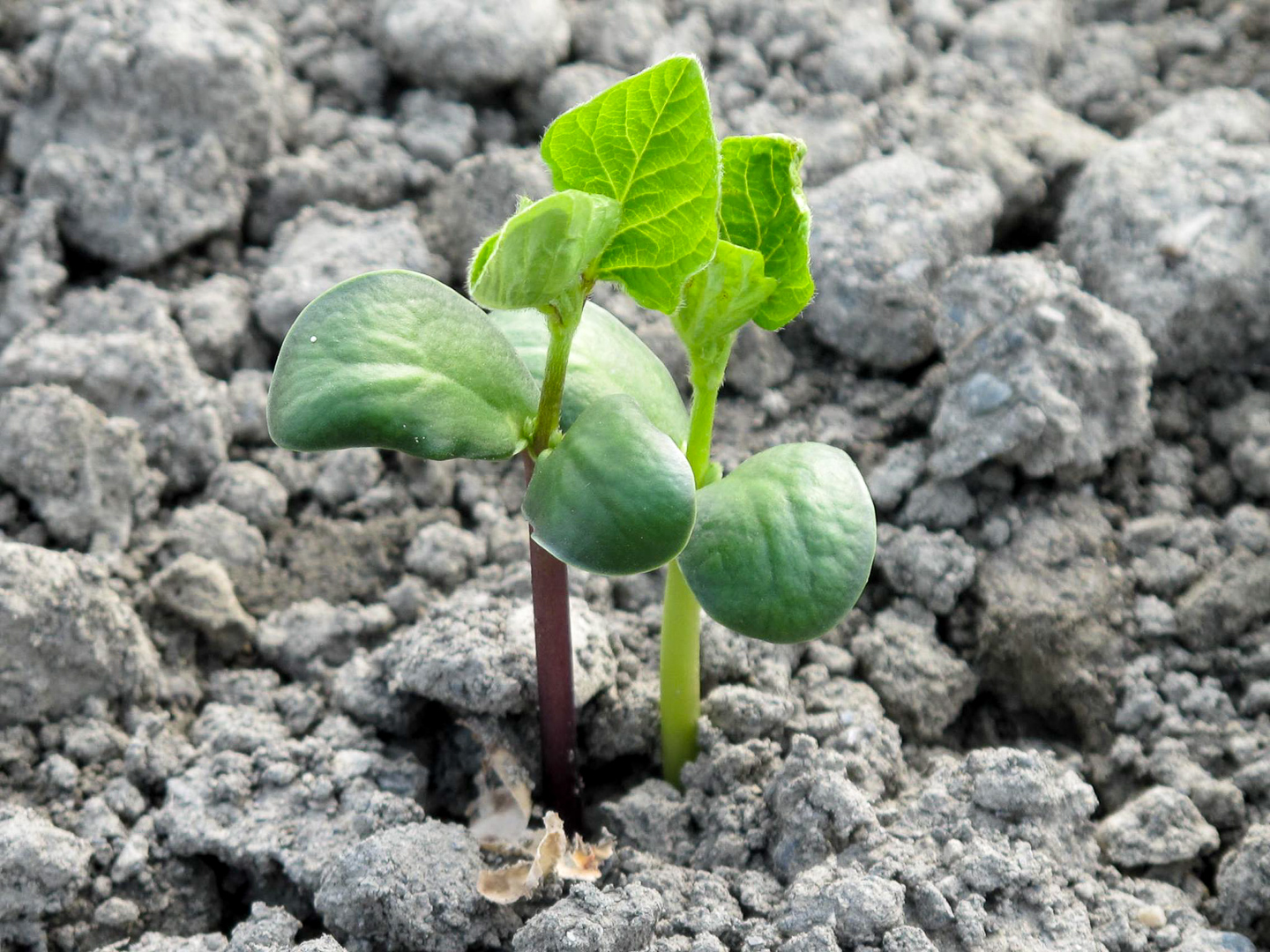
Soybeans used for seed saving must be ensured to be of varietal purity, which can be identified by whether the color of the hypocotyl (at the arrow) is uniform.
If it is a soybean variety that bears white flowers, the lowermost hypocotyl is green; if it is a soybean variety that bears red flowers, the lowermost hypocotyl should be purple.
Different varieties of soybeans also have different hypocotyl colors. In the photo above, soybeans of different varieties have already been planted mixed together, which is unfavorable for future seed saving.
2. After harvest
The conditioning process after harvest also determines varietal purity. Conditioning includes drying, sorting and storage. Sorting is divided into large, medium and small beans. Nowadays edamame almost always uses large beans as seed; because yellow soybeans or black soybeans are originally medium or small beans, medium beans are usually chosen as seed, while small beans are sent to processing plants to be ground into powder or made into soy milk and tofu.
After the seeds are brought in, they must first be dried and graded by size with a grading and sorting machine. Special attention must be paid to the drying temperature. Soybeans for produce can be dried at a slightly higher temperature, and it is fine as long as it does not exceed 40°C; however, those used as seed must be dried at a low temperature so as not to damage the germ, and the seed coat should also be kept from breaking as much as possible. The drying temperature may vary depending on the equipment; usually a general open-type dryer is 35 to 37°C, and a closed circulating type is 32 to 34°C.
For storage, large-pack space bags or medium-sized feed bags can be used. Feed bags usually have a layer of plastic bag inside; after sealing, they can be placed in a cold storage room.
In fact, farmers almost all know how to save seed; the reason for failure may be that the earlier steps and techniques were not done well. Even if farmers already have the seed on hand at the front end, if they are too lazy to remove the false and the mixed, the seed purity will not be pure, and the final cultivation results and yield may be less than ideal, wasting all the previous effort.
The principle of seed saving is to select the best seeds, and their quality must also be higher than that required for produce.