Introduction to the Agronomic Characteristics and Plant Traits of the Super High-Yield New Soybean Variety Tainan No. 7
The new green manure soybean variety Tainan No. 7 was developed by the Tainan District Agricultural Improvement Station through single-plant selection and pure-line breeding from green-pod bean and local green manure soybean landraces. Thissoybean cultivation costshould not be low!
Tainan No. 7has strong early growth vigor, high fresh plant biomass, tolerance to moisture, drought and cold, and stronger weed suppression than other green manure soybean varieties. Its growth period is longer than that of the green-pod bean landrace, and its field coverage is complete. It can be used for green manure cultivation in two cropping seasons of fallow fields or for orchard sod culture. In November of year 91 of the Republic of China calendar, it was approved for promotion by the Crop New Variety Registration and Naming Review Panel convened by the Council of Agriculture, Executive Yuan.
After our country joined the World Trade Organization, how to effectively adjust rice production area and encourage the planting of green manure crops in fallow fields to maintain soil fertility and rural landscapes has become a necessary measure for current agricultural development. In the past, agriculture emphasized production, and the time land could rest was short, so planting the short-term green manure sesbania was quite suitable. Howeverthe current fallow period lasts as long as 123 ∼137 days, and if there are two fallow periods in a year, the number of fallow days exceeds 200, so the required green manure crops will favor those with longer growth periods. Because sesbania plants become lignified, it is more suitable for mechanical incorporation within about 60 days after cultivation, meaning that one fallow cropping season requires two consecutive plantings to achieve the effect of one planting of green manure soybean, increasing the costs of land preparation for sowing and incorporation. In addition, sesbania pests are increasingly spreading and seriously harming crops, further highlighting the need for diversification of green manure crop species and varieties in fallow farmland.
Characteristics of the New Variety
1. Agronomic Characteristics
1. Growth habit: Germination occurs about 3∼7 days after sowing. Days to flowering are about 52∼93 days in the spring crop, 49∼85 days in the summer crop, and about 40∼53 days in the autumn crop. Growth duration is 203∼210 days in the spring crop, 175∼186 days in the summer crop, and 88∼100 days in the autumn crop. It is sensitive to light, and the plant grows prostrate and is of the indeterminate type.
2. Maturity: late-maturing.
3. Suitable planting time:
(1) Green manure cultivation: can be planted throughout the year.
(2) Orchard sod culture: can be planted throughout the year.
(3) Seed production: in the Tainan area, production can be carried out from late August to mid-October. For manual harvesting, late August to late September is the best sowing period; for mechanical harvesting, mid-October is the best sowing period.
4. Disease resistance: without inoculation with pathogens and without pesticide control, this variety showed no purple seed stain or powdery mildew, and its infection rates for downy mildew and rust were lower than those of Huwei green-pod bean.
5. Insect resistance: the damage ratio of insect holes on leaf area was lower than that of Huwei green-pod bean.
6. Coverage period: the growth period of the spring crop is about 200 days, and the field coverage period is maintained for 150 days. In orchard sod culture, the branches and leaves cover the soil surface and dry up at maturity without the need for plowing. By the following spring, it can be resown, or after the plants naturally dry up, proper irrigation can allow the seeds in the pods to germinate and regenerate, eliminating the need for replanting and saving the cost of one land preparation and sowing.
7. Yield:
(1) Fresh grass yield: at 80 days of growth, 19,933 ∼ 45,000 kg per hectare in the spring crop, about 22,150 ∼ 41,500 kg per hectare in the summer crop, and about 24,700 kg per hectare in the winter crop.
(2) Seed yield: manually harvested yield per hectare is 2,014∼3,344 kg, and mechanically harvested yield is about 1,958 kg.
2. Plant Traits
1. Plant: the average coverage height is 61.3 cm in the spring crop and 62.8 cm in the summer crop; in orchard sod culture, the main stem of the spring-sown crop can reach 325∼372 cm, while in autumn seed production the main stem length is about 112∼171 cm, with about 2.9∼3.7 branches. The number of main stem nodes is 15.7∼20.1.
2. Seedling: young stem purple.
3. Stem: mature stem green.
4. Leaf: trifoliolate, leaflets ovate, leaf color bright green.
5. Flower: purple.
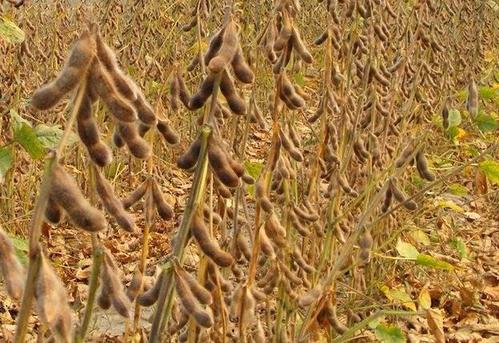
6. Pod: pod shape sickle-like, dark brown, covered with brown pubescence, 2 ∼3 seeds per pod.
7. Seed: elliptical, seed coat brown, cotyledons yellow, hilum brown, 100-seed weight 7∼9 grams.