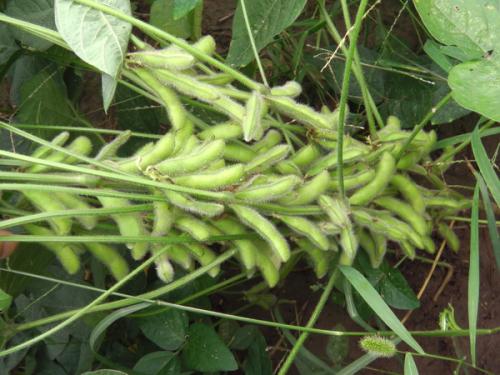
Differences Between Soybean Green Manure Varieties Tainan No. 4 and Tainan No. 7 and Their Yields
Soybeans are something we can often see in our daily lives. This agricultural product is needed for many of our agricultural by-products, so it is a highly valuable crop! Below, two soybean varieties are introduced. These are different from hyacinth beans, but the planting method is the same as the planting method for hyacinth beans!
Green manure soybean
There are extremely many varieties of soybeans used for green manure, including yellow soybeans, green-skinned beans, black beans, and others. They prefer warm and humid conditions and adapt to cultivation throughout the province. The seeds have great value as a nutritious food, and the rhizobia in the roots have a nitrogen-fixing effect. The stems and leaves have a high nitrogen content, making this an important and excellent green manure crop in the country. The seeding rate per hectare depends on seed size: small-seeded varieties (100-seed weight below 12 grams) 30-50 kg, medium-seeded varieties (100-seed weight 12-18 grams) 50-60 kg, and large-seeded varieties (100-seed weight greater than 20 grams) 60 kg or more. For green manure soybeans, the appropriate incorporation period is 80-100 days after sowing (around the green-ripe pod stage), when the biomass is relatively high and the fertilizer effect is good. If incorporated too early, the biomass yield is low and the fertilizer effect is poor. Currently promoted varieties include Tainan No. 4 and Tainan No. 7.
1. Tainan No. 4
Bred in 1999, selected from a local variety of green-skinned beans. The seeds are yellow-green with brown hilum, and the 100-seed weight is 6-10 grams. The seeds are small, and the seeding rate per hectare is only 30-35 kg, saving half the amount compared with ordinary soybean seeds and reducing the cost of green manure cultivation. The plant type is erect, with a plant height of 60-108 cm. The lowest pod position is at least 10-12 cm above the ground, allowing mechanical seed harvesting. The flowers are purple. The sowing period is from February to August. It has great adaptability to the cultivation environment. After sowing, it can achieve complete field surface coverage in 50-60 days and maintain field coverage for 120-150 days. At 80 days of growth, the fresh grass yield is 20,000-37,000 kg, and the plant nitrogen content is 113-251 kg. It is suitable for first and second crop green manure cultivation in paddy and upland fields and for autumn crop seed propagation and production in Tainan County. At present, the annual promoted cultivation area of Tainan No. 4 reaches more than 25,000 hectares. This variety adapts to growth in the high-temperature and high-humidity environments of spring and summer. The plants do not have a lignification problem, and after planting, mechanical incorporation is easy at any time.
2. Tainan No. 7
Bred in 2002, selected from a local variety of green manure soybean. The seeds are brown, with a 100-seed weight of 7-9 grams, and the seeding rate per hectare is 35 kg. The plant type is erect in the early stage and prostrate in the later stage. The main stem length is 325-372 cm. The flowers are purple. The sowing period is from February to October. The growth duration is 175-210 days. At 80 days of growth, the fresh grass yield is 20,000-45,000 kg, and the plant nitrogen content is 95-211 kg. Tainan No. 7 is suitable for green manure cultivation in paddy and upland fields in all regions of Taiwan, China. It has strong early growth vigor, high fresh grass biomass, tolerance to both moisture and drought, and a stronger suppressive effect on weeds than other green manure soybean varieties. It has a long growth period and complete field coverage, and can be promoted for green manure cultivation in two crop seasons in fallow fields. It is tolerant to diseases and pests and also strongly cold-tolerant. When planted in early November, at 90 days of growth, the fresh grass yield per hectare reaches 24,700 kg, not inferior to other winter green manure crops, so it can also be used as a winter green manure.