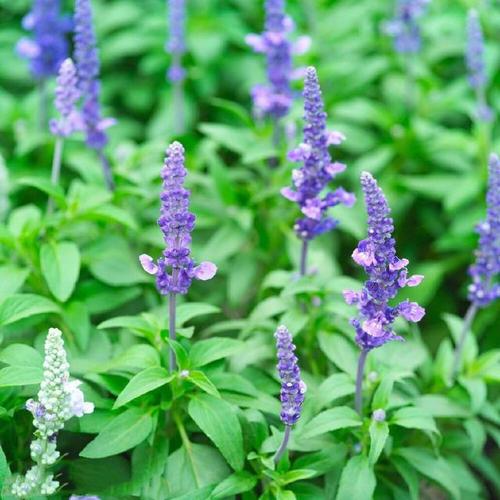
What are the differences and characteristics between true lavender and lavandin?
The difference between lavender and sage is something most people know, but do you know how to tell lavandin and true lavender apart? The biggest difference with lavandin is that it is more "stimulating" and "invigorating," while only true lavender has "calming" and "soothing" properties.
The difference between lavender and sage is something most people know, but do you know how to tell lavandin and true lavender apart? The biggest difference with lavandin is that it is more "stimulating" and "invigorating," while only true lavender has "calming" and "soothing" properties!
As for the aroma, it is recommended to put a drop of each of these two lavenders on a tissue and smell them. The scent of lavandin is stronger and more stimulating, as if carrying a camphor note, and the aroma directly irritates the nasal passages; the aroma of true lavender is clean and fresh, mild, elegant and sweet!
Lavandin: its Latin scientific name is Lavandula intermedia
Lavandin grows at elevations of 400-800 m and, with the help of pollen-carrying bees as matchmakers, it is a variety produced by crossing spike lavender with true lavender. As a result, lavandin has stronger viability and is less prone to disease; it is resistant to insects and drought, has vigorous vitality and a high oil yield. Lavandin likewise carries the energy of family warmth and support and can be included among essential oils to keep on hand. It is not suitable for people with low blood pressure, as it can lower blood pressure; it is suitable for palpitations. Because it has anti-mucosal-inflammatory and expectorant effects, it can be used for respiratory infections. It is suitable for situations requiring long-term pain relief. It can bring people a sense of ease, taking things as they come.
The gray-blue petals of lavandin are relatively large and hard, but its therapeutic effects are said to be relatively fewer, and its price is relatively cheaper. This is because, compared with true lavender, lavandin is more stimulating and invigorating, and only true lavender has calming and soothing properties!
Lavender True: its Latin scientific name is lavendula angustifolia
It grows at elevations above 1000 m. On the surface of the flower spikes, glistening oil sacs can be seen, and under a microscope the epidermal glandular hairs can be seen protecting the oil sacs. The essential oil is distilled from the whole plant after drying. Also known as narrow-leaf lavender or alpine lavender, its leaves are finer and its flower spikes shorter, with low yield; it is mainly composed of esters and its fragrance is light and delicate.
True lavender can be called a universal panacea. The most frequently mentioned therapeutic effect of true lavender is helping with sleep. Lavender, which carries the energy of the mother, is more effective for infants and young children who sleep poorly because of separation anxiety or feelings of loneliness, or for adults whose insomnia comes from fear caused by feeling unsupported and unable to obtain the basic necessities of survival. It is often used to soothe emotions, calm and aid sleep, activate new cell growth, lower blood pressure and so on. The effect everyone is most familiar with is none other than its relaxing effect and its antidepressant effect; this comes from the fact that the essential oil itself can activate the body's parasympathetic nervous system, and thereby allow the body to relax. Many sources show that after using lavender, its effect can be comparable to that of certain sleeping pills, and it has no notable side effects; in experiments, its acceptance was also very high.
Compared with other varieties of lavender, it is milder, and even babies can use it at low doses. It is one of the few essential oils that can be dotted directly onto the skin undiluted.
Because the annual demand for lavender essential oil is very large, the output of true lavender has not increased especially, while instead the rise of lavandin means that in terms of production it can be said to have gradually replaced the position of true lavender. When buying true lavender, it is recommended to choose a trustworthy brand, otherwise you may pay a high price and end up being a sucker!
In summary, lavandin is similar to true lavender in some uses, but its relaxing effect is far inferior to that of true lavender, and it is not suitable for states that require sedation.