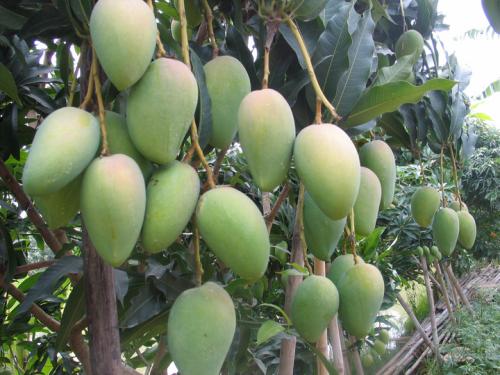
Mango production up 17%, Agriculture and Food Agency confident it can keep prices stable
This year, the climate during the flowering and fruiting stages of mango cultivation was suitable for mango growth. The Agriculture and Food Agency estimates that mango production will increase by 17% compared with last year. According to statistics from the Agricultural Products Market Trading Information Station, arrivals at the Taipei auction market this week increased by nearly 30% compared with the same period last year, and prices also fell by about 20%, to NT$53.6 per kilogram. The Agriculture and Food Agency stated that some fruits have reduced production due to natural disasters, and mangoes are expected to provide an alternative choice. Mangoes can also be made into various processed products. Although prices are lower, they will still remain at a certain level.
According to statistics from the Council of Agriculture, as of 2018, the planted area of improved mango varieties in Taiwan, China (such as Irwin and Jinhuang) reached more than 13,000 hectares. Production areas are concentrated in Tainan, Pingtung and Kaohsiung, among other counties and cities, with Tainan City having the largest area at 6,775 hectares.
Last year, affected by factors such as low temperatures and water shortages, flowering and fruiting in various mango production areas were poor. Last year's production was 128,365 metric tons. This year's winter climate, with little rain, is suitable for mango growth, and total production is estimated to reach 149,665 metric tons, an increase of 17% over last year and an increase of 14% over the average annual production of 131,550 metric tons.
Hsu Hui-fei, a section chief of the Agriculture and Food Agency, said that mango production has indeed increased, but besides being eaten fresh, mangoes can also be made into various processed products, such as mango ice and dried mango. This year, summer fruits including lychees and watermelons have reduced production due to natural disasters, which will create a substitution effect. Therefore, mangoes can still maintain a certain price level.
Yao Chih-wang, director of the Southern Branch of the Agriculture and Food Agency, said that overall production in Tainan this year has returned to normal. At present, sporadic harvesting of Tainan mangoes has begun, and prices still depend on quality and specifications. On the 30th, the average price of Irwin mangoes at the Yujing fruit and vegetable market was NT$44 per kilogram. Exporters to Japan and farmers in production areas have also successively completed contracts, and are expected to begin purchasing mangoes in their jurisdictions in mid-June for domestic and export operations. In order to improve fruit quality and increase marketing channels for farmers, the Southern Branch is also actively guiding farmers to participate in traceability certification to comprehensively improve agricultural product safety and increase marketing channels as well as consumer preference and trust.
In addition, regarding exports, Agriculture and Food Agency Director Hu Chung-yi said that many Japanese traders still hope to order mangoes from Taiwan, China. Even with such a large increase in mango production, they are still snapped up, and they can even be asked to place orders for next year's mangoes.