Composting Techniques Are on the Verge of Being Lost: These Old Methods Are Worth Learning
Driving through downtown Shanhua and turning onto the field paths, it is hard to imagine that such a hidden paradise could exist within the living circle of the Southern Taiwan Science Park. From a distance we saw an elderly couple smiling broadly and waving at us - and yes, this was rice-growing expert Hong Guosheng and his wife. The auntie said, "The uncle has been waiting for you out here since early morning. He has a bad cold, so I told him to wait inside the house to avoid the wind, but he insisted on waiting outside." The uncle waved his hand to signal his wife to stop talking, and at the same time pulled us toward the house. From this couple we saw the tenderness they have for each other, and we also learned the older generation's way of receiving guests.
After entering the house, the uncle brought out the rice he grows and said, "The rice I grow has a very springy texture, and it does not go bad when kept for a long time. This is the healthy rice I ate as a child." Behind the uncle's beaming smile, however, was a past of tightening his belt in order to protect the land and health. Knowing this story filled me with emotion and admiration. Last year I quit my job and resolved to go into farming, insisting on natural farming methods, and I was going through days of ”zero harvest.” Hearing the uncle's story gave me the strength to keep going.
Walking in the uncle's fields, I, also a farmer, could tell at a glance that this was a rice paddy rich in ecological life, with earthworms moving through it and frogs croaking back and forth. He said that for 25 years he has insisted on using no chemical fertilizers or pesticides, so the field's natural ecology is abundant.
When the uncle was young, he collapsed and was sent to the hospital three times from pesticide poisoning. Lying on the hospital bed, scenes of farming without pesticides from his youth kept surfacing in his mind, so he decided to give up conventional farming methods and switch to natural farming, only to encounter repeated failures. In 1989 the government sent farmers to Japan to learn EM microorganism composting in order to promote organic agriculture. Because Uncle Hong Guosheng had received a Japanese education and was fluent in Japanese, he served as the group's interpreter. After returning to Taiwan, the uncle continually tested the knowledge he had learned, and after 16 years finally created a miracle, successfully growing local crops with EM microorganisms. Having been vegetarian for many years, Hong Guosheng and his wife, in gratitude for heaven's unseen arrangements, vowed to teach EM microorganism composting for free so that pesticide incidents would never happen again.
This interview happened because the uncle, now 89 years old, worried that the composting technique would be lost, and he specially opened a demonstration class. When I heard the news, of course I would not miss it. I also recorded the whole process, hoping to pass on the uncle's technique seamlessly.
On the day of the demonstration class, dozens of students came from all over the province, showing the charm of the uncle and EM microorganisms. The uncle, with a cold, began explaining in a hoarse voice and prepared to demonstrate EM microorganism composting. Before visiting, we had already learned that the uncle had a bad cold and had suggested postponing the class, but the uncle said, "I do not know when I will pass away. My body can still handle it now, so I must teach quickly." This spirit of benefiting the world is truly admirable, and it also made us determined to learn EM microorganism composting well no matter what, so as not to waste the uncle's painstaking effort.
P.S. From the visit in late March to the day this article was completed, more than three weeks have passed, and the uncle's cold still has not healed. I pray that heaven will protect this national treasure and bless the uncle with a speedy recovery.
[Uncle Hong Guosheng's EM Microorganism Composting Method Fully Revealed]
1. Material Formula
Before deciding to compost, you must first determine the area to be fertilized. About 100 kg of EM microorganism fertilizer can supply one fen of land for one application. Taking rice as an example, fertilizer must be applied once right after transplanting, and again before heading. One rice crop requires two applications in total.
The material ratio is as follows:
Sesame meal powder : rice bran : fish meal : water : EM microorganism stock solution : molasses = 100 : 100 : 50 : 70 : 0.3 : 0.3 (by weight)
Calculating the cost according to the material ratio, EM microorganism fertilizer costs much more than commercially sold organic fertilizer.
The uncle said, "Being able to let everyone eat healthy agricultural products while also taking care of the environment and ecology - this effort is worth it."
P.S. Sesame meal powder can be replaced with soybean meal powder
2. Mix the Solid Raw Materials (sesame meal powder, rice bran, fish meal)
Pour all the weighed sesame meal powder, rice bran, and fish meal together, then use a shovel to mix the three raw materials evenly. Do not underestimate this work. This work drained all my strength. The next day my shoulders were sore, my hands could not be raised, my legs ached, and for several days I walked like a robot. The experienced uncle, while guiding us, kept shoveling fertilizer, and his stamina and skill far surpassed us young people. All of this comes from years of accumulated experience!
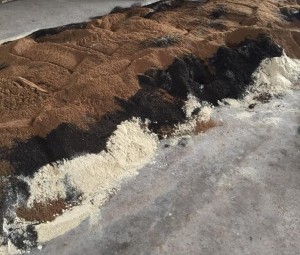
8. From the fourth day to the twelfth day after composting, the temperature must be measured every day. If the temperature exceeds 50 degrees, the pile must be turned.
9. On the twelfth day after composting, the measured temperature is 48 degrees, and it is time to bag it. Before bagging, turn the pile first and then bag it. That completes it. As long as the bagged fertilizer is not placed in sunlight, it can be stored for more than two years.
After finishing learning about composting, we prepared to leave.
During these few days with the uncle, I could feel that he has a strong sense of mission.
In the past, powerful humans, in order to expand their living space, arbitrarily used pesticides and chemical fertilizers to dominate the fate of animals and plants, yet destroyed the original face of nature. It is time to change. Let us relearn how to coexist peacefully with nature. This should be the idea the uncle wanted to convey!
P.S. EM microorganisms ( Effective Microorganisms ; probiotics) composting has been popular in Japan for more than 30 years. It can inhibit the reproduction of pathogens, decompose chemical substances, purify the environment, increase antioxidant capacity, and improve human immunity, so it is regarded as one of the best development directions for ecological agriculture.
If you want to learn about EM microorganism-related questions, you can ask on Facebook at ”Yangge Organic Farm.”
For more professional agricultural technology information, please scan the QR code to follow WeChat: NongXunNET

Please indicate the source when reprinting.