What Is the Fall Armyworm? A Detailed Guide to Its Damage, Impact and Control Methods
The fall armyworm is a moth native to the tropical and subtropical regions of the Americas, and is recognized by the United Nations Food and Agriculture Organization (FAO) as a major global agricultural pest. It is also a common corn pest.
The larvae of the fall armyworm eat many different crops, feeding mainly on corn, though they will also eat most other crops, including rice, sorghum, millet, sugarcane, vegetables and even cotton.
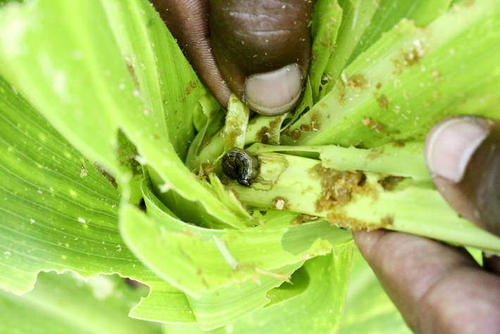
The egg masses of the fall armyworm are covered with large amounts of the female moth's abdominal hairs, giving them a fuzzy appearance; the mature larvae that hatch can be recognized by two external features: a yellow inverted Y shape on the head, and 4 spots on each body segment along the back.
The impact caused by the fall armyworm
The fall armyworm has already caused agricultural losses in a considerable number of regions around the world; in parts of Africa, as much as 70% of crops have been damaged by the fall armyworm, and according to a CNN report it has caused losses of about 6 billion US dollars (about 186 billion New Taiwan dollars), which should not be underestimated.
The fall armyworm has already invaded multiple provinces in southern China, and will have a major impact on grain crops produced domestically in China, including soybeans and corn, which cannot avoid the pest damage. Combined with the ongoing China-US trade war, China is expected to raise import tariffs on American goods, but a large proportion of China's grain imports come from the United States, including wheat, corn and soybeans, and the dual impact of the pest damage and the trade war is very likely to further push up domestic grain prices in China.
Taking corn, the favorite food of fall armyworm larvae, as an example, the most likely places for them to appear are: the underside of the corn plant's leaves, the corn ears, and the whorl of leaves at the top. Fall armyworm larvae do not start eating from the edge of the leaf, but instead bite a hole directly in the middle of the leaf.
According to information from the Centre for Agriculture and Bioscience International (CABI), after the fall armyworm larva has stayed on the plant for 14 days, it drops down into the soil, and after about 8-9 days it emerges as an adult. After mating, the adults begin searching for a place to lay eggs; a single female fall armyworm can lay about 100 eggs at a time, and about 1000 eggs over its lifetime, with one generation having a lifespan of roughly one month.
Control methods for the fall armyworm
At present there is still no low-cost method for eradicating the fall armyworm on a large scale, and once it invades, it is very difficult to eradicate because it spreads quickly. However, quite a few control methods have actually been developed for the fall armyworm in the Americas. In the United States, for example, the main approach at present is to use genetically modified crops, combined with biological control using the fall armyworm's natural enemies, or combined with the use of related pesticides.
However, the cost of these methods is relatively high, especially the use of genetically modified crops, which is relatively hard for farmers in parts of Africa and Asia to afford, since most of them are smallholders. The United Nations Food and Agriculture Organization has also already been cooperating with governments of various countries, providing pest control advice and assistance suited to each country's situation.