What harm do bacterial fruit blotch of melons and watermelons cause? Prevention and control of bacterial fruit blotch of watermelon
In Taiwan, China, between 1992 and 1993, in the coastal areas of Yunlin County and the Shanhua area of Tainan County, sporadic findings were made of large watermelons showing irregular water-soaked, slightly cracked lesions on the fruit surface, occurring mainly during the rainy season. The lesions spread over the rind and did not harm the flesh in the early stage.
In May 1997, on the surface of muskmelon fruits in the Yilan area of Taiwan, China, symptoms resembling damage by melon fruit flies appeared. The lesions did not expand, and when the fruit was cut open no insect bodies were found, but the flesh was brown-rotted. It was confirmed to be caused by the same pathogenic bacterium as bacterial fruit blotch of watermelon. At the same time, because it coincided with the rainy season, under high-temperature and high-humidity conditions, outbreaks were also reported in the Taitung and Hualien areas. In the Taitung area, the damage rate in some watermelon fields approached 20%; subsequently, in the Longjing area of central Taiwan, small watermelons showed diseased fruits different from those of large watermelons and resembling those of muskmelon. In August, in Jialixing, Tainan County, the diseased fruit rate of netted muskmelon grown in the open on about 7 hectares reached 40%, causing heavy losses to farmers. In April 1998, damage was successively reported in open-grown muskmelon fields in Dalin, Chiayi County, Xuejia, Tainan County, and Nanzi, Kaohsiung County. In May and June, muskmelons in the Yilan area were damaged again, and the damage rate was more severe than in the previous year.
Pathogenic bacterium and symptoms
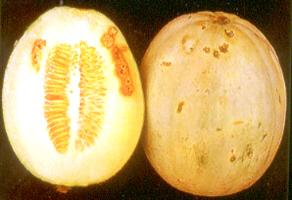
The pathogenic bacterium A. subsp. citrulli (formerly named Pseudomonas pseudoalcaligenes subsp. citrulli) is a Gram-negative rod-shaped bacterium. Besides damaging watermelon and muskmelon, by artificial inoculation it can infect other cucurbit crops, tomato, pepper and eggplant. Symptoms vary with host species and variety. The typical symptom on muskmelon fruit is small spots on the rind, dark brown or olive-colored, with or without a water-soaked halo. The spots on the rind mostly do not expand, but the pathogenic bacterium has already invaded the flesh tissue, causing water-soaked, brown rot or suberized symptoms; some varieties show irregular water-soaked patches on the rind. In the early stage of disease, the lesions are confined to the rind, but in the middle and late stages the pathogenic bacterium also spreads toward the flesh. Besides damaging the fruit, the cotyledons, true leaves and stems can all be affected. The symptom on true leaves resembles downy mildew and is limited by the leaf veins, but it spreads along the veins, appearing dark brown and water-soaked. Under high-humidity conditions, milky-white traces exuded by the pathogenic bacterium can be seen on the lesions. When young leaves are infected and the disease does not continue to spread, the lesions rupture and the leaves become deformed. Damage to the stems forms water-soaked brown lesions that gradually enlarge and cause wilting. When leaves and stems are severely diseased, besides affecting plant vigor, they become the main source of infection damaging the fruit.
Leaf lesions on muskmelon, where milky-white traces left by the pathogenic bacterium exuded from the lesions can be seen
The typical symptom on watermelon fruit is that on the upward-facing rind of the watermelon fruit, small water-soaked spots first appear, then gradually expand into irregular large olive-colored water-soaked patches. In the early stage of disease, the lesions are confined to the rind and the flesh tissue remains normal, but the commercial value of the watermelon is already seriously affected, and it cannot be stored because in the middle and late stages of disease the infected rind also shows cracking. The pathogenic bacterium can spread to the flesh alone or together with saprophytic microorganisms, causing the flesh to rot. After some varieties of fruit are infected, only cracked small brown spots appear on the rind, without obvious olive-colored water-soaked patches, but the pathogenic bacterium has already invaded the flesh tissue and caused severe water-soaked symptoms. On watermelon cotyledons, water-soaked spots appear and then turn into brown necrotic lesions, often accompanied by a yellow halo. Infection of true leaves forms inconspicuous small brown spots, with little direct effect on the plant, but these are the main source of infection for fruit infection. In fields in the Taitung and Tainan areas, bacterial fruit blotch of bitter melon was found on the two varieties "Gaoyue" and "Yuehua," and the bacterial strains isolated from diseased leaves and fruits have been confirmed to be A. subsp. citrulli.
Control measures
The pathogenic bacterium can contaminate and attach to the seed coat during seed harvesting and washing, and it has also been confirmed to contaminate the endosperm inside the seed. After contaminated seeds were stored at 12°C for 12 months, the transmission ability of the pathogenic bacterium was not reduced. After plug trays containing soil, medium and organic residues of watermelon root fibers were soaked in a suspension of the pathogenic bacterium and stored at 4°C, the pathogenic bacterium could survive for only 63 days, and its survival ability decreased as the temperature rose. Seed contamination is the main transmission route of this disease, and naturally contaminated watermelon seeds show a very high disease incidence after sowing. If diseased fruits or plant residues are left to rot in the field, they can all become an important source for the next crop, while how long the pathogenic bacterium can survive in other weeds or soil remains to be investigated.
Treating seeds with hot water at 50°C, fermentation mixed with watermelon juice and residues, dilute hydrochloric acid, sodium hypochlorite or calcium hypochlorite can all reduce the rate of seedling infection, but cannot remove the pathogenic bacterium inside the seed. Tests have confirmed that soaking muskmelon or watermelon seeds in 1% hydrochloric acid for 20 minutes, then rinsing with running water for 20 minutes, air-drying and sowing can reduce the disease incidence. Overhead irrigation and rainwater are important routes for the spread of the pathogenic bacterium in greenhouses and fields. Many watermelon or melon seedling nurseries, because of contaminated seeds plus sprinkler irrigation for water supply in the facility, had 100% of seedlings diseased, causing heavy losses. Before the waxy layer of the rind has completely covered it, the pathogenic bacterium easily enters through the stomata, whereas in mature fruits, because the stomata of the rind are covered by the waxy layer, the pathogenic bacterium can only infect through wounds. In inoculation tests, it can be found that the younger the watermelon fruit, the higher the disease index. During the pollination period of melon, inoculating female flowers with the pathogenic bacterium can cause lesions to appear at the small-fruit stage, so in the field period attention should be paid to control before the small-fruit stage. Chemicals that showed relatively strong inhibition of the growth of the pathogenic bacterium were screened indoors, and three were selected for seed disinfection and field trials. The results showed that after seeds were inoculated with a high concentration of the pathogenic bacterium, soaking the seeds with 81.3% copper hydroxide wettable powder and 10% streptomycin-tetracycline wettable powder until the seeds germinated (25°C, about 24 hours) could reduce the rate of seedling infection.