There Is No Cure for Citrus Greening Disease: Learn These Three Tactics to Leave It Nowhere to Hide
On May 22, I went to Guilin to attend a mandarin orange cultivation exchange meeting. I gained a lot, learned a great deal of new knowledge, and met many big names in citrus technology and expert growers.
But what was surprising was that on such a serious occasion, there were still people advocating that citrus greening disease can be treated. In exchanges after the meeting, it also turned out that fellow attendees were dissatisfied as well. This is because the view that citrus greening disease can be treated misleads growers, not only delaying valuable prevention and control time, but also allowing the disease to spread.
Here we can only sort through the characteristics and prevention methods of citrus greening disease once again, so that more people know the basic facts about it.
Citrus greening disease: incurable!
Citrus greening disease is a devastating infectious disease that occurs in citrus. Its pathogen is a bacterium of the genus Candidatus Liberibacter. At present it cannot be treated, and anyone claiming to be able to cure it is a fraud.
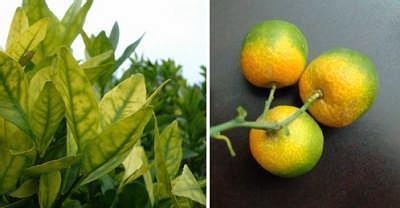
Transmission routes of citrus greening disease
There are two transmission routes for citrus greening disease: one is through grafting; the other is through the Asian citrus psyllid. The Asian citrus psyllid is the only natural vector that spreads this disease in the field.

Prevention and control of citrus greening disease
1. Agricultural control
Eradicate orange jasmine (Murraya paniculata) and wampee (Clausena lansium) in and around the orchard: eradicate already planted Rutaceae plants such as orange jasmine and wampee within 3000 m in and around the citrus orchard.

New shoot management: remove and control shoots, release shoots uniformly, and reduce food for psyllids.

2. Chemical control
Seize the 5 shoot growth periods throughout the year for pesticide application, control psyllids well, and the probability of citrus greening disease transmission can be effectively reduced.
(1) Before spring shoots sprout (February-March): Spray pesticide before spring shoots sprout to kill overwintered adult psyllids and reduce the insect population base for the year. This is the most effective period for killing psyllids in the orchard. Killing one adult psyllid here equals killing 20-300 psyllids in summer and autumn, because 1 adult psyllid can lay 20-200 or more eggs. For the pesticide, choose psyllid-killing agents effective at low temperatures, such as fenpropathrin + triazophos, etc.

(2) Spring shoot period (April): During the spring shoot period, choose pesticides that can effectively control both adult and nymph Asian citrus psyllids and also control aphids and whiteflies. A 20% (isoprocarb + imidacloprid) formulation can be used.
(3) Summer shoot period (May-June): Psyllids and scale insects can be controlled together. A 51.5% (chlorpyrifos + beta-cypermethrin) emulsifiable concentrate can be used.
(4) Autumn shoot period (July-August): During the autumn shoot period, choose pesticides that can effectively control both adult and nymph Asian citrus psyllids and also effectively control citrus leafminer and rust mites. A 10% imidacloprid wettable powder at 1000 times + 20% carbosulfan emulsifiable concentrate at 1500 times solution can be used.

(5) Late autumn shoot period and winter shoot period (September-December): For late autumn shoots that emerge from September to early October, or winter shoots that emerge from mid-to-late October to January, pesticide must be sprayed before shoot removal, then shoots removed. A 20% (isoprocarb + imidacloprid) emulsifiable concentrate and 2.5% synergized bifenthrin at 2000 times can be used.
3. Handling diseased trees
For diseased trees that have already been confirmed infected, pesticide must first be sprayed to kill adult and nymph psyllids on the diseased trees, to avoid driving disease-carrying adult psyllids onto healthy trees. Then cut down the diseased trees as soon as possible and burn the branches.
After cutting, treat the diseased roots cleanly. To prevent the diseased stumps from regrowing leaves, generally use glufosinate, or use the charcoal fire from burning branches and leaves to burn the stumps to death.

Summary
There are many so-called masters who claim they can cure citrus greening disease. They are like the tai chi masters on the internet before: they boast extravagantly, but as soon as real fists are shown, they are immediately knocked down.
Prevention and control of citrus greening disease: planting virus-free seedlings, managing psyllids well throughout the year, and promptly discovering and cutting down diseased trees, that is the path that should be taken.