Latest Treatment Methods for Huanglongbing: Citrus Huanglongbing and Integrated Control
I just happened to write an analysis article on Huanglongbing in southern Jiangxi, titled "Citrus AIDS" Huanglongbing Spreads Across the World's Largest Navel Orange Production Area in Southern Jiangxi: A Natural Disaster and Even More a Man-Made One, which can serve as an answer. There is currently no way to cure Huanglongbing, but if the local authorities can decisively take certain measures and carry out unified prevention and control, southern Jiangxi can still be saved.
--------------------------------------------------------------------------------------------------------------------------------------------
If you have seen the science fiction film "Interstellar," you will certainly remember the crop blight spreading across the Earth. On some future day, crops contract an incurable disease, and patches of corn and okra die off, leaving humanity to wait helplessly for death.
Science fiction mirrors reality. In 2015, in the Ganzhou region of Jiangxi, the world's largest navel orange production area, citrus trees across large areas were infected with Huanglongbing, known as "citrus AIDS." Many farmers could only cut down entire plots of navel orange trees they had planted years before, and they did not dare to plant again.
In response, the Harvest Research Office, through investigation and statistics, found that the large-scale outbreak of Huanglongbing in southern Jiangxi was closely related to years of large-scale unscientific planting in the region. It appears to be a natural disaster, but in reality it is a man-made one.
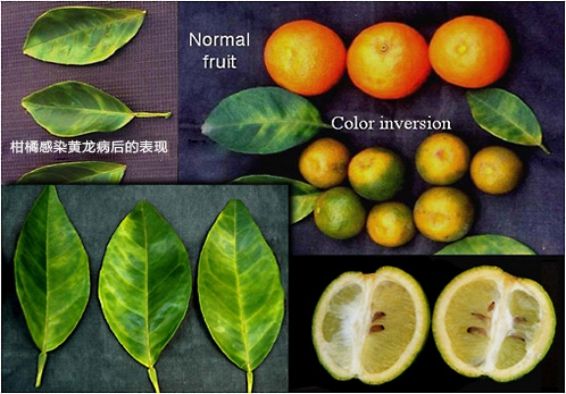
Figure 0: Comparison of navel oranges with Huanglongbing and normal navel oranges
"Citrus AIDS" Huanglongbing is an incurable disease of citrus; it cannot be treated, only cut down
Huanglongbing is a devastating citrus disease spread by the Asian citrus psyllid, and it is also a malignant disease of special concern in domestic citrus production areas. Like "cancer cells," it spreads and rampages very quickly, and is called "citrus cancer" and "citrus AIDS." Huanglongbing has two characteristics:
1. There is no cure; once a citrus tree is infected, it can only be cut down and removed.
2. It spreads extremely easily. The Asian citrus psyllid acquires the pathogen by feeding on diseased trees and then transmits it, and the speed of spread is very fast. Ganzhou City, as a major domestic navel orange production area, is suffering from Huanglongbing, and the trend is worsening.

1. Huanglongbing is a global problem and cannot be cured
Huanglongbing is believed to be caused by a bacterium that lives specifically in the phloem tissue of citrus. Its transmission routes include grafting and transmission by the Asian citrus psyllid. All currently known citrus varieties and citrus relatives can be infected with Huanglongbing. Infected plants not only fail to produce economic value, but highly susceptible varieties such as navel orange and grapefruit gradually decline and die within a few years. Once a fruit tree is infected, there is no cure, and it can only be cut down and removed.

2. The Asian citrus psyllid spreads the disease, and poor management can lead to large-scale transmission
The Asian citrus psyllid is a major pest during the new shoot stage of citrus and is also the transmission vector of citrus Huanglongbing. Adults mostly lay eggs on the tender shoots of diseased trees. After hatching, the nymphs suck the sap of tender shoots, which can produce large numbers of pathogen-carrying adults. The adults fly to new plants and transmit Huanglongbing. Management strategies for Huanglongbing mainly rely on using insecticides to control psyllids, digging out and removing infected plants, and cultivating pathogen-free seedlings. Poor field management mainly manifests as:
(1) Failure to control psyllids in time, producing large numbers of pathogen-carrying adults.
(2) Failure to promptly cut down and dispose of plants found to have Huanglongbing, allowing them to become sources of infection.
(3) Excessive use of pesticides and fertilizers causing soil compaction and leading to root rot.

------------------------------------------------------------------------------------------------------------------------------------------
One outbreak of Huanglongbing destroyed 10 years of hard work for Ganzhou fruit farmers
1. In 2014, Ganzhou's navel orange output accounted for 48% of China's, a very high concentration

According to statistics, in 2014, the navel orange output in southern Jiangxi reached 1.23 million tons, accounting for about 48% of domestic output. It is truly China's largest navel orange production area. In 2014, southern Jiangxi's navel orange planting area was 1.68 million mu, the largest single-region navel orange planting area in the world, and its output ranked third in the world. High concentration promoted the development of the citrus industry, but it also brought the risk of disease transmission.

2. Cutting down fruit trees destroyed ten years of fruit farmers' hard work in an instant
In 2012, Huanglongbing began to break out on a large scale. Although according to statistics from the Ganzhou fruit industry department, over three years the navel orange planting area fell from 1.78 million mu to 1.68 million mu.
However, according to non-governmental surveys, the situation seems to be even more serious. Over the past 3 years, in Xunwu, Anyuan, and Xinfeng counties, where navel orange planting in southern Jiangxi is most concentrated, the area of diseased trees cut down reached almost one third. In Xunwu County, which has the largest navel orange planting area, the planting area decreased from 600,000 mu to more than 400,000 mu. In Xinfeng County, in the autumn and winter of 2013, 1.5247 million infected plants were confirmed, with an incidence rate of 11.8%. Moreover, Huanglongbing has an incubation period, and diseased trees will continue to appear in the next few years.
Some farmers said that navel oranges take about seven or eight years from planting to full production, and many diseased orchards are now exactly in their full-production period. This outbreak of Huanglongbing destroyed nearly ten years of their hard work.

Farmers suffered heavy losses, and replanting became a risky investment, so they could only go out to work again
1. Income losses that year were severe
Chen Hong, a farmer from Guanzhou Village, Nanqiao Town, Xunwu County, Jiangxi, began planting navel oranges and mandarins six years ago, and at most his family had nearly 1,000 fruit trees. As Huanglongbing broke out on a large scale, he cut down nearly 300 fruit trees in 2013 and another six or seven hundred in 2015, cutting down almost all of them. Small and medium-sized growers of his scale are very common locally. According to a survey by the Harvest Research Office, in Wangwu Village, Chengjiang Town, Xunwu County, entire plots of navel orange trees were cut down. Most of the fruit forest in Guizhumao Town, Xunwu County, was also cut down, and after cutting the trees, most local people went out to work again.
2. Newly planted fruit trees take 3 years before they bear fruit
Cutting down navel orange trees that had been cultivated for years was truly a last resort. One mu has 60 fruit trees, with income of 10,000 to 15,000 yuan. But navel oranges take about 3 years from planting new seedlings to bearing fruit, and about 5 years to enter full production. The earlier-stage investment in water, fertilizer, and management per mu costs tens of thousands of yuan, a very high input.
3. Huanglongbing can recur at any time, making the risk even higher
After cutting down the navel orange trees, many farmers did not dare to plant navel oranges again, because navel oranges take three years to bear fruit, and Huanglongbing is spread by psyllids, so replanting carries great risk and they could be infected again at any time. If they switched to other crops, some planted oil tea and some planted vegetables, but the income was not as high as navel oranges. For example, one mu of oil tea, after full production, yields an income of 3,000-4,000 yuan a year, far less than planting navel oranges. Therefore, some farmers simply let the land lie fallow and went out to work, or changed careers and did other business.
Everyone followed the trend of planting, which made the local ecological environment too uniform and buried hidden dangers for the disease outbreak
1. Southern Jiangxi was poor for a long time, and planting navel oranges was an important way for the region to become wealthy
Southern Jiangxi is one of the country's larger contiguous poverty-stricken areas. Planting navel oranges was an important way for the region to become wealthy, because the area is especially suitable for growing navel oranges, and after full production one mu of navel oranges can yield an output value of more than 10,000 yuan, hence the saying "one navel orange tree equals three pigs." Through large-scale navel orange planting, the per capita net income of farmers in southern Jiangxi rose from 4,182 yuan in 2010 to about 6,970 yuan in 2014.
2. The wealth-creating effect made local people follow the trend and plant navel oranges
Calculating 60 trees per mu, with each tree producing 100-200-plus jin of navel oranges, at a market price of about 1.5-2.9 yuan, the output value per mu of navel oranges is close to 20,000 yuan. This wealth-creating effect attracted farmers to plant on a large scale. Many people dug up previously planted crops such as oil tea and switched to navel oranges, and many former mountain forests were also converted into fruit forests. Not only farmers planted trees; local shop owners, teachers, and civil servants also planted navel oranges in almost every household, and many outsiders came to Ganzhou to rent mountains and open forests to plant navel oranges.
According to statistics, the navel orange planting area in southern Jiangxi grew rapidly from more than 300,000 mu in 2000, reached 1 million mu in 2005, and reached 1.78 million mu in 2012. Output also increased rapidly from less than 100,000 tons to about 1.23 million tons.

Figure 7: Southern Jiangxi navel orange area and growth rate. Source: Ganzhou Fruit Industry Bureau

3. The government actively mobilized people's enthusiasm for planting navel oranges, but did not scientifically manage the red lines well
It is understood that in the early years, in order to mobilize people's enthusiasm for planting navel oranges and accelerate shaking off local poverty, a county government in southern Jiangxi put forward the slogan "work in the office in the morning, go up the mountain in the afternoon," mobilizing Party members and cadres to help farmers build orchards and plant navel oranges. This gave people very strong confidence and fully mobilized society's enthusiasm for planting navel oranges, but it did not draw scientific red lines well.
Within a few years, the people of Ganzhou filled the mountains and fields with navel oranges, and even dug up and planted trees in the natural biological isolation belts between orchards. This destroyed the protective barrier of the ecological environment and created conditions for psyllids to spread Huanglongbing. Although the government's approach mobilized farmers' enthusiasm and expanded the planting area, the lag in guidance and control measures for scientific planning and scientific planting was equivalent to multiplying the risk of a Huanglongbing outbreak several times over.

4. This ultimately made the region's varieties too uniform, the ecology fragile, and Huanglongbing extremely likely to spread devastatingly
In agricultural planting, single-crop cultivation has always been a potential threat. From the perspective of natural laws, the problem of single-species planting poses an enormous hidden danger. If the planting structure is uniform and a region plants only one crop for a long time, soil fertility will decline, biodiversity will disappear, and pests and diseases will also worsen.
Ecological principles tell us that the stability of an ecosystem depends on biodiversity. A complex ecosystem always has a greater capacity to respond to changes in the external environment than a simple ecosystem, and the stability of an agricultural system likewise depends on the diversity of agricultural biological varieties. Single-crop continuous cropping weakens biodiversity in the agricultural ecosystem, increases instability and fragility, and reduces resistance to natural disasters and pests and diseases.
In southern Jiangxi, according to statistics, 88% of navel orange varieties are the excellent Newhall, while other varieties such as Bonanza and Navelina account for only 8% and 3%. Single-crop planting and uniform varieties create enormous hidden dangers for navel orange cultivation in southern Jiangxi.
Although single-variety planting helps control quality and yield, it is not conducive to disease control. The outbreak of Huanglongbing in southern Jiangxi this time is deeply connected to excessively uniform planting varieties.

5. Devastating ecological disasters caused by excessively uniform planting varieties are common around the world
Large-scale single-crop planting of economic crops such as bananas and rubber has also encountered situations in which global planting was too uniform, ultimately causing rubber blight and rubber tapping panel dryness to sweep the world uncontrollably, resulting in huge losses. Taking banana Panama disease as an example, the once globally widely and uniformly planted banana variety "Gros Michel" suffered more than 90% infection worldwide because of the outbreak of Panama disease, causing irreparable huge losses.
In the nineteenth century, the Irish used a potato variety called "Lumper" as a staple food, the largest single cultivation attempt people had ever tried. As a result, potato blight spread, causing the historically famous "Irish Great Famine." By September 1846, an estimated three quarters of the potato harvest had been destroyed, causing the most serious famine in European history since the Black Death, and Ireland's population fell by a full half.
--------------------------------------------------------------------------------------------------------------------------------------------
Under such uniform ecological conditions, there was not enough effective management for prevention, control, and protection
1. The government did not pay attention to building effective ecological isolation belts, making it easy for psyllids to spread Huanglongbing
Citrus Huanglongbing existed in the past as well, but the emergence of such a large-scale outbreak is closely related to the rapid, blind, and disorderly development of the industry. Studies have shown that in different citrus planting areas, using natural or artificial forest for ecological isolation can control the spread of psyllids to a certain extent and also provide a living environment for the natural enemies of psyllids.
The purpose of ecological isolation belts is to prevent the spread of psyllids. In ecologically standard citrus orchards, shelterbelt strips are planted according to plan (Chinese fir or other tree species), and natural forests and shrubs can also be used to isolate orchards into blocks like tofu cubes, using physical isolation to control the harm of psyllids. Specific arrangements can be made reasonably according to each village's land use conditions.

2. Villagers did not control the area, and neglected orchards became outbreak points of "epidemic disease"
Driven by profit, Ganzhou fruit farmers planted navel oranges on all usable land in the mountains and fields, and even dug up and planted trees in the forest and shrub belts between orchards, planting large contiguous areas. Once prices fell, however, they abandoned them, and neglected orchards became outbreak points of "epidemic disease."
Huanglongbing is mainly spread by the Asian citrus psyllid, and psyllid control is especially critical in Huanglongbing prevention and control. Farmers in southern Jiangxi filled the mountains and fields with navel oranges, with no barriers between plots, making it easy for psyllids to spread and contributing to the outbreak of Huanglongbing.

3. Soil deterioration and fruit tree root rot caused by excessive fertilizer and pesticide use bred disease
Navel orange root rot is a common navel orange disease, mainly caused by orchard soil compaction and imbalanced soil nutrient structure, which causes the cortex of fibrous roots to brown and rot to varying degrees. After infection, tree vigor weakens and resistance to pathogens is poor, making trees vulnerable to Huanglongbing.
In 2013, an expert team from the Fruit Tree Huanglongbing Research Office of the Central South Agricultural Science and Technology Development Research Institute conducted field investigations in major navel orange counties such as Xunwu, Anyuan, and Xinfeng, and brought back multiple navel orange orchard soil samples for analysis and research. They found that the sampled orchards had severe imbalances in soil nutrient structure and relatively high residues of chemical fertilizers and pesticides in the soil, leading to deterioration of the fruit tree growing environment and causing widespread root rot in the orchards. This was also an important factor in the outbreak of navel orange Huanglongbing in the Ganzhou area.
--------------------------------------------------------------------------------------------------------------------------------------------
When Huanglongbing appeared in small areas, farmers were reluctant to cut down trees, which worsened the disease -
1. Farmers were reluctant to cut down trees, causing the disease to spread
Huanglongbing often has an incubation period, and farmers often cannot quickly and accurately identify diseased trees, which is also one reason for its spread. In southern Jiangxi, more farmers discovered the disease but were reluctant to cut down the trees, or handled them improperly after cutting them down, which intensified the spread of the disease. Cutting down the trees also cut off their only source of income. When a small-area outbreak occurs, once psyllids stay on diseased trees, they quickly spread the disease to other orchards.
2. Unified prevention and control was difficult to implement, and farmers refused to deal with diseased trees
The most difficult part of Huanglongbing prevention and control is unified prevention and control. As long as one household does not manage it, everyone suffers along with them. Later, orchards with infection rates exceeding a certain proportion had to be completely cut down and removed. From persuading farmers to plant trees back then to now persuading fruit farmers to cut down trees, grassroots cadres have also encountered their most headache-inducing task.
The local government has already realized the seriousness of the problem and issued policies to subsidize farmers, such as sending technicians to help farmers with control, paying 10 yuan for each diseased tree cut down, and so on. However, because the subsidy was too small, many farmers still refused to deal with diseased trees.

Failure to pay attention to nursery stock quarantine and failure to mandate planting virus-free seedlings also buried hidden dangers for the Huanglongbing outbreak
1. Nursery stock trade was out of control, leading to quarantine being out of control
At the source of the navel orange industry, ineffective control of nursery stock was also an important reason for the Huanglongbing outbreak. Worldwide, planting virus-free nursery stock is the standard for preventing and controlling Huanglongbing. But in southern Jiangxi, the lack of supervision, failure to pay attention to nursery stock quarantine, and failure to mandate planting virus-free seedlings became one of the reasons for the spread of the disease.
Although laws and regulations include the "Quarantine Regulations for Citrus Nursery Stock Production Areas" and the "Ganzhou City Citrus Virus-Free Nursery Stock Breeding and Supply Implementation Plan," the navel orange nursery stock purchased by farmers basically had not undergone strict quarantine. Large numbers of diseased seedlings flowed to the market, and when people wanted to plant trees, they bought navel orange seedlings from the market, causing long-distance, large-scale human-mediated spread of Huanglongbing.

2. Farmers had weak awareness of disease prevention and introduced nursery stock from epidemic areas
The transport of budwood and nursery stock, which should have been strictly controlled by the government, was not strictly implemented. This allowed a small number of nursery operators or citrus farmers with weak awareness of disease prevention, driven by profit, to illegally introduce pathogen-carrying budwood and nursery stock from epidemic areas such as Guangdong, Fujian, and Wenzhou, burying hidden dangers for the Huanglongbing outbreak.

--------------------------------------------------------------------------------------------------------------------------------------------
The United States kept Huanglongbing within a controllable range through government intervention and active management
1. Foreign experience proves that Huanglongbing cannot be cured, but it can be effectively controlled
Huanglongbing is temporarily incurable, but losses can be minimized through prevention and control. California and Florida in the United States are also important navel orange growing areas in the world, and the U.S. citrus industry likewise faces the threat of Huanglongbing.
Figure 16: The U.S. citrus industry is also threatened by Huanglongbing
However, through effective management and control, the United States reduced losses to a controllable level by following the approach of strengthening quarantine, mandating the use of virus-free nursery stock, promptly digging out and removing diseased plants, and strictly controlling the Asian citrus psyllid. According to a report released in September 2011 by the U.S. Department of Agriculture's National Agricultural Statistics Service (NASS), compared with 2010, Florida's overall citrus planting area decreased by 2.3%, but citrus output increased by 4%.

2. The U.S. government invests huge sums every year to research and manage Huanglongbing in a unified way
In 2012, the U.S. Senate passed legislation to provide large amounts of funding each year for research on citrus Huanglongbing, in order to fight the citrus Huanglongbing occurring in Florida and other major citrus-producing states. Large companies such as Coca-Cola also invested hundreds of millions of dollars to remediate citrus groves cut down because of Huanglongbing.
To effectively prevent Huanglongbing from expanding and spreading further, the U.S. Department of Agriculture (USDA) spent 30 million U.S. dollars to build a "Huanglongbing Prevention and Control" project. It is understood that the USDA divided this project into two parts: one part was a temporary solution: establishing a multi-department joint task force including the USDA Animal and Plant Health Inspection Service (APHIS), the Agricultural Research Service (ARS), the National Institute of Food and Agriculture (NIFA), as well as national agricultural departments and agricultural industry groups. They closely monitor citrus production areas, with the aim of minimizing losses caused by Huanglongbing.
The other part was establishing a long-term Citrus Disease Research and Education program (CDRE), with the aim of finding prevention and control solutions that thoroughly solve the plant diseases threatening the citrus industry.

In 2013, the United States also established a Huanglongbing management center together with countries in the Americas. It established standard operating procedures for responding to Huanglongbing and established mechanisms for risk communication, supervision, diagnosis, and management. It established regional information, communication systems, and network mechanisms. It set up plant management agencies to carry out regional prevention and control. It established a citrus grove rehabilitation plan and dispatched expert teams to carry out Huanglongbing prevention and control.

3. The United States' well-developed Huanglongbing prevention and control technologies
(1) Early diagnosis and early treatment: The University of Florida developed a device that can accurately detect Huanglongbing and can rapidly diagnose it before the human eye can judge, with an accuracy rate of 98%. After confirmation, the infected area is promptly locked down, and the entry and exit of citrus nursery stock is strictly controlled to prevent it from spreading outward.

(2) Soil control: Different management methods are used according to different degrees of infection to maintain normal production. In addition, environmental pH is controlled, and the pH of irrigation water and soil is lowered to protect the citrus root system and improve disease resistance.
(3) Heat treatment: Research has found that heat treatment technology can temporarily prolong the life of diseased trees, maintain a certain yield, and reduce losses. The next step will be to test and study the effects of heat treatment on large orchards.

(4) Biological control: The psyllid parasitoids Diaphorencyrtus aligarhensis and Tamarixia radiata have been proven to be the two most important parasitoids of the Asian citrus psyllid and can effectively control field population density of the psyllid. Their production and field release should continue to be expanded. In addition, fungi can also be used to control psyllid adults.

(5) Physical control: Setting traps to lure and kill psyllids, such as yellow sticky boards and insect lure lamps. It is understood that the joint task force in Florida, USA, inspects citrus orchards in its area at regular intervals, reports test results, and analyzes the data by establishing statistical models. So far, a statewide Huanglongbing monitoring system has been established. In addition, the joint task force also uses the above measures to help growers control the Asian citrus psyllid, truly achieving the effect of unified prevention and control.
--------------------------------------------------------------------------------------------------------------------------------------------
Southern Jiangxi needs unified prevention and control and an active response to the Huanglongbing epidemic
In southern Jiangxi, China, farmers planted on a large scale and in a uniform way, did not pay attention to building a stable ecological environment, did not reasonably control the area, and applied large amounts of chemical fertilizers, causing imbalanced soil nutrient structure and environmental deterioration. After the outbreak, they were unwilling to cut down trees, causing the disease to spread more severely.
The government, meanwhile, lacked responsibility in planting planning, mandatory nursery stock quarantine, and diversified planting varieties. After the outbreak, it did not act quickly enough and did not have a good response plan, which likewise promoted the spread of Huanglongbing.
The outbreak of Huanglongbing in southern Jiangxi was not only a natural disaster, but even more a man-made one. In facing Huanglongbing, experience should be learned and an active response should be taken.
The Harvest Research Office provided some suggestions for navel orange growers in southern Jiangxi, hoping that the navel orange industry in southern Jiangxi can have more scientific response measures and fewer blind attempts in the face of the Huanglongbing disaster.
Block the source: This means grasping the nursery stock stage well in the early stage of industrial development and controlling the pathogen source. New orchards should not carry pathogens, and orchards in epidemic areas should not increase pathogens. To block the source, nursery stock must first be well managed. At the beginning of orchard construction, great attention must be paid to the selection and purchase of nursery stock, eliminating the introduction of pests and diseases as much as possible. Nursery stock breeding must be carried out by qualified and eligible companies or individuals, with net-house cultivation and pathogen-free seedling production.
Kill the vector: This means killing, within the industrial base, the intermediate vector and chief culprit that spreads the citrus Huanglongbing pathogen -- the Asian citrus psyllid. This pest, acting in collusion with diseased trees, should be thoroughly eliminated. There are concentrated time periods (tender shoot stage, low-temperature period) during which control can be carried out. Practice has proven that applying pesticides uniformly in contiguous orchards during 6 key periods -- winter, early spring orchard cleaning, spring shoots, summer shoots, autumn shoots, and late autumn tender shoots -- can effectively kill the Asian citrus psyllid.
Emphasize planning: Scientifically plan and reasonably control the planting area. Reasonably return farmland to forest, and plant tall trees such as Chinese fir between different villages and towns as ecological isolation belts to hinder the spread of psyllids. In addition, adjust the planting proportion of a single variety and increase the proportion of varieties with strong disease resistance. Form a navel orange planting system with reasonable area density and diversified variety types.
Emphasize technology: A change in concepts may find a breakthrough for industrial development. The urgent task now is to do the work of "prevention" deeply and thoroughly. The government should organize unified prevention and control, use early diagnosis technology, biological control, and physical control technology to control psyllids, while strengthening management, controlling environmental pH, and lowering the pH of irrigation water and soil to protect the citrus root system and improve disease resistance.
Article source: WeChat public account "Miller's Wheat Field," produced by the Harvest Research Office. Please indicate the source when reposting.