Where is the yellow dragon fruit native to? Suitable rootstocks for grafting and cultivation methods
Yellow dragon fruit, also known as yellow pitaya (Pitahaya Amarilla), is distributed in regions such as Colombia, Ecuador, Peru and Bolivia. Because the fruit is refined, sweet and juicy, it can be called the finest in the dragon fruit world. However, its ripening period is two to three times longer than that of ordinary dragon fruit, and the fruit also bears slender sharp spines, so caring for it is very complicated. Therefore, nowadays it is almost only grown by ordinary households for their own enjoyment. But in Kaohsiung, I "heard" that on the road toward Baolai there is an orchard specializing in growing yellow dragon fruit. It is just that I have never been to Baolai, so I dare not be sure whether this is really true. How is this different from red dragon fruit cultivation? Let us take a look together!
Several months ago I got a few yellow dragon fruit branches from other gardening enthusiasts. To me that really felt like a dream, so I could not wait and immediately picked a branch of red-fleshed large-fruit dragon fruit from my own garden to serve as the nurse for this yellow dragon fruit. Why not directly root the cuttings? This is because the root system of yellow dragon fruit is different from that of ordinary dragon fruit. The root system of ordinary dragon fruit can grow to a length of more than one meter after half a year of planting, while that of yellow dragon fruit is less than 10 cm. With such a root system, to cultivate strong branches and also flower and fruit would really be asking too much of the "dragon", so finding a rootstock with a stronger root system becomes a very important task.
We use a knife to make the first cut starting from position No. 1. When cutting, there is no need to cut into the vascular bundle. Then make a second vertical cut, and the angle of the second cut should preferably lean a little further in toward the position of the vascular bundle in the middle. This allows a larger area to come into contact with the vascular bundle of the rootstock, thereby increasing the success rate. After completing this, cut once more on the left side of the branch using the same steps.
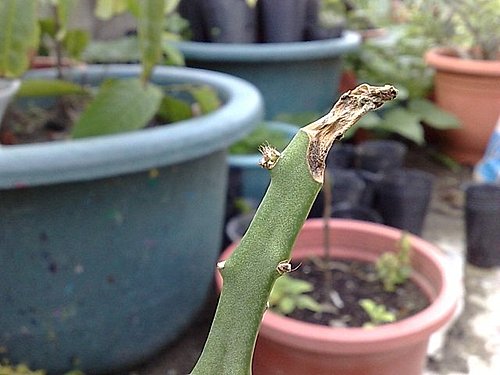
This is the red-fleshed large-fruit dragon fruit in my garden. After cutting it off, I removed all the spines on its branch, that is, its growth buds. The reason for doing this is to prevent it from having the chance to grow side shoots, which would cause the grafted yellow dragon fruit to be neglected.
Next, choose a good position and cut open from the middle of the vascular bundle, and be careful not to cut the vascular bundle off. Otherwise, nutrients will only be able to enter the yellow dragon fruit branch from one side, while the other side may, if lucky, join on its own, but may also rot and cause the graft to fail.
Once the rootstock and scion have been prepared, they can be joined. As long as the vascular bundles of the two branches are aligned and gently inserted all the way in, it is done.
However, during the healing period, dragon fruit may slide or slip off because of the mucus from the wound, so we must use string, stockings or elastic bands to secure both branches, and place them in a cool place for three days before inserting them into soil to wait for rooting. Otherwise, the rootstock is very likely to become infected by bacteria and rot.