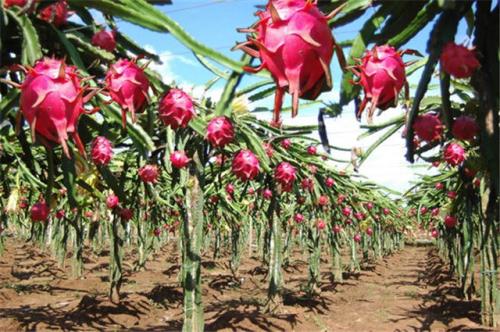
When Is the Dragon Fruit Season? A Detailed Look at Yield and What Makes It Unique
Red dragon fruit is very popular now. Compared with white-fleshed dragon fruit, red-fleshed dragon fruit is even more popular, because its color makes people want to eat it and its taste is sweet and fragrant. Now let us take a look atthe Red Dragon Fruit Quality Fruit Evaluation Event!
The "National Red Dragon Fruit Quality Fruit Evaluation Event," the one that red dragon fruit growers nationwide value most, is here again! To encourage growers to produce high-quality red dragon fruit, improve market competitiveness and promote red dragon fruit consumption, the Fengshan Tropical Horticultural Experiment Branch of the Taiwan Agricultural Research Institute, Council of Agriculture, Executive Yuan has scheduled the 10th "2018 National Red Dragon Fruit Quality Fruit Evaluation Event" for July 31 (Tuesday) from 8:50 a.m. to 2:00 p.m., and sincerely invites friends from all over the country who are interested in red dragon fruit cultivation and evaluation to come and join the fun.
Red dragon fruit is an emerging fruit tree introduced and cultivated from Vietnam and Central and South America 35 years ago. The red dragon fruit produced in the early days had a strong grassy smell and a bland flavor, and was poorly accepted by people in the country, once causing a wave of abandoning cultivation and giving up planting. Over the past 10 years, through the holding of the national red dragon fruit evaluation event, domestic red dragon fruit has improved year by year in both variety selection and cultivation techniques. In addition to improved quality and increased consumer acceptance, affected by the rapid expansion of cultivation area, this year's red dragon fruit output is showing a bumper harvest. At this time, the quality of red dragon fruit should be improved even more to win consumers' purchases.
Besides its special appearance and unique flavor, red dragon fruit, because of its bright appearance and vivid colors, has the sales appeal of a premium fruit. In addition, its requirements for soil texture and climatic conditions are not strict, so it is suitable for both commercial production and home hobby cultivation, making red dragon fruit cultivation areas spread across the country, with an area already reaching 2,847 hectares (2018 Agricultural Statistics Yearbook) and a yield of 66,000 metric tons. Among these, the central region has the most planting (Taichung, Changhua and Nantou together account for 44%), followed by Tainan, and it is also planted in Penghu and Kinmen.
The production period of red dragon fruit is from mid-to-late May to early December, with July to August each year being the peak production period. The Fengshan Branch chooses late July each year to hold the "National Red Dragon Fruit Quality Fruit Evaluation Event," which not only provides a platform for interaction and exchange among growers, but also uses this to market Taiwan's high-quality domestic red dragon fruit and offer consumers another new choice of fresh premium fruit.
In terms of evaluation, the participating fruits must first pass the Agricultural Research Institute's "food safety inspection" - rapid biochemical residue toxicity testing - before they can enter the subsequent evaluation. This quality fruit evaluation event continues to uphold the principles of fairness, openness and impartiality, inviting representatives from industry, government and academia to serve as judges, and selecting according to items such as the weight, flavor, taste, sugar content and appearance of the participating fruits. Starting last year, a bonus point system (1-5 points) has also been added for those with agricultural product production traceability (QR Code), production records (TGAP), organic certification and Global GAP certification, in order to encourage farmers to participate in the label certification system promoted by the government. Participating fruits must excel in both internal and external evaluation items to have a chance to stand out. It is a fiercely competitive "dragon" vs. "tiger" battle. After the competition results are announced, awards will be presented on site. In the red-fleshed group, the top thirteen by total score are selected (1 champion, 1 runner-up, 1 third place and 10 honorable mentions; in the white-fleshed group, the top five by total score are selected (1 champion, 1 runner-up, 1 third place and 2 honorable mentions), and gift certificates, award certificates and trophies of NT$5,000, NT$3,000, NT$2,000 and NT$1,000 are presented respectively. The Fengshan Tropical Horticultural Experiment Branch of the Taiwan Agricultural Research Institute, Council of Agriculture, Executive Yuan sincerely invites people from all over the country to visit and offer guidance on the day of the competition and join in the event.