Red Dragon Fruit Cultivation Techniques: How to Balance Cost and Yield
Red dragon fruit originally grew in tropical rainforests and began to be cultivated on a large scale in Taiwan, China in the 1980s. In recent years it has become familiar in Taiwan, China and is a rising favorite in the fruit and vegetable market. Below, starting from seedling raising, the cultivation techniques of red dragon fruit are described separately, as a reference for farmers when growing red dragon fruit.
Seedling raising and planting: cuttings are the most common
In the early days, because branches were hard to obtain, only seedlings grown from seed could be used for mass propagation and planting; at present, propagation by cuttings is the most common, with branches cut off and planted directly in the field. Red dragon fruit branches bear aerial roots, and generally roots can grow 1 to 2 months after planting. If used for seedling raising, the cutting length should be 30 cm or more, and vigorous, thick, sun-facing, pest- and disease-free, 1- to 2-year-old fleshy stem branches should be selected; the base of the branch should be sharpened or cut at a slant, placed in a shady, cool place to let the wound dry and heal, then dipped in a little rooting agent or additionally treated with a fungicide, and inserted at a slant into loose potting soil to speed up rooting and reduce rot at the cut. If a little of the fleshy stem can be scraped away to expose the central vascular bundle before cutting, so much the better.
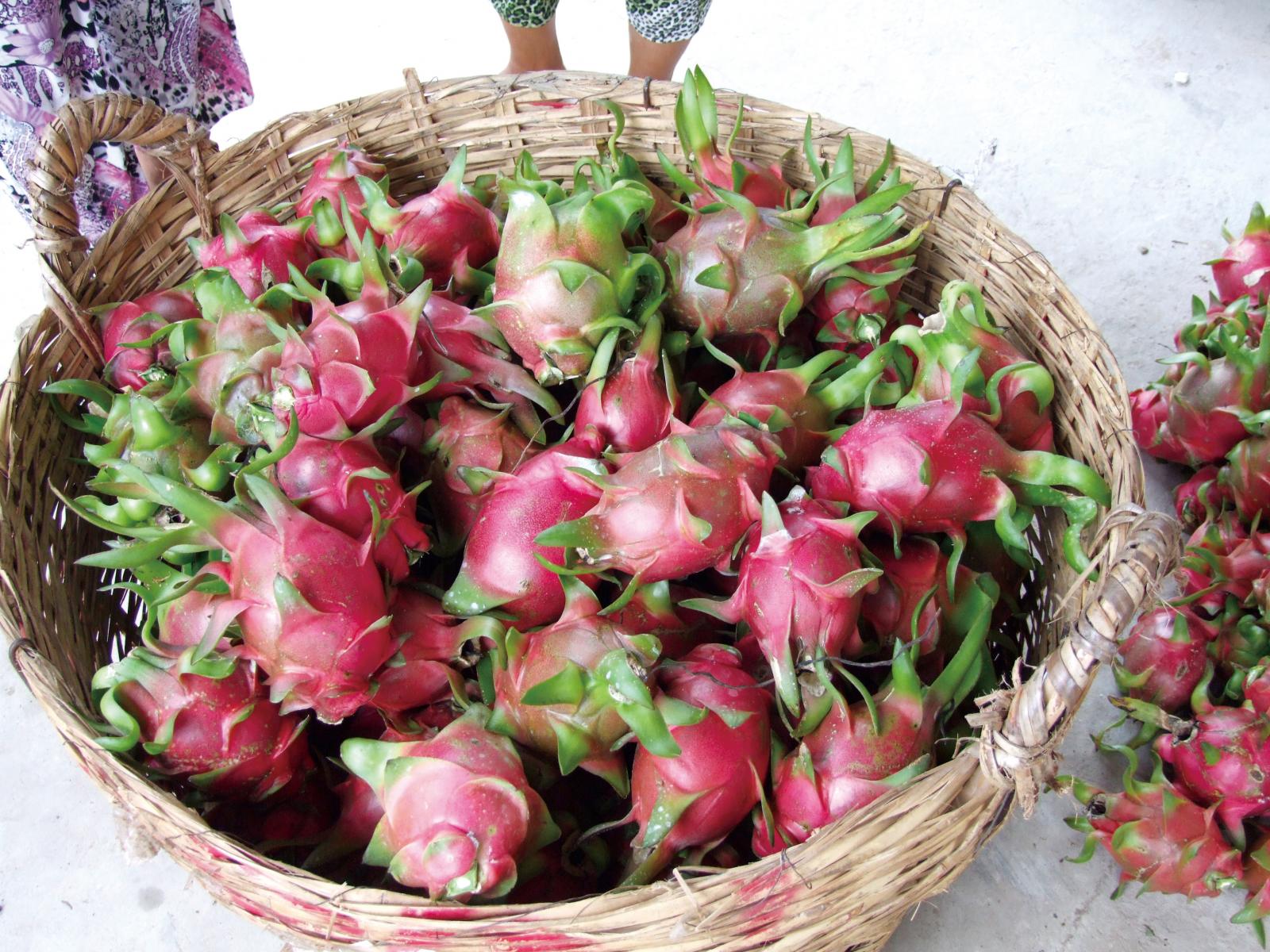
Whether the cultivation techniques for red dragon fruit are good or not will be directly reflected in its appearance. This is Vietnamese red dragon fruit; in appearance the color change is poor, the peel cannot turn fully red, and the scales are rather long and thick.
The cut fleshy stems can first be dried in the shade for several days, and after the wounds heal they can be inserted as cuttings, which can prevent basal rot (basal rot disease). The cut branches can also be planted directly, but the depth should not exceed 3 cm; it is enough to cover the base all around with soil. At first, water should not be supplied too much, otherwise the wound easily rots, but after roots grow in 2 months, the water supply should be sufficient to speed up the sprouting of new shoots. Propagation by cuttings is currently the fastest and simplest method of raising planting stock, and it can preserve the characteristics of the original mother plant; it can be carried out all year round.
When renewing varieties, grafting is generally used (including cut grafting, soft-tip grafting, bud grafting, side grafting and many others). The appropriate grafting method is chosen according to the climate and environment and the growth of the branches, and the survival rate can generally be above 80%. When propagating by cut grafting or side grafting, the rootstock chosen should be perennial, preferably a fleshy branch without buds; the rootstock should be at least 30 cm long, and grafting during the high-temperature period must be protected with a paper bag to prevent the scion from losing water and wilting; soft-tip grafting and bud grafting are mostly carried out in the cooler early spring. After the graft survives, if the bud grows into a branch of 90 cm or more, it can flower the following year when the climate and environment are suitable.
Red dragon fruit is suitable for planting in all four seasons, but the cooler seasons of spring and autumn are best, as they can reduce water loss from the branches. New branches that emerge after planting may show flower buds after 10 to 14 months, and the original mother plant may also sprout flowers in the same year, but the mother plant and overly young new branches should not be allowed to keep flowers or fruit; the principle is to cultivate robust branches, and generally only a small amount of fruit is kept starting the year after planting.
One of the methods for renewing and changing varieties of red dragon fruit: the central vascular bundles of the scion and rootstock must be closely joined.
Support frames: cement material is more durable
Red dragon fruit is a perennial climbing fleshy plant; the main branches must climb on a wall or support frame to grow attached to it. Hobby growers can plant it beside supports such as fences and walls, while large-scale commercial cultivation requires building climbing facilities, and firmness and durability must be taken into account. Because the type of support frame affects later management operations, including the convenience of pruning, bagging and harvesting, and also affects the yield per unit area and the cost of lighting treatment, it must be carefully evaluated in order to reduce production costs.
More than 10 years ago, production models such as horizontal cultivation using grape trellises, espalier climbing, free-standing single-plant cultivation and plastic pipe frameworks were mostly used, but the methods mentioned above have mostly been eliminated. Commercial production mostly uses the following 2 methods of trellising, and the row and plant spacing vary with the type of support; generally the row spacing is 2.8 to 3.2 m, the plant spacing is 2 to 2.5 m for the single-post type and 45 to 60 cm for the A-shape type, and the support frame height is 1.2 to 1.8 m.
1. Single-post type or iron-tower type
Central America and Vietnam mostly use this method; the upright materials include cement posts, rot-resistant tree trunks, plastic pipes (galvanized pipes) filled with cement, galvanized pipes or assembled rust-proof iron rods, and bamboo-steel bars, forming a tower shape. This method makes management operations convenient, and cultivation in 2 to 3 layers can also be tried (by raising the height of the posts), which can increase yield. Taking a cement post (total length about 180 to 210 cm) as an example, it can be designed and installed with about 60 cm buried in the soil and about 120 to 150 cm above ground, with a post diameter of about 10 to 12 cm; the post contains 2 pieces of No. 4 rebar, and the post shape is mainly square. Although its construction cost is high, it is durable for a long time and has better load-bearing capacity, making it the longest-lasting material among single posts. (See Table 1)
The planting method is to choose 2 to 3 seedlings to plant on the four sides of the post, first tying them manually with plastic rope (cloth strips) to fix them; later, after aerial roots grow, they can also attach to the post surface, so that the branches climb up the post to the top, and after elongating they attach to the iron ring and then spread to the surroundings so that they droop. Only drooping branches are allowed to produce buds and flower, and side shoots on the main trunk are all cut off. Because branches occasionally break from the top of the cement post, to avoid this, they should be tied with iron wire or a ring-shaped support such as a discarded tire, iron frame or steel cable should be added at the top, so as to prevent the attachment site from overheating or breaking.
Using wooden stakes for planting often results in the whole plant falling over because the wood rots or because the load is too heavy, so it is not recommended. Single-post planting is independent cultivation, requires no consideration of planting direction, and has the best ventilation and light penetration, which can reduce the rate at which disease damage spreads. In branch management, the drooping branches should be distributed evenly around (with manual assistance) to avoid tilting.
Circular iron frames welded from galvanized pipes cost less, but the load-bearing capacity for the branches must be considered to prevent falling over.
2. A-shaped trellis type
Using materials such as galvanized pipes, galvanized tubes, iron rods, plastic pipes or bamboo poles, they are crossed to form an A shape; at the crossing point, materials are placed horizontally or ground stakes are additionally buried and steel cables pulled to strengthen support for branch growth. The growing vines are then guided onto the horizontal frame and evenly distributed. Harvesting and management with this method are still fairly convenient, and the setup cost is slightly lower than the single cement post type.
Branches can effectively use the space between plants, there are many fruiting surfaces, the yield per unit area is the highest, and it is also favorable for light treatment to regulate production. However, with this method attention must be paid to the light intensity on the row orientation (mainly north-south orientation) and the wind-exposed side (to prevent falling over). The disadvantages are that, because of dense cultivation, ventilation is poor, the branches overlap in a complex way, and it is not easy to control the number of branches. Manual fruit picking and pruning are more likely to result in puncture wounds. Planting methods such as the A-shaped trellis are all high-density planting, and once disease occurs it spreads quickly, which is not conducive to the prevention of pests and diseases.
3. Other non-scale planting
Red dragon fruit can be allowed to climb on low walls, coral rocks, living tree stumps, and even utility poles. Trellises (using grape trellises) are the least suitable as supports; this method lets red dragon fruit branches grow on the trellis surface like grape vines, but because the stems extending horizontally branch a lot and produce few buds and flowers, the fruiting surface is mostly on the trellis and hard to harvest, and after many years the branches on top of the trellis are so dense that renewal pruning is difficult. Red dragon fruit flowers and fruits more easily on naturally drooping branches; although horizontal branches receive more light, they easily produce long new shoots, and the fruit set is instead low.
Bud removal, pinching, weeding
Every spring, the thorns on the branches easily sprout new buds; the buds (thorns) on the main trunk and main branches should all be cut off with a banana knife. If it is a fruiting mother branch, 1 to 2 buds can be selected and kept at an appropriate position above to cultivate into fruiting branches. When fruiting branches reach 60 to 90 cm or more, they should be pinched or shortened to prevent continued growth from touching the ground or the furrow, and to promote branch maturity and earlier flowering and fruiting.
Because red dragon fruit has a shallow root system and fleshy stems, never use systemic herbicides such as glyphosate for weeding; mechanical weeding or covering with rice husks, weed-control mats and the like should be used to control weeds. In addition, growing a grass cover can have effects such as retaining water and fertilizer, increasing soil temperature, preventing soil erosion and reducing the loss of soil nutrients, which helps the growth of the red dragon fruit root system, but some pests and diseases may tend to increase because of this, such as ants, stink bugs and snails, so more attention must be paid to prevention.
Using a machine for shredding branches helps clear branches from the field.
Pruning: an essential operation for controlling branch quantity
During the shoot-sprouting period, red dragon fruit often grows so luxuriantly in its fleshy stems that there is concern the support may collapse, so pruning is an essential operation each year to control the number of branches. The pruning method affects the difficulty of the pruning work and indirectly affects labor management costs, so the post height should be considered when the orchard is established, to make pruning operations convenient.
Pruning each year is roughly carried out after the production period ends; first the current year's branches are thinned out, then, together with irrigation and fertilizer management, new branches are induced to sprout, and these new branches are then selected and cultivated as next year's fruiting branches. In addition, the amount of pruning should take into account the overall nutritional status of the plant.
Red dragon fruit branches are divided into 3 types according to age. First are "old branches over 3 years old"; because all their bud eyes have already flowered or sprouted and can no longer flower, and to avoid the support bearing too much weight, old branches that have fruited are cut off from the base each year after harvest ends, so as to cultivate new fruiting branches anew. In addition, "1- to 2-year-old branches" are the most likely to flower and fruit and should be appropriately selected and kept; the selection criteria differ among varieties. Because the production period of red-fleshed varieties ends later, new branches begin to sprout only in December of that year, and such new branches must be more than 5 to 6 months old before they have fruiting capacity, so it is best not to keep fruit on immature branches from the previous year, or to keep fruit only at the end of the period; because the production period of white-fleshed varieties ends earlier, new branches begin to sprout in October, and at this time cultivation of these new branches can begin as next year's fruiting branches.
In order to control the quality of red dragon fruit, it is recommended that no more than 2 flower buds be kept on the same branch, and the whole plant should be controlled to below 20 flowers.
Quality control: flower thinning, pollination, fruit thinning
Red dragon fruit can produce more than 10 batches of flowers a year, and commercial cultivation mostly chooses 4 to 6 of these batches of flowers and fruit for management; if fruit is kept from every batch, it is instead difficult to control fruit quality. To produce large, high-quality fruit, flower thinning, bud thinning and pollination must be done well.
Flower thinning starts with bud thinning; generally no more than 2 flower buds should be kept on the same branch. After the buds grow into flower buds or fruit set is confirmed, thinning can be carried out once more. Generally, bud thinning can begin 3 days after bud emergence, mainly removing poorly growing, clustered and deformed buds. About 6 to 8 flower buds are kept on the branches of the same main branch, each batch of flowers and fruit on the whole plant should be controlled to below 20 flowers (fruit), and fruit should also be kept on each branch in batches. After the flowers fade, deformed fruit and diseased or weak fruit should be thinned out in time, with at most 2 fruit kept per branch.
Most currently cultivated varieties no longer need manual pollination, but there are still some red-fleshed varieties that, because of differences in flower structure or because they have self-incompatibility, still require manual or cross-pollination to ensure fruit enlargement and increased yield; for pollination, it is actually enough simply to put pollen on the stigma, and there is no need to pour pollen into the hole of the style. Because red dragon fruit flowers are large, manual pollination is still fairly simple and easy compared with other fruit trees.
The effective pollination time can be from 6 p.m. to 7 a.m. the next morning, but the best time is when the flowers are in full bloom from 8 p.m. to 12 midnight. If heavy rain occurs within 4 hours after pollination (to the extent that it batters the petals), then most of that batch of flowers cannot set fruit; when pollinating, the movements should be gentle, and it is enough to use a writing brush to pick up pollen and lightly touch the stigma. Pollen is collected in the afternoon from flowers that will open that day, or stored in advance in the refrigerator compartment, where it still has germination ability after 1 week. To avoid red-fleshed red dragon fruit flowering without setting fruit, 10% other different varieties and lines can be interplanted to increase the pollen diversity in the orchard and reduce the phenomenon of self-incompatibility. In addition, 18 hours after pollination the pollen tube has not yet reached the ovule in the ovary, and observations show that red dragon fruit needs at least 48 hours to complete pollination, so the style should not be removed within 3 days after flowering.
After pollination, the ovary of red dragon fruit enlarges and fills out day by day, but because its flower organs are relatively large and there is no obvious abscission layer tissue between the ovary and the style, the withered petals do not easily fall off on their own; to prevent the withered petals from becoming a breeding ground for pathogens, the petals should be removed within 7 days after pollination. After the natural fruit drop period ends, fruit on weak stems should first be cut off, weak fruit and deformed fruit removed, and manual fruit thinning carried out on branches with too much fruit set; in principle, about 1 fruit is kept per 30 cm of the same fruiting branch, to avoid the fruit becoming smaller due to competition for nutrients.
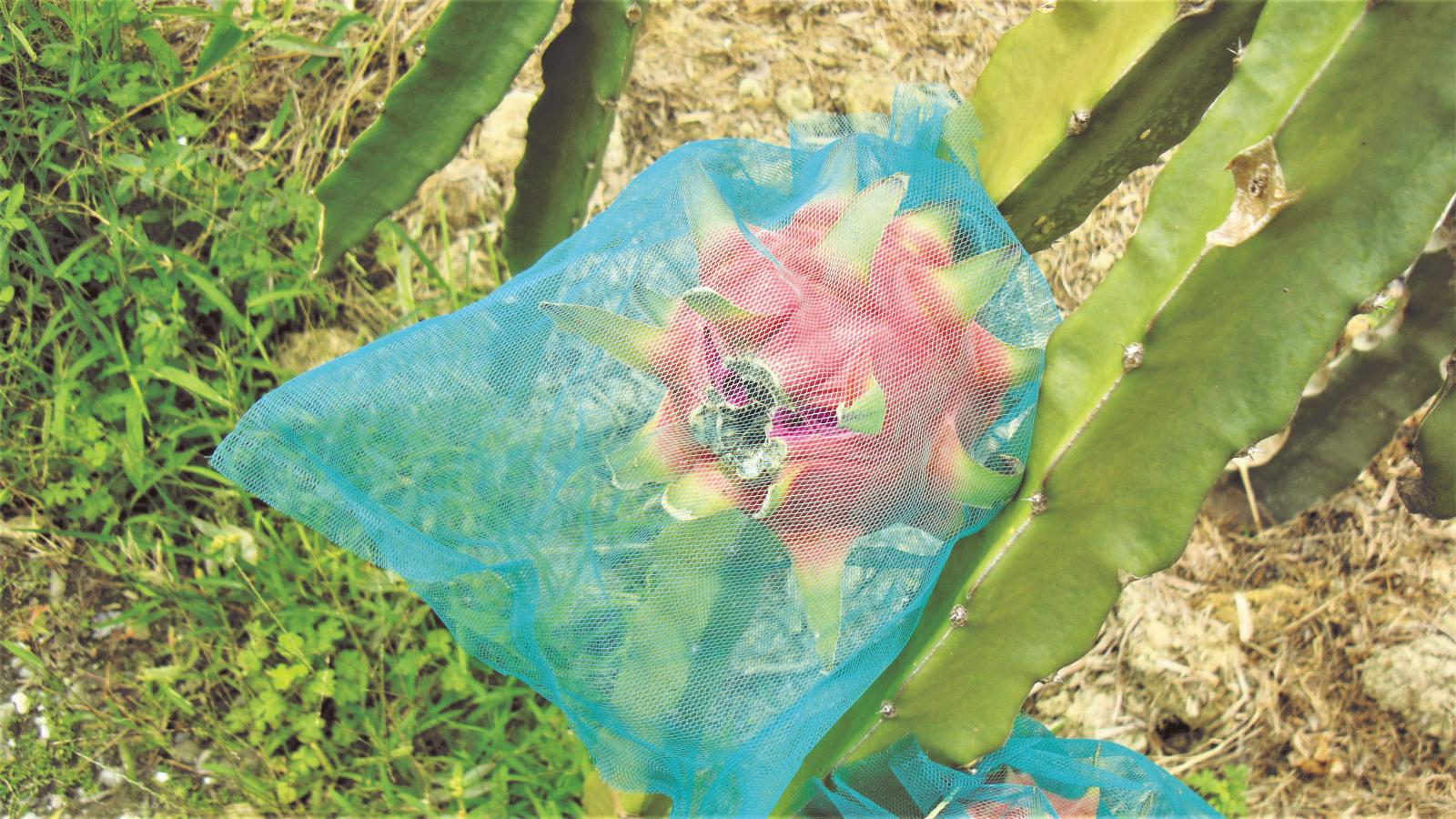
Mesh netting is another special bagging material; besides having the characteristic of good breathability, it can also prevent bird damage and oriental fruit flies.
Bagging: reducing insect damage and man-made injury
In the early days, red dragon fruit cultivation did not commonly use bagging, but in recent years it has been found that bagging can reduce fruit flies, snails, bird damage, skin sunburn and man-made injury, and can improve the glossiness and cleanliness of the peel; coloring is also more even, which helps raise the commodity value and increase the market price.
Bagging is generally started right after the flowers fade and completed within 2 weeks. As for bag types, waste newspaper was used in the early days, while in recent years many materials have been used, such as black mesh netting, green mesh netting, white paper bags, non-woven fabric bags, plastic cup sleeves and thin kraft paper bags. Test results have found that the suitable material types under different climatic conditions are not the same; in the central region of Taiwan, China, non-woven fabric bags and thin kraft paper bags have the best effect, with the most even coloring and no effect on fruit quality.
Because the temperature is higher in the southern region of Taiwan, China, mesh netting with good breathability has a better effect. Although non-woven fabric bags and thin kraft paper bags have good shading rates, their breathability is poor; used at high temperatures they accelerate fruit ripening, worsen quality, and sooty mold becomes severe. During bagging management, attention must be paid to smoothly draining accumulated water at the bottom of the bag, so as to avoid excessive humidity inside the bag, which would instead increase pests and diseases.