Key Management Techniques for Crimson Seedless Grapes During the Coloring Period
Everyone knows that Crimson Seedless grapes are an extremely late-ripening variety. Since after mid-to-late September, sunlight and temperatures both drop sharply, and the leaves also age severely. If you want to keep new shoots, you worry about downy mildew. The overall photosynthesis of the plant and nutrient absorption are greatly affected, so coloring is a huge problem. Today, the editor of Huinong Network will talk about the implementation plan for managing Crimson Seedless grapes during the coloring period!
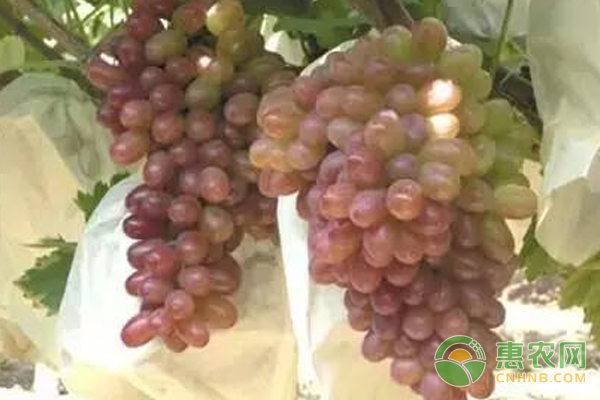
Because the ripening stage of Crimson Seedless grapes is after mid-to-late September, the coloring of Crimson Seedless must be carried out in advance, and the end of July is the first step.
At the end of July, first of all, we need to stop all pests and diseases, and add Bordeaux mixture.
The second step is to remove unnecessary tender shoots, whether they are terminal shoots or forks, to prevent re-infection with downy mildew after the start of autumn.
Third, close to the third wire (the area that female workers can reach), keep one new shoot, leave it facing outward, and let it extend horizontally, waiting to increase sunlight after the start of autumn to promote coloring.
Fourth, for fruit that has not grown large enough, irrigation and fertilizer flushing must be done in the evening recently, enlarging the temperature difference to promote fruit enlargement.
Fifth, combined with weeding, appropriately loosen the soil with a tiller, without fear of breaking the surface roots, (to regulate soil temperature and improve air permeability).
The start of autumn in August is a dividing point.
First. After the start of autumn, top the reserved new shoots, leaving at least 3 leaves, regardless of size.
Second. After 7---10 days (depending on fruit size), spray the new shoots with a nutritional coloring agent.
Third. Combined with pest control, spray microbial agents throughout the orchard.
Fourth. In mid-August, apply 30 jin per 1 mu of low-nitrogen high-potassium water-soluble fertilizer by flushing, or monopotassium phosphate and potassium nitrate at a 1 to 1 ratio, (15 jin each). This is the irrigation amount; for large water seepage irrigation, appropriately increase the amount.
In early September, around Teachers' Day, the shape is basically set. Small clusters and loose clusters will color first. Loose clusters have no inner fruits, and the color is basically normal. The second are tight clusters; large clusters still require further effort.
First. Top all branches and forks completely, regardless of size. (Except for those already infected with downy mildew and with insufficient leaf area.)
Second. At the end of August and the beginning of November (depending on cluster type and size), spray the new shoots a second time with a nutritional coloring agent.
Third. Combined with pest control, spray microbial agents throughout the orchard once again.
Fourth. In early September, apply 15 jin per 1 mu of high-quality high-potassium water-soluble fertilizer by flushing and 15 jin of monopotassium phosphate. (This is the irrigation amount; for large water seepage irrigation, appropriately increase the amount.)
Fifth. Till the soil layer to regulate soil temperature. Around National Day, some grapes with poor fruit shape, excessive yield, overly large clusters, and poor management still fail to color. At this point, there is no choice but to rely on bag removal for coloring and hormone-based coloring agents.
If it is not serious, tear the lower hole of the bag to improve air permeability, and try not to remove the bag. In order for Crimson Seedless grapes to successfully color, the editor suggests that the above implementation plan for managing Crimson Seedless grapes during the coloring period be learned by growers. After all, this is a society that judges by appearance. The editor believes that beautiful color in your Crimson Seedless grapes will greatly increase your sales volume!