Detailed Explanation of the Key Points of the Curtain-Style Trellising Technique for Passion Fruit
Passion fruit is generally grown mainly with a flat canopy trellis, letting the leaves form a large canopy overhead. The fruit hangs below the canopy, but this means the ground and the fruit cannot receive sunlight, which greatly affects the yield and quality of the passion fruit. Therefore, most passion fruit is now grown with curtain-style trellising. So how exactly should this be done? Below, the editor brings you the curtain-style trellising technique for passion fruit. Let's take a look!
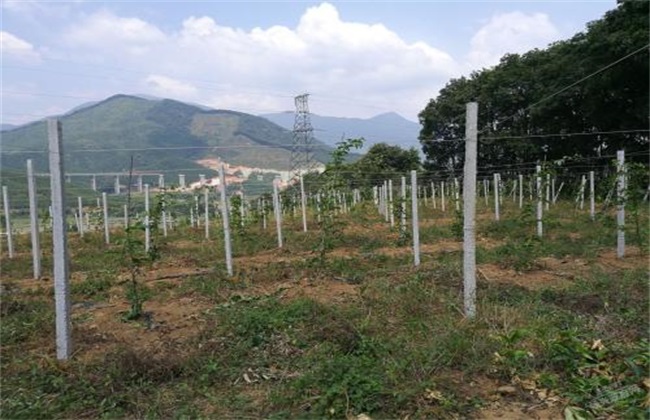
1. Material preparation
When building a curtain-style trellis, the first thing we need to do well is choosing the materials. For those who have the means, the main material is best based on steel posts. For the steel pipes used as supports, the specifications should be 32 pipe, 3 mm thick, and about 2.7 m long; normally, about 80 pieces per mu is enough. The steel pipes used for the surrounding supports have similar specifications, but the length should be controlled at 3 m, with 20 pieces prepared per mu. The crossbars are the most important and should be mainly threaded steel rebar; the ones for the surrounding supports should be slightly thicker, with about 200 pieces per mu. If conditions do not allow it, other materials can also be substituted.
2. Row and plant planning
For curtain-style trellis planting of passion fruit, the row direction should mainly follow the east-rising, west-setting direction, so that the photosynthetic capacity of the passion fruit can be maximized. If planting on hilly land, adjustments should be made flexibly. The plant and row spacing per mu should be kept at about 2.2 * 0.75 m, with about 400 plants per mu. Then, when setting up the trellis posts, set one post every 3 m, with the post length kept at about 2.7 m. Bury 50 cm into the soil, and about 100 posts are needed. Then connect the two ends of the upper and lower crossbars, keeping about four parallel vine-training lines. Keep about 4 plants between two posts; after they grow taller, their vines can be trained onto the 4 lines, improving the utilization rate of the three-dimensional space.
3. Training vines onto the trellis
After the preparatory work is done, it is time for the vine training of the passion fruit. We should let each fruit seedling grow along one line, letting it climb and develop vines, to satisfy the living habits of passion fruit. When the seedling grows to about 1.5 m and reaches the line, then pinch off its top. Then keep about two robust side branches at its top, using them as secondary vines and letting them develop along the line to both sides. When another seedling connects with the secondary vine, pinch off the top. Finally, all the branches and vines growing from the secondary vines are tertiary vines, which should be allowed to hang down and bear fruit. Seedlings at the top layer that exceed 2 m should also be trained and pruned in the same way.
4. Proper pruning
Pruning work is very important; we mainly use the double main vine form. After the main vines reach the top, remove all branches and leaves below 50 cm. Then also do a good job of heading back the side branches, that is, when the top layer connects to the lower layer and the lower layer connects to the ground. Stop cutting back and strengthen fertilizer and water management to promote vigorous growth of the branches and vines. This is so that each subsequent batch can stop being cut and pruned. After the last fruit on each tertiary vine is picked, it should be cut off, keeping only its first node and removing the excess. This is mainly to let the second batch of tertiary vines bear fruit, ensuring about three batches of tertiary vine fruiting branches each year.
The above is a brief introduction to the curtain-style trellising technique for passion fruit. That is all for today's introduction. This article is for reference only, and I hope it can help everyone!