What are the watering precautions for kiwifruit?
Kiwifruit is also called qiyiguo in China. It is a fruit with very high nutritional value, and its planting area is also relatively large. When growing kiwifruit, the first thing to pay attention to is doing the watering work well. Watering is very important for the growth of kiwifruit, but there are also many precautions when watering. So what exactly are they? Below, the editor brings you the watering precautions for kiwifruit. Let's take a look!
1. Pay attention to soil properties
Soils with different properties for growing kiwifruit also have different fertilizer needs. Therefore, when watering, we should pay attention to observing the soil properties and control the amount of watering well. Generally, when the soil moisture content of sandy soil and clay soil is about 25%-35%, it feels somewhat dry when grasped by hand. When it is about 70%, if it feels moist when grasped by hand and can still scatter, it is the optimal moisture content. When growing kiwifruit, if the leaves are not only wilted under strong light but still wilted after the strong light, it means the plant is already short of water, and at this time it should be watered promptly.
2. Pay attention to the amount of watering
The amount of watering is of course also something we need to pay special attention to when watering kiwifruit. We should reasonably adjust the field water-holding capacity according to the growth phenological period of kiwifruit. For example, during the budbreak period of kiwifruit, the field water-holding capacity should be maintained at about 80%. Good soil moisture is very beneficial for kiwifruit budbreak and the growth of new shoots and leaves. Then during the flowering period, the field water-holding capacity should gradually decrease to about 70%, which can promote flowering and fruit setting, and the soil should be kept alternating between dry and wet to ensure the normal growth of kiwifruit.
During the fruit expansion period, the field moisture content should be increased to 80%. This is very helpful for fruit expansion, and this is also a period when the transpiration of kiwifruit trees is relatively high. However, it should be noted that water cannot accumulate for a long time. If water accumulates, it will not only cause excessive growth of new shoots but also cause root rot. After entering the fruit ripening period, the water-holding capacity should be maintained at about 75%, which is beneficial for the accumulation of fruit sugar content and coloring. Therefore, everyone must pay close attention to ensure that the water needs of kiwifruit are met.
3. Watering methods
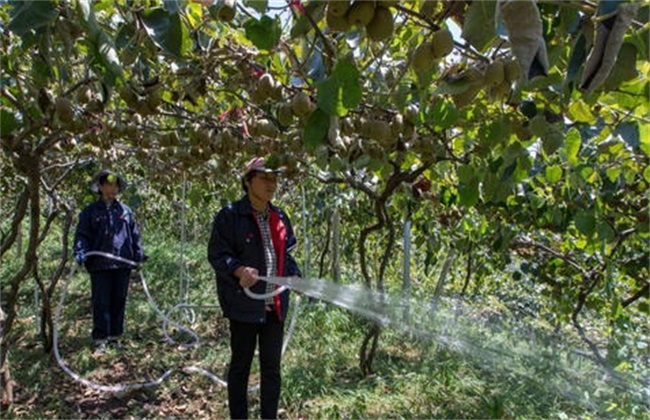
Finally, we should also pay attention to mastering the watering methods. Do not use flood irrigation when watering. Localized irrigation should be the main method, such as furrow irrigation and hole irrigation. This can not only reduce water use, but when water enters from the beds and furrows, it also will not destroy the soil aggregate structure. Root respiration remains normal, and the soil is moist without water accumulation, so the roots will not rot because of it. If ridge planting is used, then when watering, water can be poured into the middle of the ridge and allowed to seep into the root distribution range. This keeps root humidity stable, improves soil aeration, and avoids root rot caused by water accumulation.
The above is a brief introduction to the watering precautions for kiwifruit. That is all for today's introduction. This article is for reference only, and I hope it can help everyone!