How to manage melons after grafting? Master these key points
Melons can be sown and planted directly, but in recent years continuous cropping has caused soil-borne diseases to become increasingly serious, severely affecting melon yield and quality. To solve the harm caused by continuous cropping, many fruit growers have begun to use grafting technology for cultivation. Many farmers pay no attention after grafting, which is a wrong approach. So how should melons be managed after grafting? Let's learn about it together.
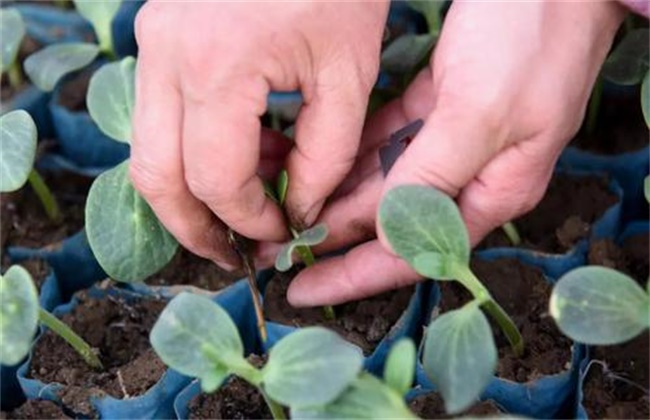
1. Regulate temperature
In the 1-3 days after melon grafting, the indoor temperature must be strictly controlled, with the daytime temperature kept between 23-25 degrees and the nighttime temperature kept between 20-22 degrees. One week after grafting, control the daytime temperature between 23-24 degrees and the nighttime temperature between 15-18 degrees. This helps the grafted seedlings' wounds heal and helps the seedlings resume growth as soon as possible after surviving. To create a microclimate favorable for the growth of grafted seedlings, a small plastic tunnel can be placed over the seedbed, uncovered during the day and covered at night, to preserve heat and control temperature.
2. Control humidity
Before grafting, the seedling bed should be watered thoroughly to increase soil and air humidity, which helps the grafted seedlings survive. After grafting, keep the greenhouse sealed for 2-3 days so that the air humidity inside the shed remains between 90%-100%, which helps the grafted wounds heal. After that, gradually increase the ventilation volume and ventilation time inside and outside the greenhouse, and return to normal management after one week.
3. Prevent strong light
To prevent the grafted seedlings from wilting, the grafted seedlings need to be shaded from light within 3 days after grafting to avoid direct sunlight. Therefore, within 3 days after grafting, the straw mats need to be fully lowered and tightly covered. After 3 days, lift every other straw mat to receive light. As time goes on, gradually increase the number of straw mats lifted. After 10 days, remove all the straw mats and enter normal management. In addition, note that the shading time should not be too late, to avoid causing the grafted seedlings to become thin, weak and spindly.
4. Prevent and control diseases
Because grafted melon seedlings themselves have wounds and are also in a high-temperature and high-humidity environment, they are highly susceptible to disease infection. Therefore, during the wound healing process, combine watering the seedbed with spraying chlorothalonil pesticide. This can effectively prevent and control the occurrence of damping-off and root rot during the melon seedling stage.
The above is an introduction to the key management points for melons after grafting. We hope it can help you. To learn more related knowledge, please follow us.