How to prune a pomegranate tree? A full analysis of the key pruning techniques
Fruit trees are pruned differently at different growth stages, and the pomegranate can be divided into summer pruning and winter pruning. Summer pruning is mainly bud removal and branch bending, while winter pruning is mainly thinning. Now let's take a look at the key pruning techniques for pomegranates with the editor.
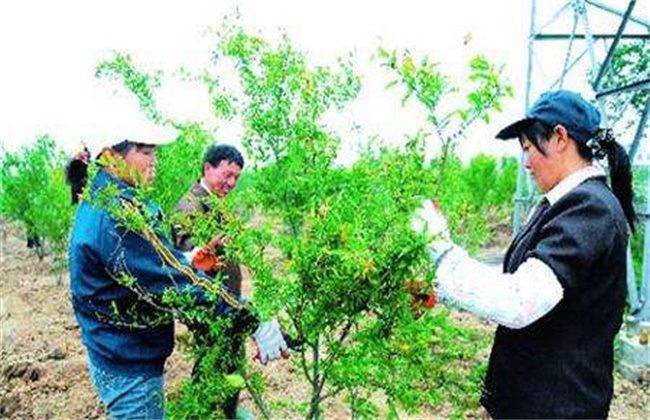
1. Pruning young trees
After planting, head the tree back at 70 cm. During the first winter pruning, from the new shoots that emerge within 30 cm below the cut, select and keep 3 branches with evenly distributed orientation as main branches to be trained, cut them back leaving 60 cm, and thin out the rest. During growth, bend the 3 main branches; the bending angle should be determined according to the requirements of the tree shape. During the second winter pruning, each main branch can keep 1 side branch, the 3 main branches should keep branches on the same side as much as possible, and the extension shoot of each main branch should be cut back leaving 60 cm. During the third winter pruning, each main branch keeps a second side branch on the side opposite the first side branch, and the extension shoots are left unpruned or lightly cut. Generally, shaping can be completed in 3-4 years.
2. Pruning trees in full bearing
Pomegranate trees in full bearing should maintain a canopy that is “sparse at the top and dense at the bottom, sparse outside and dense inside, sparse in large branches and dense in small branches”, so excess vigorous branches, water sprouts, inward-growing branches, crossing branches, overlapping branches, diseased and pest-infested branches, and thin weak branches should be thinned out in time. At the same time, attention should be paid to the balance between tree growth and fruiting. In winter, part of the vigorous branches should be thinned out from late trees, and as many short fruiting mother branches as possible should be kept. During the growing season, branches should be bent. Weak trees should be renewed and rejuvenated by retraction, and drooping branch groups should be retracted and lifted up, paying attention to the renewal of branch groups and fruiting in turn.
3. Pruning aging branches
Aging branches are mainly rejuvenated and renewed by retraction. For main and side branches that are drooping and weakened at the front, retract to an upward-growing branch to restore their vigor. For main and side branches that are bare at the rear, retract to a branching point at the rear, or after leaf fall and in the following year use vigorous sprouting shoots or water sprouts at the rear, combined with branch bending during the growing season, to gradually cultivate main and side branches. In winter, aging plants should be sawed off at ground level. During the second winter pruning, select and keep 1-3 shoots from the sprouts as new trunks and retrain them; this is renewal.
The above is an introduction to the key pruning techniques for pomegranate trees. I hope it can help you. To learn more related knowledge, please stay tuned to us.