Why Is the Interior of a Peach Tree Bare? Causes and Prevention Measures Explained
The peach tree is a strongly light-loving species, easy to cultivate and manage, with strong adaptability. In addition, its fruit is juicy and delicious and rich in nutrients; besides being eaten fresh, it can also be processed into juicy products such as canned goods, dried fruit and candied fruit. However, during the growing process, improper pruning often leads to weak, thin branches in the interior of the canopy, and in severe cases the interior becomes bare, causing the fruiting zone to shift outward and yields to decline. So how should interior dieback of peach trees be prevented? Let's take a look.
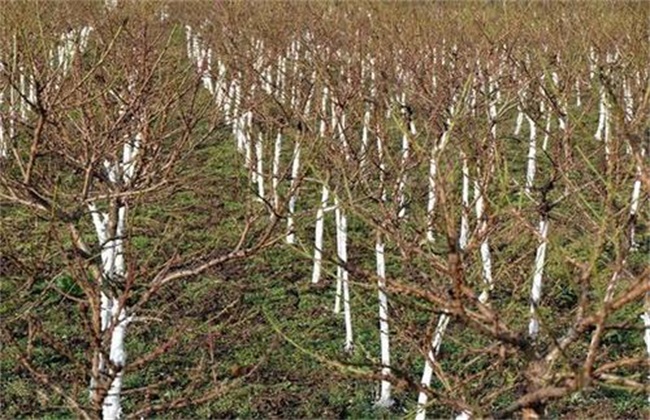
I. Causes of Bare Interior
There are several causes of bare interior in peach trees. First, early leaf drop: leaves have poor cold resistance, causing premature abscission, weak branch growth and low photosynthetic efficiency, which reduces the accumulation of nutrients in the tree, easily forms secondary shoots and worsens the bare interior. Second, alternate bearing: alternate bearing in peach trees is the main cause of bare interior. In an "on" year, the high yield consumes a lot of nutrients, reducing the accumulation in interior branches and causing thin, weak branches and poorly developed flower buds; in an "off" year, the low yield allows the plant to accumulate more nutrients, causing dense, vigorous branch growth, easily forming water sprouts, resulting in poor light penetration and easy branch death. Third, improper training and pruning: when interior branches are too dense, water sprouts are not removed in time, and the main branches have a small opening angle, all of which can cause the interior branches to become bare.
II. Prevention Measures
1. Cultivating Main Branches
Peach trees have strong apical dominance. The extension shoots of the main branches can be lightly pruned and left unheaded to weaken apical dominance and promote flower bud formation and the growth of branches in the lower part of the canopy. The main branches should be trained to grow in a curved, extending manner so that all parts grow evenly and the development of lower branches is promoted. During winter pruning, methods such as replacing the branch tip with a rear branch can be used to gradually increase the main branch angle year by year, so that the main branches grow in a curved, extending manner.
2. Opening the Main Branch Angles
When the main branch angle is too large, light penetration is poor, the tree shape becomes disordered, and it is very easy for branches on the upper side to become dense and vigorous, causing the fruiting zone to shift outward; conversely, when the main branch opening angle is small, the tree is strong at the top and weak at the bottom. According to practical surveys, the main branch angle of peach trees in the natural open-center form should preferably be 60-70°. For varieties with a relatively upright growth habit, measures such as replacing the branch tip with a rear branch and weighting, pulling and propping can be used to open the main branch angles.
3. Flower and Fruit Thinning
Flower and fruit thinning can be carried out from top to bottom and from inside to outside along the branches. On the same branch, first thin out twin flowers with incomplete floral organs, small thin flowers and late-opening flowers. On the same peach tree, when thinning fruit, first remove dense fruit, deformed fruit, diseased and insect-damaged fruit and small weak fruit, then remove fruit with short stalks, fruit with no leaves near them, and fruit facing upward.
4. Reasonable Pruning
Pruning can regulate the contradictions between renewal and aging, between vigor and growth amount, and between fruiting and growth in fruit trees, keeping them in balance. Pruning allows branches and leaves to be distributed reasonably, improves light penetration in the orchard and canopy, maximizes the use of various resources, and increases yield and quality.
5. Pest and Disease Control
The pests and diseases that affect peach trees include bacterial shot hole, peach leaf curl, aphids, peach leafhoppers and leaf miners. They can be prevented by spraying lime sulfur or zineb during orchard cleaning, and when disease occurs, the appropriate treatment can be applied to eliminate them thoroughly.
The above is an introduction to the causes of and prevention measures for bare interior in peach trees. We hope it helps you. To learn more related knowledge, please follow us.