Detailed Explanation of Pruning Techniques for Muskmelon
Market demand for muskmelon is growing stronger and stronger now, so more and more farmers are growing muskmelon. Muskmelon is generally planted in early spring and harvested starting in May, with a relatively short growing period. Nowadays it is mostly grown in greenhouses, but during the growing process, if you want high yields, pruning is key. Follow along with the editor below to take a look at muskmelon pruning techniques.
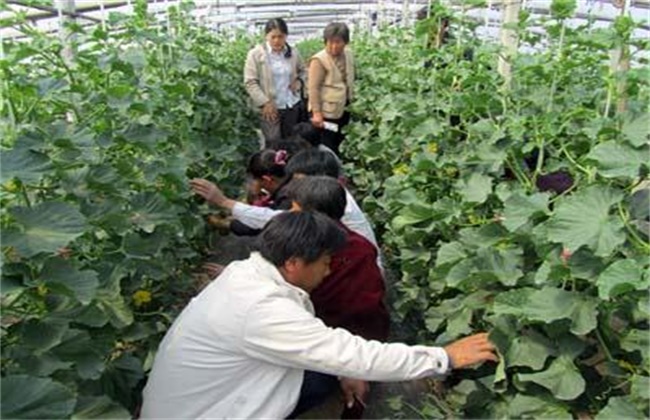
I. Muskmelon Pruning Methods
1. Single-vine system
That is, the main vine is not removed; all lateral vines before the fruit-setting position are removed, and lateral vines from the 10th node upward in the middle section are selected and kept for fruit setting. Leave 2-3 leaves before the fruit and pinch the growing tip of the lateral vine, while for the upper lateral vines, pinch the growing tips at the appropriate time according to actual field conditions or thin them out as appropriate.
2. Double-vine pruning
When the main vine grows to 3-4 true leaves, pinch off the growing tip. When the lateral vines grow to 15 cm, select and keep 2 strong ones and thin out all the rest. When the lateral vines grow to 20-25 nodes, pinch off the growing tips, and keep fruit on nodes above the 4th node of the lateral vines. For secondary lateral vines, leave 2 leaves and pinch the growing tip. After fruit setting, the secondary lateral vines above the lateral vines can be allowed to grow freely. If the plant grows too vigorously and the field becomes too dense, the secondary lateral vines that do not set fruit can be thinned out.
3. Three-vine pruning
For early-maturing varieties in which both lateral vines and secondary lateral vines can set fruit, pinch off the growing tip of the main vine at 3-4 true leaves, select and keep 3 strong lateral vines, and pinch off the growing tips at 6-10 true leaves. Most secondary lateral vines can set fruit at the first or second node, and to prevent the secondary lateral vines from growing rapidly and consuming nutrients and affecting fruit setting, pinch off the growing tips of the secondary lateral vines leaving 2 true leaves two days before the female flowers open. For example, if the branches and leaves grow too vigorously, the lower secondary lateral vines that do not bear fruit can also be thinned out as appropriate.
II. Pruning Precautions
1. Principle of tight early, loose later
During the rapid elongation stage of lateral vines, pruning must be done in time; after secondary lateral vines appear, the growing tips must be pinched and the vines must be trained in time to promote fruit setting. At the same time, vines should be thinned as appropriate to promote the plant's transition from vegetative growth to reproductive growth and to promote fruit growth. After the fruit expands, pinch the growing tips, thin the vines, or allow them to grow freely according to growth vigor. Pruning tightly in the early stage gives an obvious early-maturing effect; otherwise the vines will become tangled together, making it difficult to distinguish the main from the secondary, leading to a low fruit-setting rate, and it will also cause excessive vegetative growth of stems and leaves, increasing the pruning workload and causing late maturity and reduced yield.
2. Pruning time
Pruning should be carried out at noon or in the afternoon on sunny days when the temperature is high, so that wounds heal quickly and infection by pathogens is reduced. At the same time, the stems and leaves are softer, which can avoid unnecessary losses.
3. Pruning is not suitable when there is dew or on cloudy and rainy days
If a single plant has too few leaves, and pruning is too severe, the plant is very prone to premature senescence, the fruit cannot fully grow, and the sweetness will also be relatively low. Removing all growing points too early is also unreasonable. Practice has proved that after fruit setting, allowing the tips of lateral vines and 1-2 secondary lateral vines to grow freely is beneficial for preventing premature senescence of the plant; especially in dry and barren plots, where leaves are small and the plant cluster is small, pruning should be even less severe.
The above is an introduction to muskmelon pruning techniques. We hope it can help you. If you want to learn more related knowledge, please stay tuned to us.