What are the control measures for stem blight in dragon fruit?
During dragon fruit cultivation, farmers often encounter various diseases such as stem blight, which seriously affect yield and growing returns and restrict the development of the dragon fruit industry. So how should dragon fruit stem blight be controlled? Let's take a look together.
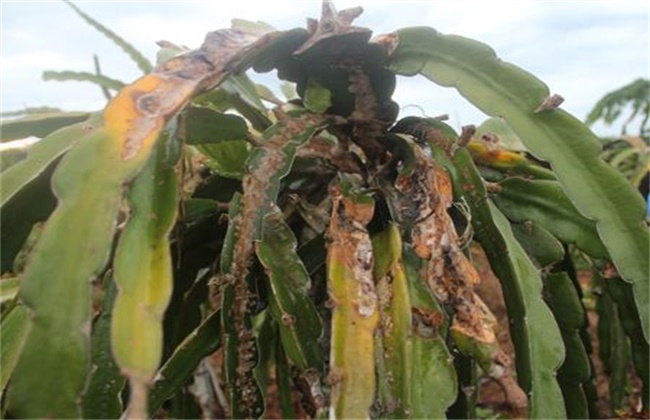
I. Symptoms
The disease appears as irregular grayish-white lesions on the ribs of the plant, with many small black spots on them. The lesions are sunken and gradually dry up, eventually forming notches and holes. They mostly occur on the middle and lower stem segments.
II. Disease pattern
The stem blight pathogen overwinters with diseased stems on the soil surface. When the spring temperature rises above 3°C, it begins to develop, and at 15°C it releases spores that infect the plant's fleshy stems. The optimum temperature for disease development is 20-30°C. Conidia are spread by rain splash and air movement for secondary infection, mainly harming the fleshy stems of dragon fruit. The disease generally begins in late March, when it has just started to cause damage, the diseased plant rate is still low, and the disease develops slowly. After April, as the temperature rises, the disease worsens, and May to July is the peak period of incidence, which is just before flowering. Because of the high temperature and the arrival of the rainy season, the best conditions for pathogen infection are created, and the disease spreads extremely quickly in the field. In addition, areas with low-lying terrain and heavy clay soil have a higher incidence than areas with higher sandy loam soil, and excessive application of nitrogen fertilizer also aggravates the disease.
III. Integrated control measures
1. Agricultural control
Select and breed disease-free seedlings. If selecting seeds, be sure to transfer and introduce seeds from disease-affected areas, and at the same time choose varieties with strong disease resistance. This is the most economical and effective measure for controlling dragon fruit diseases. After harvest, promptly remove diseased and residual branches and field weeds to keep the field clean and reduce the pathogen base. During the growing period, strengthen fertilizer and water management. Do not use flood irrigation, so as to avoid root asphyxiation and death; drip irrigation and ridge cultivation are best. Apply more organic fertilizer and phosphorus and potassium fertilizer to improve disease resistance.
2. Chemical control
Bordeaux mixture, prochloraz, prochloraz manganese salt, thiophanate-methyl, mancozeb, carbendazim and other agents can be used for propagation, spraying once every 7-10 days, for 2-3 consecutive sprays.
The above is an introduction to the control measures for dragon fruit stem blight. We hope it can help you. To learn more related knowledge, please stay tuned to us.