Correct methods and technical key points for flower and fruit thinning of pear trees
Pear trees produce a large amount of flowers. If too many fruits set, the tree load becomes too heavy, which affects fruit quality and results in small fruits. Moreover, because nutrients are consumed in large amounts, alternate bearing can occur, and sometimes regreening and reflowering also appear. Therefore, flower and fruit thinning of pear trees is a necessary measure in production. So how should it be done? Let's take a look together.
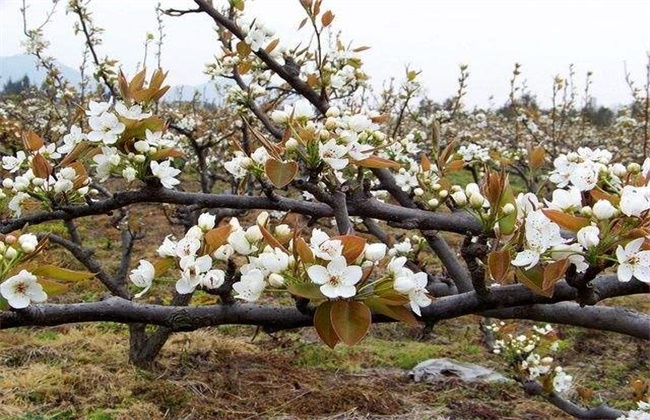
1. Flower thinning methods
Flower thinning on pear trees saves tree nutrients better than fruit thinning. Removing excess flowers as early as possible can concentrate the tree's nutrients to supply flower and fruit growth and tree development. When there are many flowers and few natural disasters, flower thinning is more beneficial than fruit thinning for pear varieties with a high fruit-setting rate. Flower thinning on pear trees can be done during winter pruning by observing the flowers, and by rechecking before flowering in spring, but the main time for flower thinning is still before the flowers open. The first two can only play a role in saving nutrients. If buds are thinned, it is equivalent to thinning out branches. It cannot change the branch-to-fruit ratio, while flower thinning can retain the fruit spur secondary shoots, increase the branch-to-fruit ratio and leaf-to-fruit ratio, and has a good effect on improving fruit quality and overcoming alternate bearing. The time for flower thinning is generally from April to May, and it can be carried out from the inflorescence separation stage to full bloom. The earlier, the better. Generally, thin the center and keep the two sides, and for the tree, thin the top and keep the middle.
2. Fruit thinning time
The fruit thinning time of pear trees is related to their varieties. Generally, for sand pears, it starts one week after flower drop and is completed within half a month after flower drop, while green-skinned pear varieties must be bagged 10 days after flowering, so fruit thinning also cannot be too late. For general pear varieties, fruit thinning should be finished no later than 26 days after flower drop. Within one month after flowering is the fruit cell division period. Thinning fruit as early as possible at this time can promote an increase in the number of young fruit cells and their volume expansion. If fruit thinning is too late, it has little effect on fruit cell division, which not only affects yield and quality, but also wastes nutrients and inhibits flower bud differentiation of the plant.
3. Fruit thinning methods
For fruit thinning of pear trees, first remove fruits that are damaged by pests and diseases, poorly fertilized, irregular in shape, with persistent calyxes, and with shorter longitudinal diameters. The fruit shape and growth potential are directly related to the position of the fruit in the inflorescence. Fruits at low positions have shorter longitudinal diameters and thick, short fruit stalks. The young fruits are obviously large at the young fruit stage but have little growth potential later. Fruits at high positions have long longitudinal diameters, small young fruits, and slender fruit stalks, with even less growth potential. Only fruits at the middle position have relatively long longitudinal diameters, medium to large young fruits, and thick, long fruit stalks, with the greatest growth potential. Generally, the first and second position fruits are thinned because their fruits have short longitudinal diameters, are relatively small, and do not have high yield or quality after ripening.
The above is an introduction to how to thin flowers and fruits on pear trees. I hope it can help you. To learn more related knowledge, please follow us.