Why are pear tree leaves turning yellow? Analysis of common causes
Pear trees are basically cultivated in all parts of China, and the economic value of pear trees is relatively high. When we grow pear trees, we inevitably encounter some problems that affect the growth of pear trees. Among these, yellowing of pear tree leaves is one of them. Yellowing of pear tree leaves affects the photosynthesis of pear trees, leading to reduced nutrient accumulation and affecting the quality and yield of pears. So why are pear tree leaves turning yellow? Let's take a look together below!
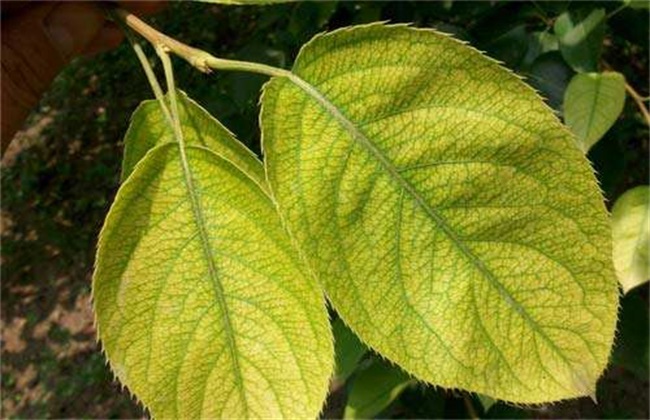
1. Insufficient light
When growing pear trees, if the pear trees show yellow leaves before autumn, then it is very likely caused by a lack of light. If pear trees lack light, the leaves cannot carry out photosynthesis, which leads to a decrease in the chlorophyll content of the leaves and gradually causes yellowing of the leaves. Therefore, when growing pear trees, we must be sure to maintain sufficient light. We should promptly prune excessively long and dense branches, etc., to improve the ventilation and light penetration inside the canopy of the pear tree, maintain good light transmission, and enable the branches inside the canopy of the pear tree to also receive sufficient light, reducing the yellowing of leaves.
2. Soil too alkaline
If the soil for growing pear trees is too alkaline, then it is also very likely to cause yellow leaf disease in pear trees. In many cases, in plots where pear tree yellow leaf disease occurs, the soil pH value is generally not lower than 8. This causes the soil to become too compacted, the concentration of ferrous ions in the soil to be relatively low, and the calcium content in the soil to be too high, creating a antagonistic effect among the ions. This further inhibits the absorption of iron by the pear tree, causing the pear tree to lack the iron catalytic enzyme when synthesizing chlorophyll, so it cannot form chlorophyll normally and yellow leaves appear.
3. Nutrient deficiency
Nutrient deficiency is one of the main causes of yellow leaves in pear trees. Different deficiency symptoms will produce different yellow leaf phenomena. First, if there is a nitrogen deficiency, then the leaf shape of the pear tree will gradually shrink, and the leaves will be mainly yellow-green. It starts from the lower leaves of the plant and slowly spreads upward, eventually causing the entire leaf to become pale yellow, and in severe cases the pear tree will die. Then there is phosphorus deficiency. If the pear tree lacks phosphorus, the leaf color will gradually darken and then slowly turn purple-yellow. If it lacks potassium, yellowing starts from the tip and edge of the old leaves, and then the leaves gradually wither and necrose.
Iron deficiency is the most common nutrient deficiency symptom that causes yellow leaves in pear trees. If the pear tree lacks iron, the areas between the veins will gradually lose green and turn yellow, but the veins will not be affected. This is also the most common yellow leaf phenomenon in pear trees. Then, if there is a magnesium deficiency, the yellow leaf phenomenon is mainly manifested on the old leaves, similar to the iron deficiency phenomenon. Calcium deficiency, however, is the opposite of magnesium deficiency. The yellow leaves are mainly manifested on the new leaves. The leaves will gradually turn yellow from the outside inward, but the veins remain green, and the leaf edges will gradually curl downward. In addition, deficiencies in manganese, zinc, sulfur, boron, etc. can all cause yellow leaf phenomena in pear trees.
The above is a brief introduction to why pear tree leaves are turning yellow. That is all for today's introduction. This article is for reference only, and I hope it can help everyone!