Key Management Techniques for Greenhouse Melons After Fruit Set
When growing melons, greenhouse cultivation can achieve high yields and excellent quality, making it the preferred choice for many fruit growers, and the management of greenhouse melons after fruit set is extremely important, directly affecting yield and quality. So how should greenhouse melons be managed after fruit set? Let's take a look together.
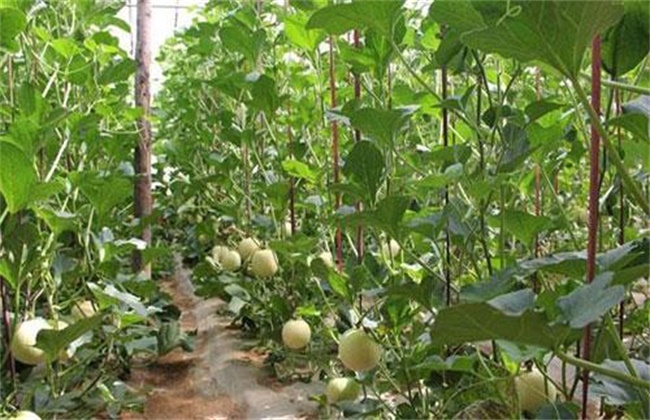
1. Temperature management
During the fruit enlargement period, temperature should be appropriately increased to widen the day-night temperature difference, keeping the greenhouse daytime temperature between 28-30°C and nighttime between 18-20°C. Generally, when the nighttime temperature stabilizes above 10°C, that is, at the end of March or early April, the inner tunnel should be removed. When the temperature is slightly lower, the greenhouse can be closed gradually at 4 pm, closing the upper vents first, and when the outside temperature is higher, gradually delay closing until around 5 pm or later. This can widen the day-night temperature difference as much as possible, promote sugar accumulation in the fruit, and improve fruit quality.
2. Fertilization
Fertilizer and water management during the melon enlargement period is extremely important, requiring multiple rounds of topdressing. Generally, after fruit set, when the young fruit grows to the size of an egg, fruit thinning should be carried out promptly, followed by the first fertilization. For weaker plants, the second fertilization is generally applied 10 days after the first. The first fertilization should have a higher nitrogen content, while the second topdressing should have a higher potassium content. Generally, 10-15 kg of ternary compound fertilizer is applied per mu, while water-soluble high-potassium fertilizer or water-flush fertilizer should be used according to the amount stated on the packaging. Fertilization can be done by furrow irrigation or drip irrigation. Furrow irrigation generally involves releasing water section by section from the longer to the shorter end, usually until the furrow is full and the fertilizer solution seeps into the bed surface; drip irrigation involves dissolving the fertilizer and applying it through the drip lines. Generally speaking, drip irrigation is superior to furrow irrigation. After furrow irrigation, ventilation should be noted to avoid excessive air humidity causing diseases.
3. Reasonable fruit retention
The second fruit set generally occurs 20-25 days after the first fruit set. At this time, the number of fruits to retain should be determined by the vigor of the vine. Generally, vigorous plants can retain 2 fruits per plant, while weak plants are recommended to retain one fruit, which can promote or advance the third fruit set and prevent premature aging of the plant.
4. Harvesting
The harvest standard for melons is when the sugar content reaches its peak but the flesh has not yet softened. When harvesting, consideration should also be given to whether different varieties have fully expressed their characteristic traits, and the decision should be based on actual ripeness. For ease of harvesting, pollination time can be used as a marker, or the color change of leaves after fruit set can be observed. When the leaves turn yellow and scorched, harvesting should be carried out in the morning when the temperature is below 20°C and there is no dew on the melon surface.
The above is an introduction to management techniques for greenhouse melons after fruit set. We hope it can help you. For more related knowledge, please stay tuned to us.