How to manage pear trees in winter? Detailed explanation of key technical points
Winter management of pear trees is extremely important and is a key measure for achieving high returns; it is extremely important for overcoming the "alternate bearing" of pear trees and for improving yield and quality. So how do you manage pear trees in winter? Follow the editor and take a look.
1. Clearing the orchard
After the fruit is harvested, promptly clean up the remaining dead branches and fallen leaves, rotten fruit, and weeds, and burn them in a centralized manner or bury them deeply. Do not give pathogens and pests a place to overwinter and hide, so as to avoid outbreaks of pests and diseases the following year and reduce the base population of pests and diseases.
2. Plowing the soil
In winter, there are relatively many pests in the orchard soil, such as pear fruit borers, pear weevils, pear gall midges, etc. Therefore, after clearing the orchard, the soil within the tree basin should be turned over once, to a depth of 25-35 cm, and the whole orchard should be plowed so that overwintering pests are turned out of the ground and frozen to death or eaten by birds, or turned deep into the ground to be smothered to death. This can not only improve soil structure, but also help eliminate overwintering pests; however, be careful to minimize root damage. For the orchard soil beyond 1 x 1 m outside the tree canopy, plow as deeply as possible to 35-50 cm. Freeze the pests in the soil to death, and also prevent soil compaction, while spreading lime for disinfection.
3. Training and pruning
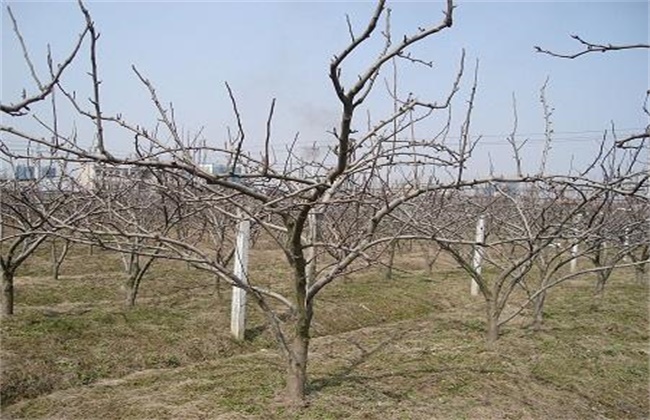
After a year of growth, fruit trees are very likely to have disordered tree shapes. In order to form a good canopy structure and achieve high quality and stable production, training and pruning can be carried out in winter from December to January. The main purpose is to make the canopy branches evenly distributed, with balanced growth, without shading or tangling each other, which helps form a tree structure with early fruiting, high yield, and stable yield.
4. Fertilization
After a year of growth, flowering, and fruiting, the tree's nutrients are heavily consumed, so nutrients need to be supplemented in time. Generally, irrigation is carried out from mid-December to early January. For trees in full fruiting stage, apply an average of 25 kg of manure water, 5-7.5 kg of soybean cake, and 2.5-5 kg of superphosphate per tree; for trees just beginning to fruit, calculate at two-thirds of this ratio. The application method is to open a ring-shaped ditch 35-50 cm deep below the drip line of the canopy, apply the fertilizer liquid into it, and then cover with soil.
The above is an introduction to how to manage pear trees in winter. I hope it can help you. To learn more related knowledge, please follow us.