What are the key points for winter management of Kyoho grapes?
After winter sets in, the leaves of Kyoho grapes fall off one after another. At this time, it seems that there is nothing to do, but in fact the winter management of Kyoho grapes is very important, as it is related to the flower bud differentiation and yield of Kyoho grapes the following year. Below, follow the editor to take a look at the key points for winter management of Kyoho grapes.
1. Apply sufficient base fertilizer
After the autumn harvest, Kyoho grapes have consumed a large amount of nutrients, so when the leaves fall in winter, sufficient base fertilizer should be applied in time to replenish the consumed nutrients and lay the foundation for a bumper harvest the following year. The base fertilizer is mainly decomposed farmyard manure, supplemented by chemical fertilizer. Generally, 7-8 kg of decomposed organic fertilizer and 10-20 kg of potassium chloride or potassium sulfate are applied per mu. When applying the base fertilizer, be sure not to add quick-acting nitrogen fertilizer.
2. Winter pruning
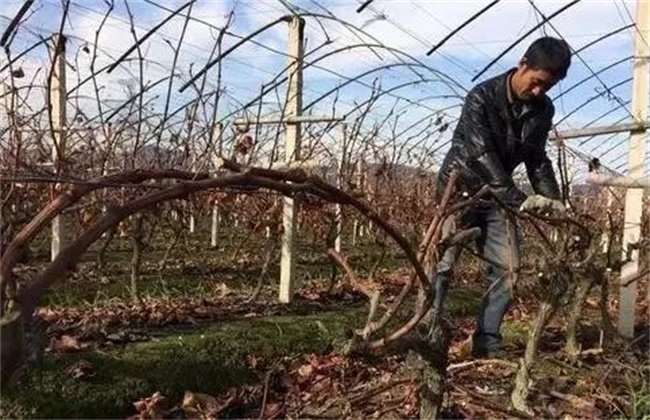
The pruning of Kyoho grapes is different from that of other grape varieties. Young Kyoho grapes should be pruned lightly with long canes left, otherwise they will grow vigorously the following year and the phenomenon of flower and fruit drop will worsen. After pruning, the branches and vines should be promptly tied to the trellis according to the principle of shaping the tree by form. Do not wait until spring when growth begins to tie them.
3. Deep plowing of the soil
When applying the base fertilizer, the soil can be deeply plowed and ripened once, which can loosen the soil and promote root growth. At the same time, the drainage system should also be properly arranged. When deeply plowing the soil, it is best to spread some organic fertilizer to improve the soil, which is extremely beneficial to root and plant growth. For relatively heavy clay soil, deep plowing should be carried out for improvement. If conditions permit, some medicinal residue, rice straw, husk residue, etc. can be placed during deep plowing, which can not only increase the looseness and air permeability of the soil, but also inhibit the growth of weeds.
4. Clearing the orchard
The main task of clearing the orchard is to clean up fallen leaves and weeds and burn them in a concentrated manner. Note that fallen leaves cannot be used as fertilizer, so as to avoid increasing the base number of pests and diseases in the soil. Then spray the whole orchard with 5 degrees Baume lime sulfur mixture, comprehensively spraying the Kyoho branches and vines, trellis poles, and ground. At the end of February when buds sprout, spray once more with 3 degrees Baume lime sulfur mixture. This has a twice-the-result-with-half-the-effort effect on disease prevention and control.
5. Winter irrigation
For orchards with severe drought or where organic fertilizer is applied and dries quickly, winter irrigation can be carried out. This speeds up the dissolution and moisture of the organic fertilizer, accelerates fertilizer penetration, and can also keep the soil moist and increase the bud sprouting rate. For winter irrigation, furrow irrigation is recommended. After the water spreads evenly over the bed surface, it can naturally seep dry. For plots with a relatively high groundwater table, winter irrigation is not necessarily needed.
The above is an introduction to the key points for winter management of Kyoho grapes. I hope it can help you. If you want to learn more related knowledge, please stay tuned to us.