Detailed Explanation of Key Techniques for Winter Pruning of Walnut Trees
After Frost's Descent, the leaves of walnut trees gradually fall, and this period is the best time for winter pruning of walnuts. Pruning at this time has the least impact on the walnut tree, and the pruning cuts will not show bleeding. So how should walnuts be pruned in winter? Let's take a look together.
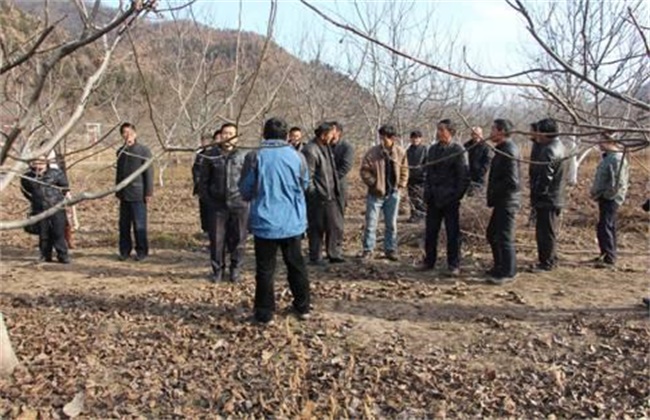
1. Control the strong leader, cut back long mother branches
The first thing to do in winter pruning of walnuts is to weaken apical dominance. This is the main key to whether walnut cultivation succeeds, and it is the main technical means of cultivating a high-yield, stable-yield tree shape. The growth habits of walnuts are rather unique. If an upright terminal branch grows to more than 3 m in the current year and is not checked, it will keep growing, causing strong branching in the upper part and few branches in the lower part. In this way, the scaffold branches cannot develop, and the fruiting branches become noticeably bare. Therefore, to control the tree shape, the top growth must be controlled so that the plant's horizontal growth exceeds its vertical growth.
2. Prune off autumn branches before pruning, leave flower heads after pruning
Walnuts differ from other fruit trees in growth habit. For its flower buds to bear fruit, it first sprouts a new fruiting branch in autumn, and then uses the terminal bud of the new fruiting branch to bear fruit. If the autumn branches are not pruned in time, the flower buds on the branch will be located in the rear half of the branch. If the branch is not headed back in time, these flower buds will not gain growth advantage, will not sprout new fruiting branches, and will naturally die. The second half of the sentence means that in actual practice it is not fixed at the junction of spring and autumn wood. For example, if the junction of spring and autumn is a leaf bud, then the pruning can be moved toward the base until the first flower bud, and the pruning point is 2-3 cm above the flower bud.
3. Branch groups should be renewed, remove weak and keep strong branches
The weak fruiting branches of walnuts are very likely to die after fruiting, so to protect high yield, the fruiting branch groups must be renewed and rejuvenated every year, removing the weak and keeping the strong during pruning. It should be noted that the training direction of walnut fruiting branch groups is not strict, with no excessive requirements; even distribution up, down, left and right is enough. Many people ask me about removing all the branches above and below the scaffold branches, but this is the wrong practice.
4. Do not leave a leader in winter pruning, and there will be no lack of a leader next year
The tree shape of walnut trees is cultivated starting after planting and trunk establishment. During winter pruning each year, do not intentionally leave a tree leader, do not leave a central upright trunk, and do not intentionally let the trunk grow taller. When cultivating the crown, pay attention to reasonable distribution of branch groups and maintain balance between the upper and lower parts. In the early stage of crown cultivation, do not first consider how the tree should grow taller; first ensure that horizontal growth is slightly greater than vertical growth. If apical dominance is too strong, the tree will keep growing taller, branches in the lower part and inner canopy will not emerge, basal branches will be greatly reduced, the lower layer of the crown will be weakened, and apical dominance will be promoted. In this way, high and stable yield is completely impossible, and later renovation will also be troublesome. Therefore, even if no leader is left during winter pruning, there will be no lack of a leader the next year, and the top growth will still be very strong.
The above is an introduction to the winter pruning techniques for walnut trees. I hope it can help you. To learn more related knowledge, please follow us.